
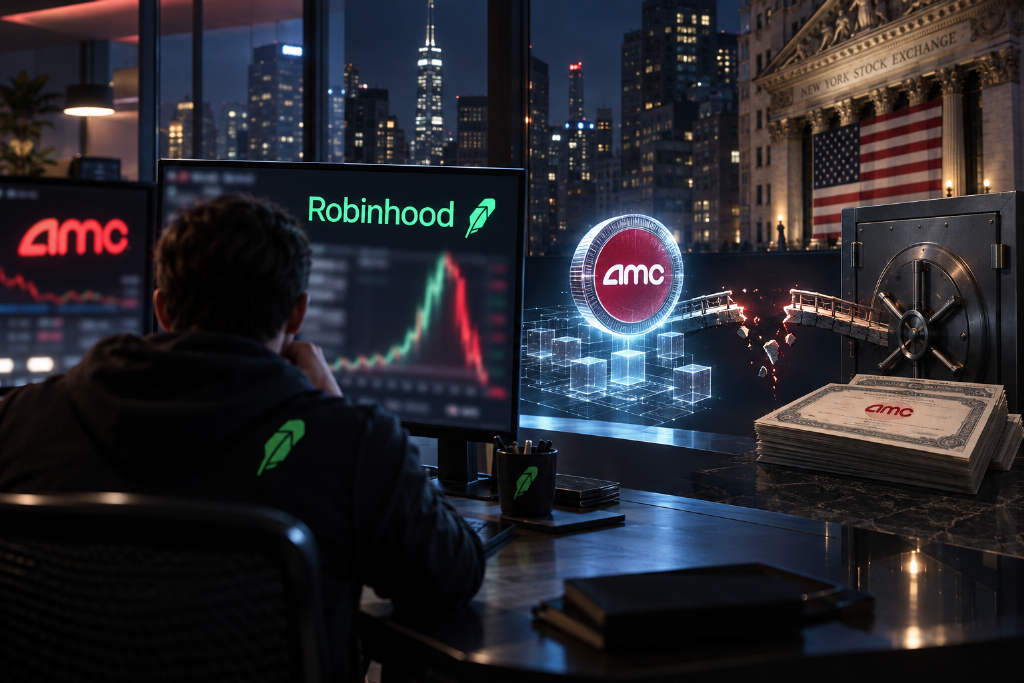
The fight over Robinhood’s tokenized AMC product has moved past legality and into a more difficult question: what does it take for a tokenized stock market to function as an actual market?

AMC Entertainment CEO Adam Aron called Robinhood’s tokenized AMC shares a "fake-ish market" and said he could pursue legal action. Robinhood CEO Vlad Tenev answered that public companies do not have approval rights over every product built on top of their stock. After that exchange, the debate narrowed to two structures: wrapped tokens, which are claims on underlying shares, and issuer-sponsored tokens registered on the shareholder ledger. The U.S. Securities and Exchange Commission has already drawn lines around what it will allow. In Tram Doman’s view, the harder issue is market structure, not just issuance.
How AMC traded on Robinhood Chain
Based on the Uniswap pool on Robinhood Chain, the closing deviation between Robinhood’s AMC token and AMC’s New York Stock Exchange close had a median of 0.87% across seven trading sessions from Aug. 31 to Sept. 9. The widest deviation was 2.71%.
Once the underlying market closed, that pattern changed sharply. Near midnight on Thursday, Sept. 3, Robinhood’s AMC token jumped from $2.55 to $23.16, roughly nine times AMC’s NYSE close of $2.54 seven hours earlier, then fell back to $3.26 within the same hour. Volume in the pool during that hour was about $10.5 million.
Doman says wrapped stock tokens are typically structured as claims on an offshore issuer, with the issuer posting the underlying shares as collateral. In theory, if the stock position and the tokenized claim remain matched 1:1, the token should track the equity. In practice, the two instruments trade separately, so they can diverge. Arbitrage desks and market makers would normally step in to close the gap. The same broad mechanism supports alignment between depositary receipts and ordinary shares, or ETFs and net asset value.
Robinhood’s setup had a constraint. The Jersey-based issuer had designated only one authorized participant that could create or redeem the token. The spike happened during hours when creation and redemption were allowed, yet that participant did not mint or burn tokens during the move. On-chain data showed 47 mint transactions on Friday, Sept. 4, all between noon and 7 p.m. Eastern Time, squarely during the cash equity session and about half a day after the token had broken away from, then returned toward, its prior level.
Why the move was not arbitrage
In a normal market, dealers can short into a premium or use existing inventory to sell against it, then rebalance later. Without lending infrastructure for the token, though, the only way to obtain new supply is to pre-fund the issuer. That means buying the stock first. If the NYSE is already closed, the broker would have needed to buy before the close.
That ties up capital. It also means the potential gain is capped by how much premium the on-chain pool can absorb. Doman’s point is that this is proprietary risk-taking, not arbitrage in the usual sense.
From the issuer’s perspective, minting without already owning the matching shares would leave it short stock it had not yet purchased, with that exposure carried until the market reopened. For an instrument sold as fully collateralized, that is a difficult position to justify.
The sellers that pushed the token back down, then, were token holders taking profit rather than arbitrageurs forcing convergence. Money stayed inside the token market. No real share turnover took place. Doman’s reading is blunt: nobody was arbitraging; participants were deploying their own capital on direction.
Speculative demand unrelated to AMC shares
The article argues that the move had little to do with AMC stock itself. Hours after Aron posted, someone launched a memecoin priced in tokenized AMC. As demand for that memecoin rose, the pool sold AMC tokens to buy the memecoin, dragging the stock token’s price along the way.
That creates a basic distortion. A product that is supposed to anchor to shares of a movie theater company ends up taking its price from speculative demand with no direct tie to the equity. Anyone downstream using that price is reading a number written by unrelated speculation.
To limit spillover from on-chain dislocations into the equity market, the SEC exemption caps on-chain trading volume at 0.25% of average daily volume for large-cap stocks and 2.5% for other listed companies. Offshore wrapped tokens sold to non-U.S. holders, including Robinhood’s, sit outside SEC jurisdiction and continue operating under that separate structure.
What wrapped tokens solve, and what they give up
Doman does not dismiss wrapped tokens. He says they have a real use case, especially in emerging markets where access to U.S. equities is restricted or expensive. Robinhood’s stock tokens cover more than 190 companies across 120 countries. xStocks and Ondo are pursuing similar access through different channels.
Outside the U.S., this model does not require issuer approval, entry on the shareholder register or country-by-country authorization. That is where its distribution power comes from. It is also where the holder’s counterparty risk comes from.
Wrapped tokens trade reach for a set of compromises: possible price dislocation, gaps in investor rights and less transparency from the issuer. The limits are not only about Robinhood’s hours or one issuer’s creation process. Price discovery does not stop when the NYSE or Nasdaq closes. Many brokers still take orders after hours and hedge through overnight venues and derivatives. But once the main exchanges are shut, the market’s ability to source the underlying stock at scale drops fast.
As a result, holders are left with a claim that can be converted in practice during only 32.5 of the NYSE’s 168 weekly hours of regular trading. Outside those hours, any premium to the stock’s last close is a risk the buyer carries and pays for when prices compress after the reopen.
Issuer-sponsored tokens change the risk profile
Issuer-sponsored tokens, or ISTs, follow a different model. They tokenize the registered shares themselves, with the issuer and transfer agent directly involved. In addition to the same 24/7 trading and programmability associated with tokenized instruments, an IST is the security itself, complete with voting rights and corporate actions.
That changes what a market maker is being asked to warehouse. Quoting a wrapped token at 3 a.m. means holding inventory that is a claim on shares, without a live stock price to anchor to. Quoting an IST means the inventory is the security and the trade is a stock trade. A thin order book at 3 a.m. is still thin, but the conversion risk between two separate instruments disappears, and an extra layer of counterparty risk drops away.
What ISTs do not deliver is the reach available beyond the regulatory perimeter. Wrapped tokens derive distribution from a lighter external regime. ISTs derive integrity from being the stock itself. For now, Doman notes, ISTs remain rare. Only a small number of names trade in that format, including Bullish’s BLSH, and liquidity is still limited.
The harder issue is how to connect both sides
Doman’s central argument is that the AMC dispute has revolved around who should be allowed to issue stock tokens on-chain, while the more difficult problem lies elsewhere: how to build the market once issuance exists.
Depth in wrapped-token markets is constrained by a gate-like conversion process between two instruments and two clocks. ISTs remove that gate. With the right infrastructure, real price discovery can happen at any hour, on any licensed venue, through approved participants, instead of relying on a very small number of designated entities.
In his framing, issuer-sponsored tokens serve regulated markets, while wrapped tokens provide exposure outside the wall. Both benefit if both develop. Wrapped markets get the two things they lack most at 11 p.m.: a live price anchor and an instrument market makers can actually use for arbitrage. Issuer-sponsored markets gain arbitrage flow because market makers can hold the token as inventory while making markets in wrapped products.
If wrapped tokens can eventually be collateralized with ISTs, creation and redemption would run on the same rail, with settlement measured in seconds rather than by reliance on the cash equity market to source shares. At that point, the two sides stop being fragmented markets and become parts of one infrastructure stack serving different use cases.
Who builds the plumbing
Doman says the next round of discussion should focus on narrower, practical questions: how to compress spreads for traders at 3 a.m., how to shorten conversion across instruments, how to clear a continuous market and who is responsible for building the pipe between the two sides.
No single company can assemble the entire stack on its own, he writes. Exchanges, brokers, asset managers, market makers, transfer agents and clearing houses each control part of the system, but none controls enough to complete it alone. Bringing those groups into one room to build a market is, in his telling, the point of industry groups such as the IST Alliance.
