
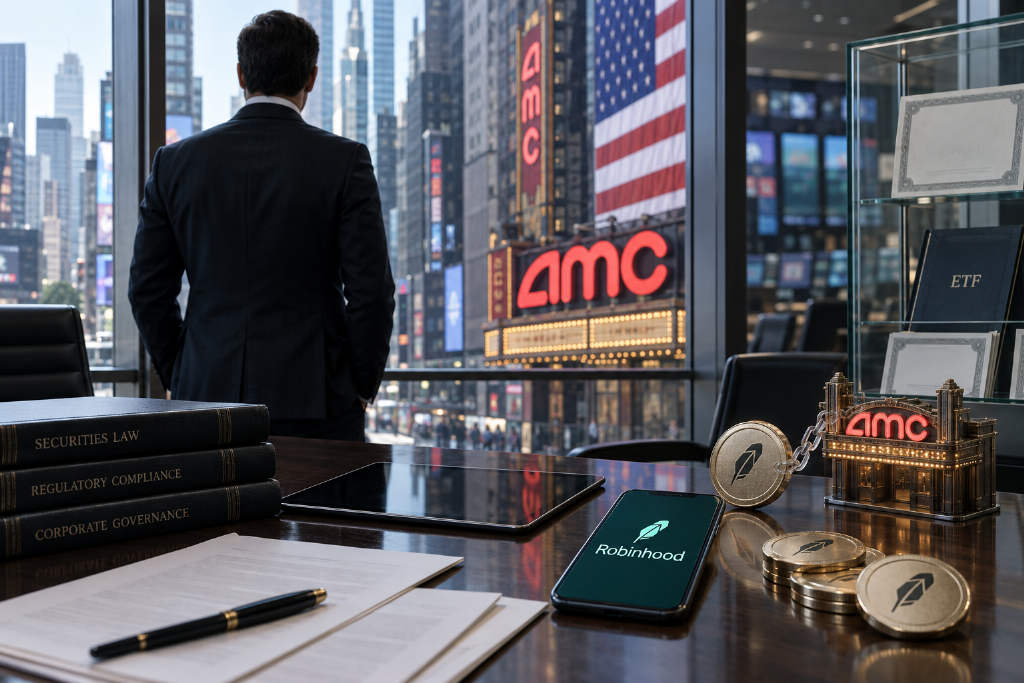
Robinhood’s on-chain stock token business crossed $3 billion in DEX trading volume within 63 days of launch, according to figures disclosed on Sept. 4. The offering now covers more than 190 listed companies, including AMC. AMC CEO Adam Aron then publicly said the company had "nothing to do" with the tokenized versions of its shares, using terms such as "despicable," "outrageous," and "disgusting" to describe the product, and said outside securities lawyers had been asked to examine whether it is legal.
The dispute quickly moved beyond AMC alone. It now turns on a broader question: once a stock is publicly traded, can anyone other than the issuer build financial products around it, or does that require the company’s approval first?
More than 190 stocks and ETFs tokenized in two months
Robinhood Chain went live in July. Within two months, Robinhood had turned more than 190 U.S. stocks and ETFs into tokens for non-U.S. users across more than 120 countries and regions.
Under the disclosed structure, the tokens are issued by Robinhood Assets (Jersey) Limited, an offshore entity. They are framed as debt securities. A licensed custodian holds the corresponding real shares on a 1:1 basis as collateral. Buyers get price exposure, not shareholder status, and they do not receive voting rights. Robinhood disclosed those terms from the outset.
AMC’s objection is that it was never asked whether it agreed to be part of such a structure. Robinhood has taken the opposite position: once a stock is publicly traded, it is freely transferable property, and third parties do not need issuer approval to create products around it if shareholder rights are unchanged.
Where the consent fight is stuck
On Sept. 11, Robinhood CEO Vlad Tenev laid out the company’s argument in a long post built around three principles. Investors have property rights in freely transferable shares. Issuers can control only the rights attached to the securities they themselves issue, not other financial products created around those shares by others. And technology should be neutral, meaning the use of blockchain should not alter who has consent rights.
He put it plainly: putting a stock on-chain should not give the issuer a veto power it never had in the offline market.
AMC has kept pressing on a narrower point. On Sept. 12, Aron asked publicly whether the tokens could still be considered truly 1:1 backed if the real shares serving as collateral were also being lent to short sellers. As of publication, Robinhood had not given a direct answer.
That leaves one of the most technical and least resolved parts of the dispute in place. Does 1:1 mean the books match on paper, or does it mean the specific shares are not being used elsewhere while backing the token? For now, there is no public answer beyond Robinhood’s own disclosures.
A debate shaped by the meme-stock era
Aron’s sharp response also draws attention back to the short squeeze episode of January 2021.
At the time, GameStop’s short interest briefly exceeded the company’s actual free float. Retail traders gathered on Reddit’s WallStreetBets and leaned into that structural weakness: if enough buying pushed the stock higher, short sellers would be forced to cover at elevated prices, and those buy orders would drive the stock up again. Retail traders also bought large numbers of call options, adding more leverage to the move. The pattern soon spread from GameStop to AMC, BlackBerry, Nokia, and other heavily shorted names with strong retail followings, later grouped together as meme stocks.
Robinhood was one of the main retail trading gateways during that period and became central to the public debate. The turning point came on Jan. 28, when the National Securities Clearing Corporation, or NSCC, sharply raised Robinhood’s collateral requirements because of extreme market volatility. Robinhood then restricted purchases of GameStop, AMC, and other stocks, while still allowing sales.
Retail traders saw that as its own controversy: why could users sell but not buy? Critics argued that the move effectively helped short sellers facing pressure to close positions. Robinhood said the restrictions were necessary to meet rapidly rising clearing-related capital demands and to avoid failing its settlement obligations.
No single narrative won out afterward. Congressional hearings followed, along with class-action lawsuits. Robinhood and its executives also faced investigations and information requests from the U.S. Securities and Exchange Commission, the Financial Industry Regulatory Authority, and the Justice Department.
Five years later, the positions look almost reversed. In 2021, AMC and its retail holders were on the side hurt by trading limits, while Robinhood was accused of blocking ordinary investors from trading. Now Robinhood is casting issuer-free tokenization as broader market access for global investors, while AMC is the party saying consent should come first.
No new financing for AMC
There is also a more direct business interest behind the argument. AMC’s recovery from the edge of bankruptcy in 2021 depended in large part on a meme-stock rally that lifted its share price and allowed the company to raise capital through repeated share sales.
Robinhood’s current tokenized stock product bypasses that path. Buyers are purchasing debt securities issued by a third party. The money goes into Robinhood’s custody structure, does not create new financing for AMC, and does not send any proceeds to the company. Retail attention may still be there, but that attention no longer flows automatically back into AMC’s fundraising channel.
On the same day Aron went public with his criticism, AMC shares rose nearly 6%. Even so, it remains unclear whether attention generated by the clash can be turned into corporate financing the way it was in 2021.
Nasdaq backs a different model with Kraken parent Payward
As Robinhood and AMC were trading blows, Nasdaq made a move of its own. On Sept. 10, Nasdaq’s venture arm said it would invest $100 million in Payward, the parent company of crypto exchange Kraken, at a $21 billion valuation. The two sides plan to work together on Nasdaq Equity Tokens, or NET, with a launch targeted for the second quarter of 2027.
This approach goes in the opposite direction from Robinhood’s. NET is designed to preserve issuer control over the stock, and token holders would receive voting rights on equal terms with ordinary exchange-traded shareholders. In other words, Nasdaq’s model aims to supply the element AMC says Robinhood lacks: issuer approval first, with voting rights carried on-chain rather than stripped away.
As part of the arrangement, Kraken will also connect to Nasdaq’s market surveillance system, covering crypto, equities, tokenized stocks, futures, and options.
Rules are still unsettled while the market moves ahead
Three lines of uncertainty still hang over the dispute.
- Robinhood has not answered whether the shares used as collateral can also be lent to short sellers.
- The SEC published a framework in January distinguishing issuer-led tokens from third-party linked instruments, and on Sept. 1 submitted a proposal to modernize transfer agent rules, but it has not formally ruled on whether structures like Robinhood’s need issuer consent.
- European regulators have also warned that tokenized products could lead buyers to believe they hold the same rights as real shareholders when they do not.
Nasdaq’s consent-preserving model will not face a real market test until the second quarter of 2027. Before then, Robinhood has already made on-chain stock trading a live business across more than 190 names and more than 120 countries and regions.
The rules are still being debated. The market has already moved first.
