

Robinhood Chain’s launch is spilling into DeFi token performance
Several DeFi projects stood out this week when ranked by seven-day gains among the top 100 cryptocurrencies by market cap. The article names Lighter (LIT, +16%), Morpho (MORPHO, +15%), Arbitrum (ARB, +13%), and Uniswap (UNI, +9%).
William M. Peaster writes that these tokens sit in different corners of crypto, but their recent moves share a clear link: each has benefited, to varying degrees, from Robinhood Chain’s fast start.
Early activity has accelerated
The piece says Robinhood Chain launched with broad ambitions around tokenized assets, even though its earliest traction came mostly from meme-driven traffic led by names such as CASHCAT. Peaster describes that as a familiar burst of onchain speculation. What changed over the past 48 hours, he says, is the scale.
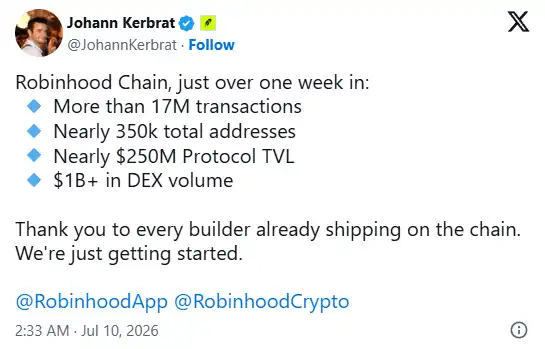
According to DefiLlama data cited in the article, Robinhood Chain’s total value locked doubled from $46 million to $96 million in just a few days. Stablecoin market capitalization on the network also rose above $270 million. The Layer 2 has generated about $900 million in DEX volume this week, with more than $500 million recorded in the past 24 hours.
That pace, the author argues, suggests the network is starting to show real staying power, prompting traders to add exposure to assets that could keep benefiting if Robinhood Chain keeps growing.
Lighter: default perpetuals venue in Robinhood Wallet
The article stops short of saying Lighter will become the next Hyperliquid. It does say that being chosen as the default perpetuals platform inside Robinhood Wallet is a major step.
Perpetual volume on Robinhood Chain is still relatively small, according to the piece. If that market expands quickly, Lighter could see higher revenue, which in turn could support more LIT buybacks and burns.
Arbitrum: Orbit infrastructure and revenue share
Robinhood Chain is built on the Arbitrum Orbit stack, and 10% of net protocol revenue from the chain flows back to the Arbitrum ecosystem.
Peaster notes that the way this revenue may translate into ARB price is a separate question. Still, Robinhood’s early traction highlights the possibility that more large companies could deploy Orbit chains in the future, which could increase revenue flowing toward Arbitrum.
Morpho: Robinhood Earn channels USDG deposits
The newly launched Robinhood Earn product is routing USDG deposits into Morpho vaults and offering roughly 7% annual percentage yield. That, the article says, helps explain why about $65 million of Robinhood Chain’s $96 million TVL currently sits on Morpho.
Like ARB, MORPHO is described as primarily a governance token at this stage, so the ultimate price effect of this new lending funnel remains to be seen. Even so, the article frames MORPHO as a proxy bet on the success of the Morpho engine, with Robinhood Earn acting as a catalyst.
Uniswap: about $1 billion in the first week
Uniswap has processed about $1 billion in total trading volume within Robinhood Chain’s first week, according to the article. That jump in activity can produce meaningful protocol fees, which can then be converted into UNI burns.
If Robinhood Chain can sustain strong volume, the piece says, that would support UNI over the longer term. It also points to Uniswap’s role as the network’s lead DEX from day one, presenting a model other companies could follow if they choose to launch their own Layer 2 chains.
Beyond the meme trade
At a broader level, the article notes that CASHCAT, currently Robinhood Chain’s top meme token, surged 5,000% over the past seven days, easily outpacing the gains in these large DeFi names.
Still, Peaster argues that CASHCAT’s future depends much more on sentiment, while infrastructure and fundamentals are better positioned to support broader onchain activity. One week after launch, LIT, ARB, MORPHO, and UNI have become some of the clearest ways to express a view on Robinhood Chain’s core growth narrative.