

Ryan Berckmans argues that Robinhood Chain does not refute Ethereum’s L1+L2 model. He says it shows that the model is already being used by companies building real businesses onchain.
The piece responds to a question raised this week by Travis Kling: “Is it now obvious that serious operating companies are not interested in L1/L2?” Robinhood was presented as the first example. Berckmans takes the opposite view. He says Robinhood picked an existing L1, Ethereum, and then built its own Ethereum L2 with Arbitrum technology.
In his description, Robinhood Chain uses Ethereum blobs for data availability, uses ETH as its native gas token, and relies on Ethereum for security. On that basis, he argues that Robinhood did not reject Ethereum’s L1+L2 structure. It built on top of it.
A change in buyers, and a change in infrastructure choices
Berckmans frames crypto as moving from one era to another. In the earlier phase, many projects were built around token issuance and token valuation. In the next phase, he expects more businesses to use Ethereum’s L1+L2 stack as the base for revenue-generating products.
He defines “real businesses serving real users” in conventional terms: companies that build products customers want, earn profits from serving them, and increase the equity value tied to those profits. In that setup, customers come from ordinary economic demand rather than demand driven mainly by new token launches.
The article groups token value into three sources: cash, meaning a reliable claim on future cash flows; utility, meaning access, control, governance, or another privileged role inside a valuable system; and monetary premium, meaning people hold the asset because they expect others to accept and value it later. Berckmans says monetary premium is real, but very difficult to sustain. He names gold, the U.S. dollar, Bitcoin and Ethereum as assets that have built versions of those network effects.
Looking back, he says most participants in programmable crypto were not ordinary cash-flow businesses. Their economic goal was often to sell a token whose value rested mainly on utility, expected monetary premium, or distant promises of cash flow. Centralized exchanges and some stablecoin issuers are presented as exceptions because they already operate more like cash businesses and therefore tend to choose infrastructure that maximizes business performance rather than token value.
Why he thinks cash businesses will lean on shared infrastructure
The article argues that a company’s end goal determines its technical architecture. If the goal is a cash business, blockchain is infrastructure and the selection criteria revolve around risk reduction, product quality, customer reach and profit protection. If the goal is token monetization, the range of possible chain choices is wider, and funding or ecosystem incentives can become part of the decision.
Berckmans does not argue that technical diversity will disappear. He says crypto will still see growth in applications, protocols, L2 designs and specialized execution environments. His criticism is directed at the tendency to turn every new idea into a sovereign ecosystem with its own L1 architecture, security assumptions, liquidity base and monetary asset, whether or not the underlying product truly needs that level of independence.
As crypto shifts toward cash businesses, he expects more experiments to be built on shared foundations. Companies will specialize at the application layer or on L2 while relying on Ethereum L1 for settlement, security, liquidity and monetary assets. In his view, that does not reduce innovation. It changes where it happens.
Regulation is presented as part of the backdrop
The article also ties this shift to changes in the buyer mix. Berckmans writes that a previous U.S. administration had worked to suppress onchain transaction growth, and that the direction has now reversed. He cites the GENIUS Act as providing a legal framework for payment stablecoins in the United States, and says Europe’s Markets in Crypto-Assets, or MiCA, regime is fully in force.
On that basis, he says brokers, payment companies, banks, asset managers and governments around the world are forming strategies around stablecoins, tokenization and onchain transactions. He does not claim that every regulatory issue has been solved, but says the environment now allows large institutions to attempt more blockchain activity. He describes the market as nearing the start of the S-curve of real adoption.
Berckmans goes further, arguing that crypto and traditional finance will not remain cleanly separated categories. Property, money, transactions, finance, identity and trust, he says, will be coordinated through networks that combine onchain and offchain systems. As that happens, a larger share of crypto participants will be operating companies serving mainstream consumers across the broader economy.

Three main paths for operating businesses
Berckmans says most operating businesses have limited appetite for building risky infrastructure from scratch. They do not want consensus, bridging, validator economics, gas, governance tokens and liquidity bootstrapping to become separate side businesses unless each one creates clear customer value.
His line is simple: chains should serve the business, not the other way around.
He notes that some businesses are naturally multichain. Exchanges, wallets, stablecoin issuers and some asset issuers may need broad distribution. Even then, “multichain” rarely means every chain matters equally. Different chains usually play specialized roles in liquidity, issuance, settlement, product state or deeper integration.
For most onchain businesses, he reduces the choice set to three common forms:
- Use Ethereum L1 when the business needs maximum decentralization, credible neutrality, minimum risk or the deepest liquidity, while accepting higher execution costs.
- Build a custom Ethereum L2 when the business needs control, customization, compliance, predictable unit economics, low latency or high throughput.
- Use one or more mature shared L2s when neither L1 nor a dedicated L2 is necessary. The article names Base, Arbitrum One, Robinhood and other established Ethereum L2s as common deployment venues.
He adds that these businesses will still bridge assets, connect products to other networks and export functionality beyond their main chain. But the main chain still matters because it shapes security, canonical state, liquidity relationships, operating patterns and long-term dependencies.
Why he says Ethereum’s split model still fits enterprise needs
Berckmans says Ethereum separates two things large organizations need. L1 provides a highly decentralized, credibly neutral and deeply liquid global hub. L2 provides a market of fast, low-cost, specialized, controllable and customizable execution environments.
In his telling, L1 stays neutral while L2s at the edge can adapt to different operators, jurisdictions, products and user bases. He argues that L2 does not just scale Ethereum technically. It scales it politically as well, because organizations can run in their own way without asking the global center, L1, to become a private chain for them.
The article does acknowledge that an independent L1 can offer control and performance benefits, and that full sovereignty over consensus and data availability can be worth it in some cases. But it says those benefits are expensive. A new L1 must build and maintain its own security system, validator or operator set, bridges, liquidity, tools, integrations and reputation. It also creates a new island of security and liquidity, raising the cost and friction of connecting with Ethereum L1 and the wider L2 economy.
For most companies, Berckmans argues, that tradeoff does not work. A customized Ethereum L2 can deliver much of what a business wants from an independent L1: high TPS, control over execution, upgrades, fees, sequencing, latency, access rules and product-specific features. At the same time, it gets benefits an independent L1 does not bring by default: Ethereum settlement and data availability, a standard L1 bridge, proximity to Ethereum-based capital and assets, and a path toward lower-trust interoperability.
He stresses that L2 design choices still matter. Admin powers, upgrade keys, proof systems and withdrawal guarantees shape the degree of user security at any moment. Even so, he says an L2 with a small number of operators can still give users a strong settlement base on Ethereum L1.
The article also describes Ethereum L2s as both independent blockchains and parts of the Ethereum economic system. They can run their own execution environments while using Ethereum for settlement, data availability and interoperability. In many cases, ETH is integrated directly into the application economy as the native gas token.
Robinhood as a business case, not an anti-Ethereum case
Berckmans presents Robinhood’s rollout as instructive. He says the company first issued tokenized stocks on the mature L2 Arbitrum One. After validating the product and clarifying its own requirements, Robinhood launched a proprietary chain built on Arbitrum technology.
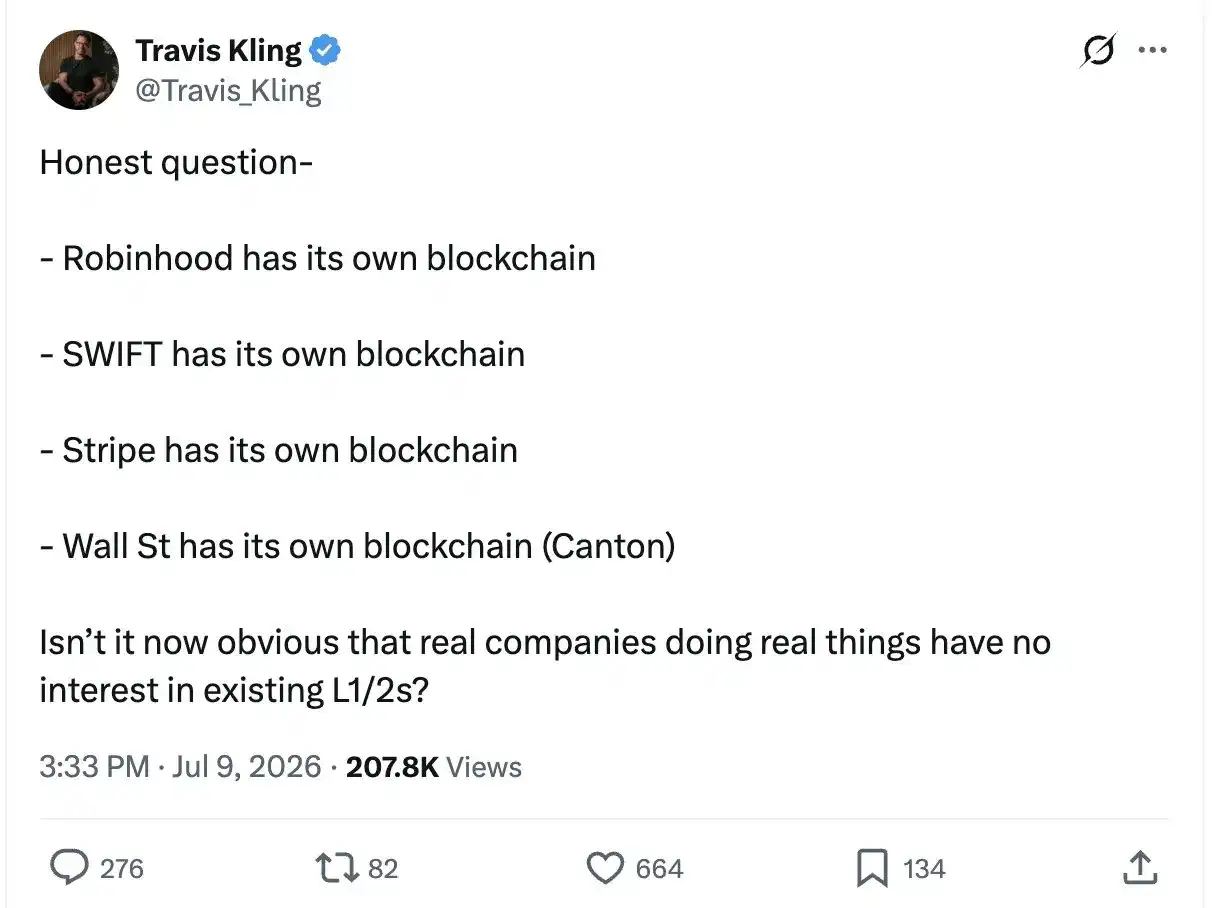
He suggests this could become a standard playbook for operating businesses: start on an existing chain, then move to a dedicated L2 once scale, product needs and unit economics justify it.
As described in the article, Robinhood Chain is tailored for financial services. It uses Arbitrum technology, offers 100 millisecond latency, predictable transaction pricing and high throughput, and is designed around Robinhood’s performance, security and regulatory requirements.
At the same time, he says it remains an Ethereum L2. It uses Ethereum blobs for data availability, ETH as native gas, and an official Ethereum bridge rather than a third-party validator set.
That is why Berckmans argues Robinhood had no need to issue a Robinhood gas token or persuade the public that a new token deserved lasting monetary premium. Robinhood already has equity, and its economics come from customers, products, assets, transactions and cash flow. In this setup, blockchain is infrastructure.
He also says using ETH as gas is a straightforward business decision. L2 services already pay L1 costs in ETH, ETH is liquid and broadly used, and adding a proprietary gas token would create extra distribution, liquidity, pricing and legal issues without improving the core product.
For that reason, he says it is inaccurate to claim that Robinhood built its own blockchain and rejected existing L1 and L2 services. In his view, Robinhood rejected sharing its dedicated execution environment with other projects, not Ethereum itself. It chose Ethereum as the parent layer of that chain.
The article points to Coinbase and Base as a similar example. Berckmans notes that Brian Armstrong has publicly shown more enthusiasm for Bitcoin than for Ethereum. Even so, when Coinbase selected infrastructure for its onchain business, it chose to become an Ethereum L2. He treats Base as another case where the decision was commercial rather than ideological.
What this would mean for Ethereum and ETH
Berckmans closes by saying this shift in participants would be favorable for Ethereum. Historically, he writes, blockchain competition was shaped mainly by teams whose incentives centered on token creation, ecosystem funding and token valuation. Looking ahead, he expects more competition to be driven by companies optimizing for security, customers, control, distribution, liquidity and interoperability in support of cash businesses.
That would push demand toward what he calls Ethereum’s “barbell” structure: L1 for risk minimization and liquidity, L2 for scaling, customization and operator control. In this model, Ethereum does not need to force every company into a single shared execution environment. It can function as the common settlement, security, liquidity and asset layer beneath many environments.
He makes the same argument for ETH. The article says ETH has built a monetary network and global trust, serves as a staking asset and as the native asset of Ethereum’s settlement layer, and acts across the ecosystem as collateral, a liquidity asset, a treasury asset and a productive asset. As more operating businesses build on Ethereum, he expects ETH to reach more users, appear in more products and take on more roles.
Berckmans’ conclusion is that Robinhood is not an exception. It is a signal. In his framework, serious businesses will use Ethereum L1 when they need the most neutral, lowest-risk and most liquid shared environment. They will build their own Ethereum L2 when they need control, customization and performance. And if their business is not large enough to justify a dedicated chain, they will deploy on mature chains, often Ethereum L2s.