

OKX and Gate have integrated Robinhood Chain and enabled gas-free transactions, with the offering focused mainly on swap activity. At first glance, the arrangement appears to require the exchanges to absorb the cost and subsidize users. A rough calculation by MarsBit author Black Mario suggests a different result: the gas subsidies may not need to come entirely from the exchanges’ own funds, and the platforms may already be generating a profit.
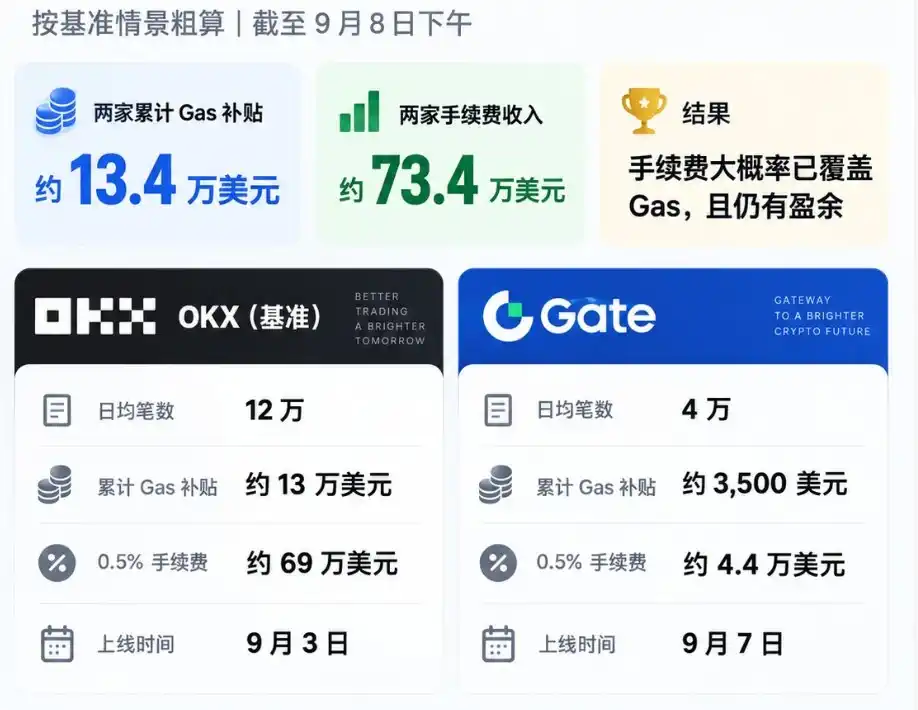
The estimate covers the period from the launch of the feature through the afternoon of Sept. 8. It uses the two exchanges’ trading volumes, transaction counts and the average gas fee on Robinhood Chain. On that basis, the combined gas subsidies were estimated at roughly $130,000 to $150,000. OKX accounted for most of the amount. Gate had been running the feature for about one day, so its share remained relatively small.
The trading route itself also generates fee income. Applying a 0.5% fee rate to the current transaction scale, fee revenue over the same period had already exceeded $700,000, according to the author’s calculation. On that single revenue line, the income would likely be enough to cover the gas subsidies.
Consider a $100 meme swap. The platform collects a $0.50 fee, while the gas cost paid on behalf of the user may be only $0.10 to $0.20. The gas-free service therefore does not mean that the exchange gives up its revenue. Instead, it uses part of the transaction fee to handle an on-chain cost that can be inconvenient for users.
Users do not need to withdraw funds or prepare ETH separately. Their capital remains in centralized exchange accounts, where it can still be used for spot trading, derivatives or wealth-management products. The arrangement may also bring additional deposits and trading activity.
In Black Mario’s analysis, OKX and Gate are using gas costs in the tens of thousands of dollars to secure access to meme trading on Robinhood Chain, along with user retention and capital deposits. Measured against the estimated fee income, the transaction appears financially favorable for the exchanges.