

Robinhood Chain, which has been live for less than two months, logged another on-chain activity spike over the weekend. Trading volume, active users and several other core metrics hit new highs, while protocol revenue climbed past a number of Layer 2 networks that launched earlier.
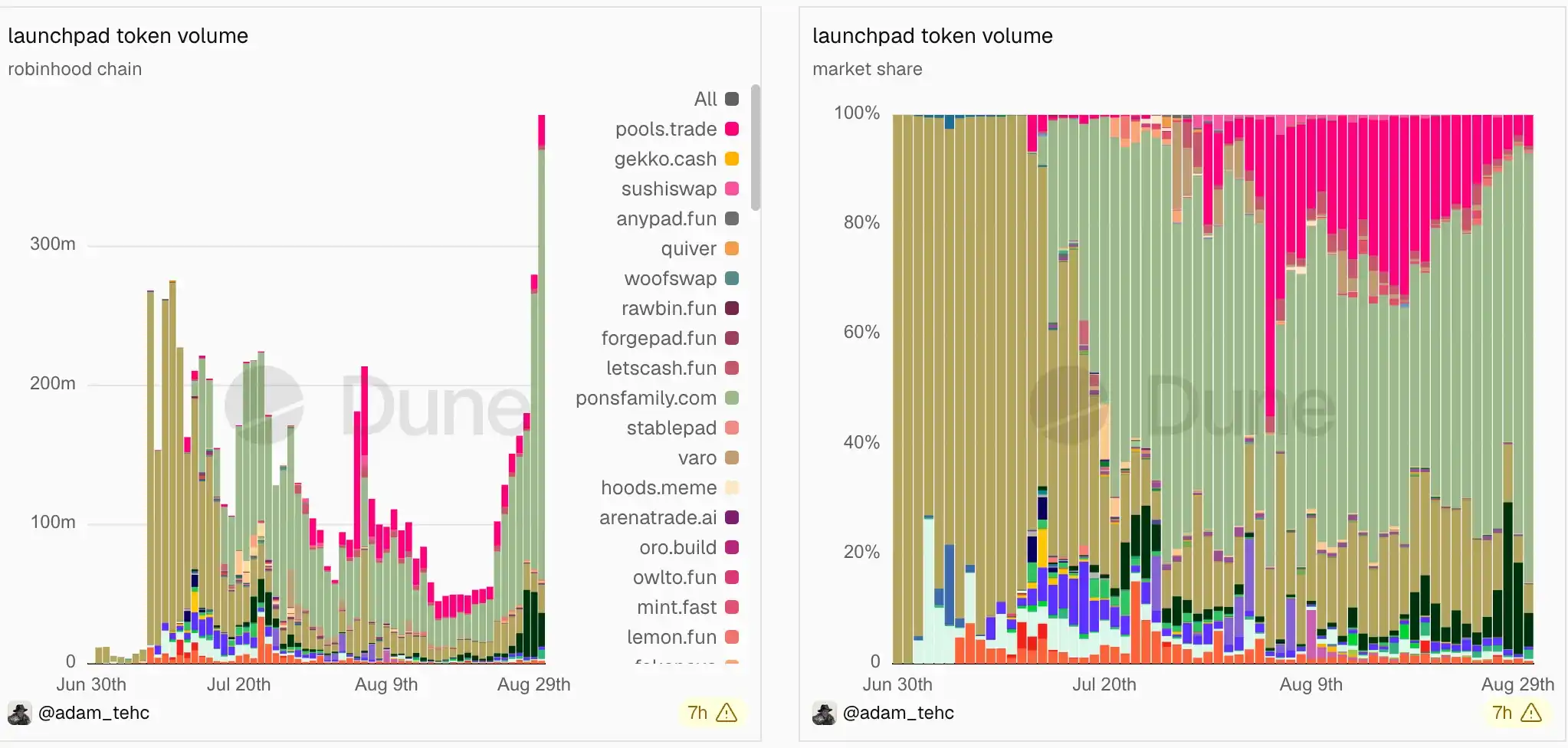
For a network still in its early phase, the pace and persistence of that growth stand out. The report says Robinhood Chain is pulling in traffic through multiple entry points at once, with capital, users and assets converging on the same network.
Pons turns Launchpad activity into a core traffic engine
The earliest traffic gateway on Robinhood Chain was its Launchpad segment. By continuously issuing new assets, Launchpad products create trading demand and keep capital and liquidity circulating within the ecosystem. In the current Launchpad race, Pons has emerged as the most watched player.
According to Dune data cited in the report, Pons recorded more than 22,000 token deployments in its latest single-day reading, a record since launch and equal to 67.8% of all token deployments on Robinhood Chain that day. Its daily trading volume also set a high at more than $308 million, accounting for over 78.2% of the chain’s total volume. Over the same period, Pons reached 115,000 daily active wallets, more than six times the figure for Pools, the second-ranked platform.
Pons has also reinforced its position through creator incentives. The platform sends 70% of trading fees to token creators, raising the expected payoff for issuers and encouraging more token launches. Official data cited in the article says Pons has paid roughly $20.93 million to token creators over the past 47 days.
As trading flow continues to move toward Pons, the fees captured by the platform have grown as well. That revenue is then routed back into the PONS token through a buyback-and-burn structure.
Under Pons’ public tokenomics, 80% of protocol revenue is used to buy back PONS through a TWAP mechanism and permanently burn the tokens. DeFiLlama data cited in the article shows cumulative revenue has topped $10.14 million, with daily revenue at one point exceeding $1 million. Pons is now the second-highest revenue protocol on Robinhood Chain.
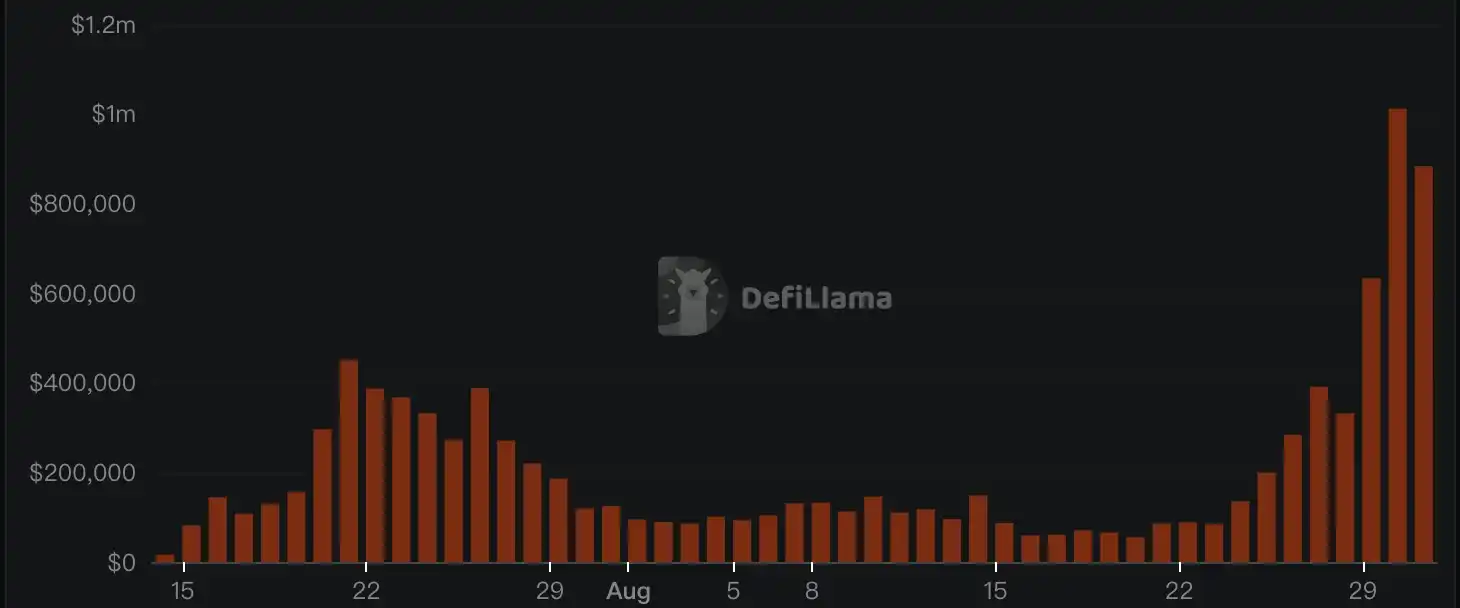
As protocol revenue has increased, so has the scale of buybacks and burns. So far, official disclosures show cumulative burns equal about 29% of total supply.
The article says this has started to reshape how the market prices PONS. Compared with Pump.fun, one of the leading Launchpad platforms in the meme sector, Pons shows stronger value capture in buyback ratios, token burning and recent revenue growth. With PUMP already carrying a higher market capitalization, the lower valuation assigned to PONS has left more room for speculative upside in the market’s view.
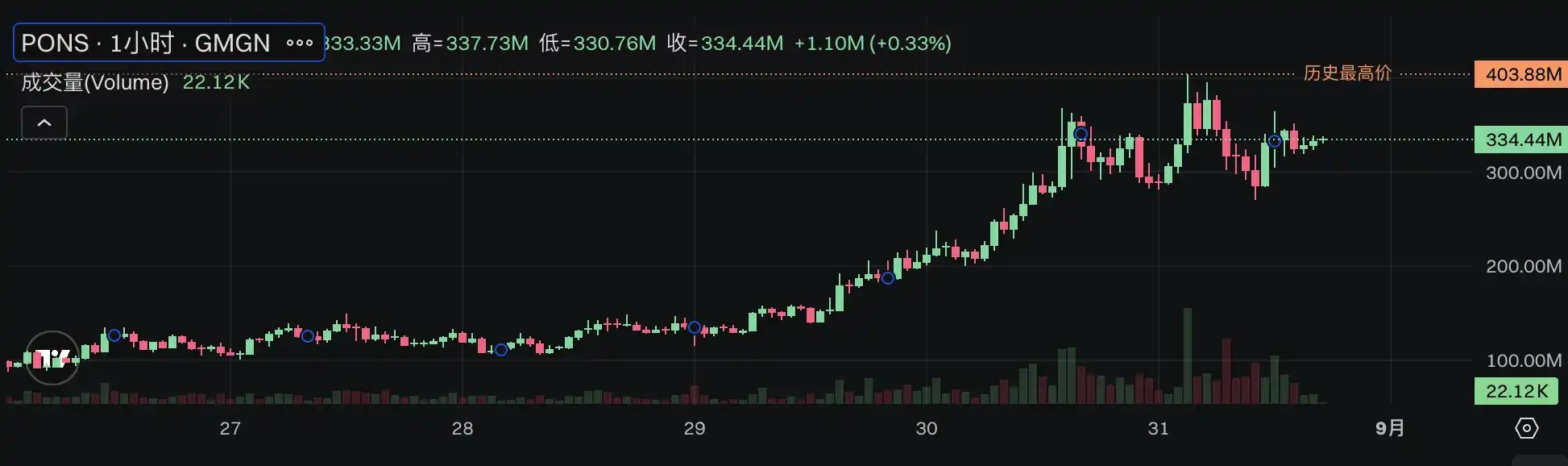
GMGN data cited in the report shows PONS rose from a market cap of under $30 million a week ago to a peak above $400 million, making it the largest token by market value on Robinhood Chain.
In that sense, Pons has become one of the chain’s main entry points for continuously producing new assets.
Trading terminals take over from issuance, and Fomo broadens the user base
If Launchpads create assets and early liquidity, trading terminals handle the demand those assets generate afterward.
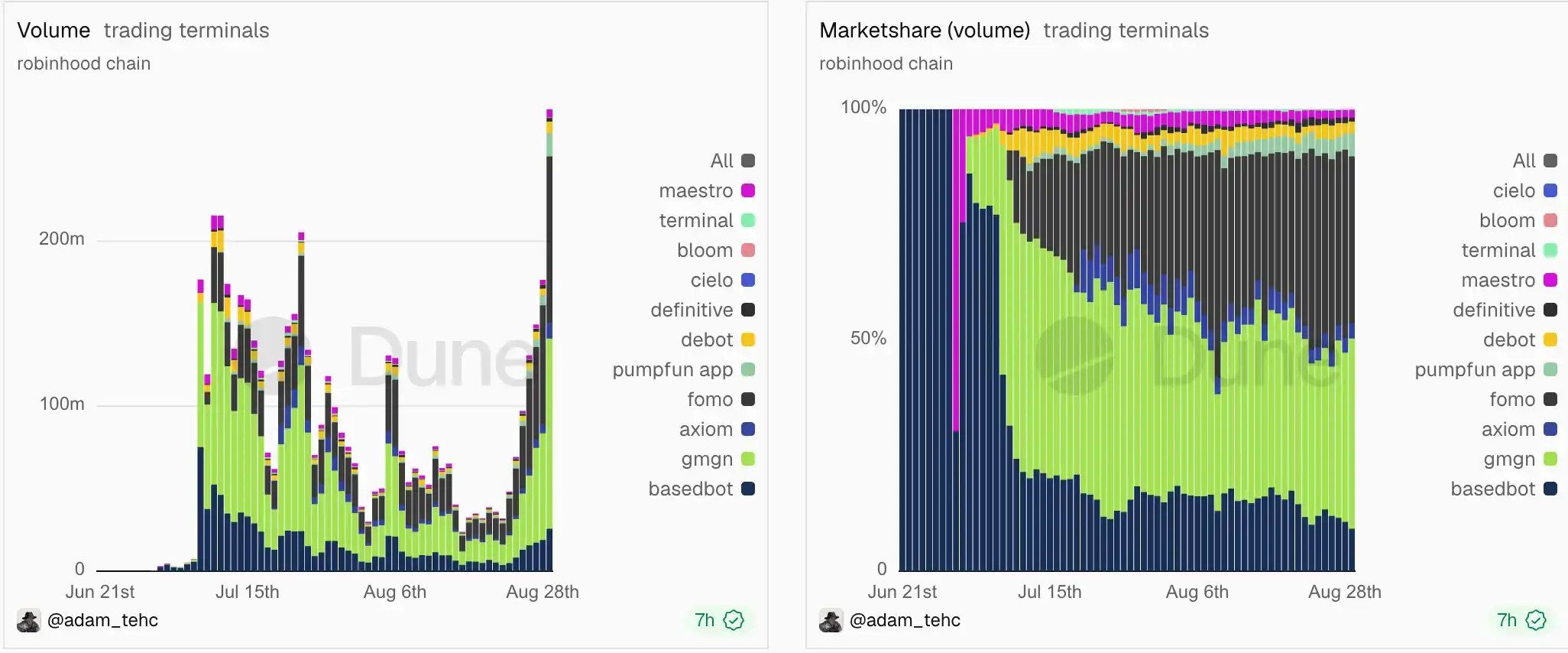
Dune data in the article shows trading terminals now contribute nearly half of network-wide trading volume on Robinhood Chain. Their daily volume accounts for 47% of the chain total, with about $280 million in daily turnover and more than 110,000 daily active wallets, both records since launch.
Among those products, Fomo is described as one of the fastest-growing. After Robinhood Chain’s mainnet launch, Fomo quickly became a major trading gateway on the network. The Fomo team has said that one in every two active wallets on Robinhood Chain comes from Fomo. Addresses tied to popular token trades also regularly show Fomo users near the top of profit rankings.
Fomo is trying to turn complex on-chain trading into something closer to a social app experience. Users can browse tokens, watch trades, copy positions and execute transactions directly inside an information feed. The article says that approach lowers the barrier to participation and gives trading a stronger social layer.
High-profit case studies on the platform have added to the draw. According to Fomo’s official disclosure, 26 traders have already realized more than $1 million in profits on the platform. On the profit leaderboard over the past 30 days, 25 users posted gains above $1 million.
Analysis from @0xAvast cited in the report says only one wallet on the Pump app generated more than $1 million in PNL, defined there as unrealized profit, over the past 30 days. On Fomo, by contrast, a user would need more than $1 million in PNL just to break into the top 30 on the profit leaderboard.
From a user-structure angle, the significance of Fomo is not limited to volume contribution. The article argues that it expands Robinhood Chain’s user boundary.
Dune data shows GMGN’s latest single-day volume on Robinhood Chain reached $1.115 billion, accounting for 41.2% of the network total and ranking first. Fomo posted about $101 million in daily volume, with a share of roughly 36%.
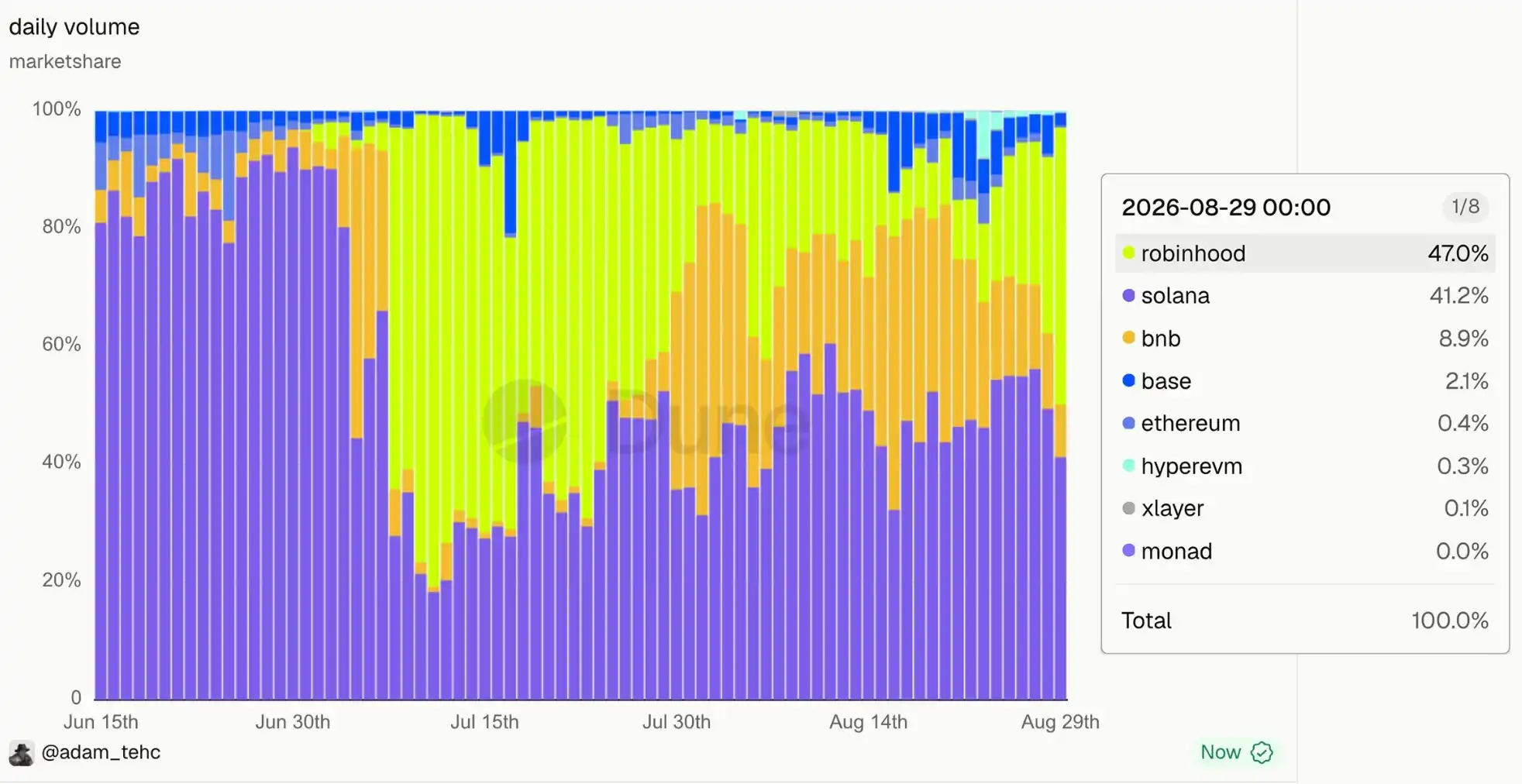
By volume alone, GMGN is larger. But the address-level breakdown points to different user profiles. GMGN had about 17,700 daily active addresses, implying about $62,800 in average daily volume per address, a profile associated mainly with professional traders, high-frequency traders and users with larger capital bases. Fomo, by contrast, had more than 64,000 daily active addresses, while average daily volume per address was only about $1,565. That suggests much wider reach among ordinary users.
Fomo CEO Se Yong said recently that currently available on-chain data may understate the platform’s real scale by about 20% to 40%, because collecting complete data across six to seven chains at the same time is difficult. He also said Fomo is adding about 40,000 new users a day through the App Store. In his view, that number is unlikely to come entirely from existing crypto users, which suggests a meaningful share may be people who were not previously active in crypto markets.
For Robinhood Chain, the article says, Fomo is bringing more than trading volume. It is extending on-chain trading from professional participants to a broader retail audience.
Wealth effects and listing expectations intensify the market game
For an early-stage public chain, wealth creation tends to be one of the strongest magnets for capital and users.
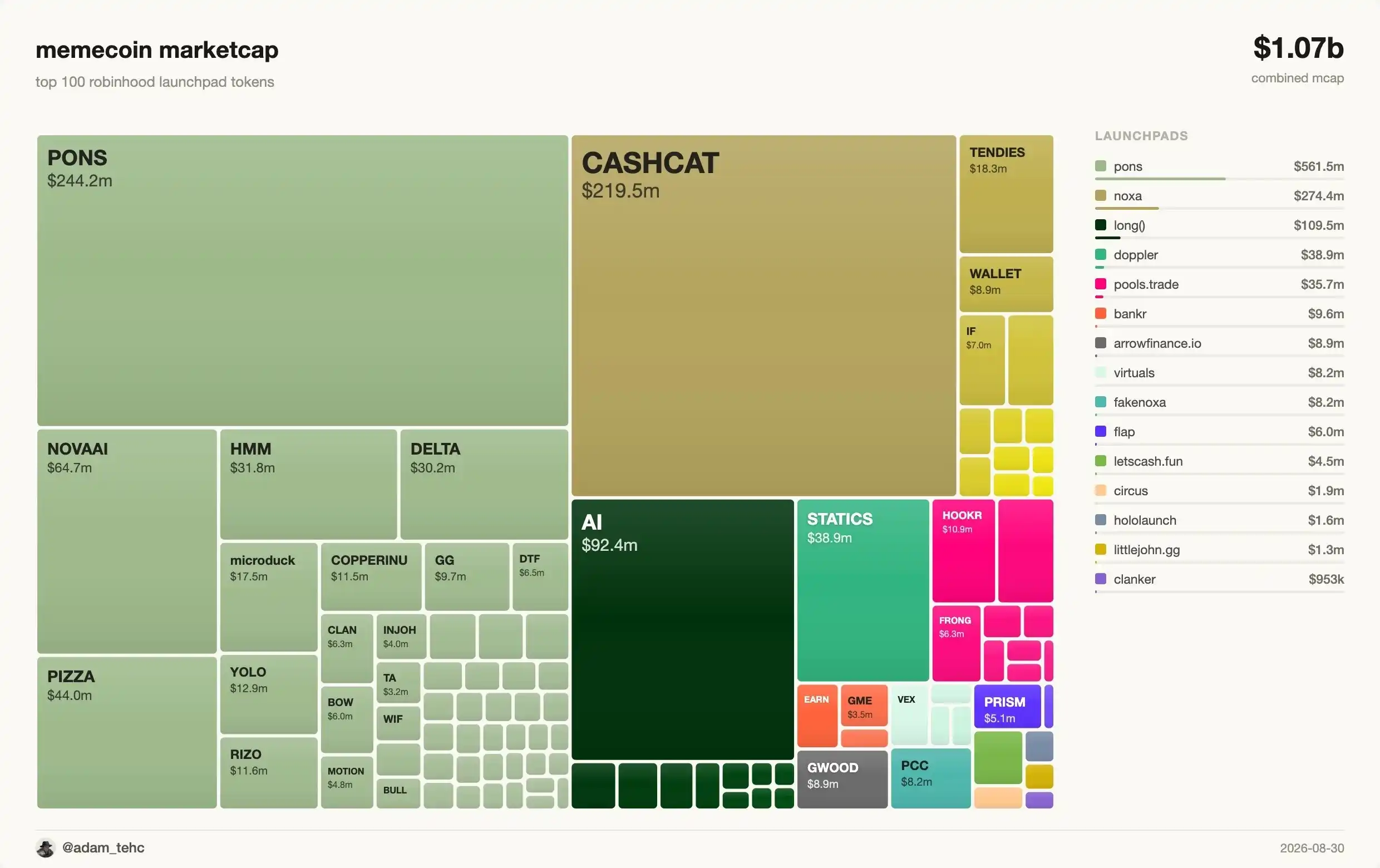
Over the past few days, tokens including PONS, AI and NET on Robinhood Chain have continued to rise, with some assets reaching all-time highs. Dune data shows the total market capitalization of the top 100 tokens on the Robinhood Launchpad has surpassed $1 billion, up 123% over the past six days.
The chain has already produced a number of high-return cases. On-chain analyst @ai_9684xtpa tracked one address that bought PONS at a low point 46 days ago with an investment of just $115,000. That position is now sitting on more than $2.82 million in unrealized profit, a return of 2456.6%. The same address also made about $598,000 in profit after exiting CASHCAT.
Holdings by well-known KOLs have added to market attention. Crypto KOL Bonkguy previously spent 67,304 USDG to buy 10.96 million PONS and has not sold so far; the position is now valued at nearly $3.8 million. Ansem spent about $57,600 buying NET, the token of DeFi protocol NetNet Capital, and also bought more than $21,000 worth of Artificial In’s AI token. Him accepted roughly 40% of the token allocation for the community token COPPERINU and, following the ANSEM token playbook, carried out a manual airdrop to the community, quickly pushing up market capitalization in a short period.
The market’s expectation that tokens on Robinhood Chain could eventually be listed by Robinhood is also lifting attention around on-chain assets. The article notes that after Robinhood listed CASHCAT, the token’s market capitalization jumped sharply at one stage. In the market’s view, any token that gains Robinhood’s attention, or lands on its trading platform, could get access to a broader user base, more trading entry points and stronger brand exposure, attracting speculative capital ahead of time. The article compares this with earlier expectations around BSC-based meme tokens getting listed on Binance.
Stock memes enter liquidity pools and give RWA a new building block
Stock memes are emerging as a differentiated play on Robinhood Chain and opening a new liquidity route for tokenized equities. Tokens including CASHCAT, STONKBROKER, INDEX and microduck have already drawn attention on the network, and some leading assets have reached relatively high market capitalizations.
Unlike traditional meme coins, which largely depend on narratives, community sentiment and capital rotation, some stock memes are starting to combine meme assets with tokenized equities. The article says that gives stock tokens, which previously had limited use cases, a new source of on-chain traffic.
Crypto analyst Qinbafrank said Robinhood Chain has already seen LP pools built from stock tokens and meme coins. Trading those meme assets directly generates volume in the stock tokens, while part of the stock-token supply is locked into LP pools. He cited this as one reason tokenized U.S. stock volume on Robinhood Chain later managed to surpass some competing products on Solana.
Robinhood itself has not made “issuing memes from stocks” into an official product. Robinhood CEO Vlad Tenev said earlier on a podcast that developers created liquidity pools the team had not originally anticipated, combining memes, crypto assets and stock tokens. In his description, memes became an entry point that channeled users toward real stock tokens, and the development went beyond the company’s initial expectations.
Qinbafrank said this can be seen as a natural result of permissionless deployment on-chain, and he broke the significance into several points.
- First, RWA has finally found a usable cold-start path. Stock assets on-chain previously had limited usage, but meme tokens can first draw in users, fees and attention, then feed volume back into stock tokens.
- Second, stock tokens are starting to become true programmable building blocks. In the past, tokenized equities mostly stopped at being tradable and viewable. Now they are appearing in more on-chain combinations and could later connect with lending, indexes and agent-based products. The industry is shifting from merely putting stocks on-chain for display to using them as DeFi primitives.
- Third, paired assets in on-chain liquidity are becoming more diverse. Meme tokens may not always be quoted only against ETH, SOL, BNB or stablecoins. Stocks, government bonds and gold could all become new liquidity-pair assets.
He added that the more important change is that the boundary between crypto markets and equity markets is getting thinner. For the first time, users can encounter crypto-native, high-volatility speculation and U.S. equities, with their more traditional pricing anchor, inside the same pool. That links speculative traffic with real financial assets.
In his view, this strengthens a broader direction: quality financial assets will continue to be split into tokens and then repriced, redistributed and recombined on-chain. Robinhood Chain also offers a reference point for other traditional finance players. A TradFi firm entering blockchain may not need to build a highly formal financial enclave first. Letting a chain become active before embedding proprietary assets into existing speculative and DeFi behavior may move faster than a model of “compliance first, then waiting for users to come.”
Several channels now reinforce one another
Viewed together, Robinhood Chain’s recent momentum is easier to understand. Token issuance keeps creating new assets. Trading terminals keep pulling in and processing order flow. Wealth effects attract more capital. RWA and stock-meme combinations add another format for asset composition.
Those elements are now feeding each other. More users, more capital and more assets are moving onto Robinhood Chain, gradually forming the growth flywheel described in the report.