
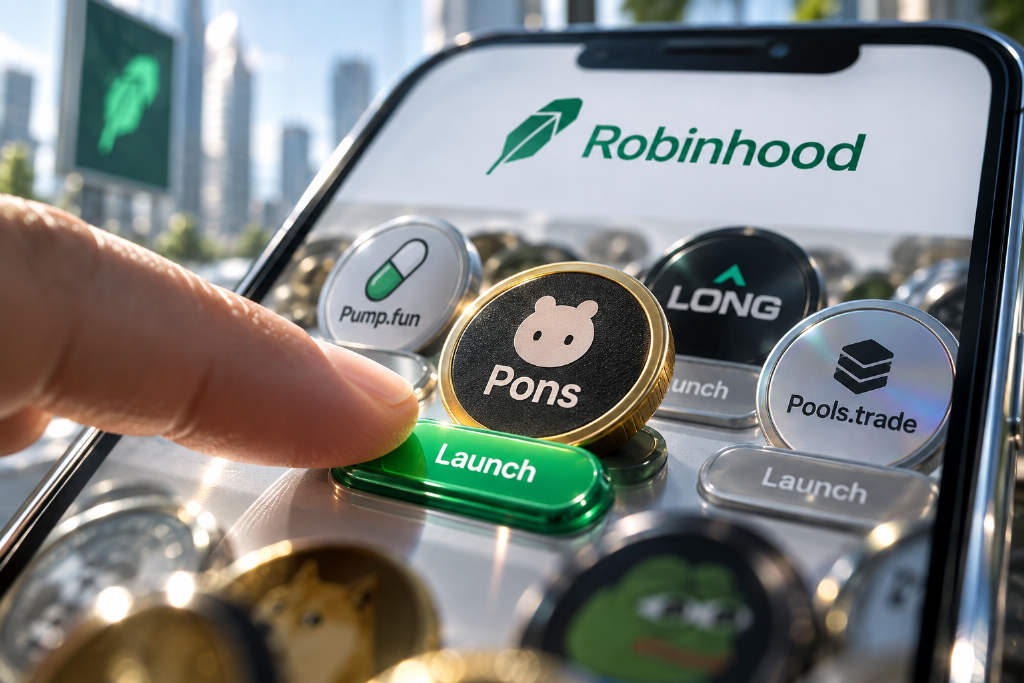
The meme launchpad race has moved onto a new chain. According to MarsBit, Robinhood Chain, which launched on July 1, generated $34.6 billion in cumulative DEX trading volume in just two months, while meme launchpads on the network pushed daily fees to as much as $6.33 million and repeatedly outpaced Pump.fun.
The article frames the current cycle as the latest step in a long decline in token issuance barriers. It starts with the ICO boom on Ethereum in 2017, moves through IEOs, IDOs, and inscriptions, and argues that each wave lowered the threshold for issuance while platforms captured a large share of the economics through fees.
Pons rose from launch to top-tier fee generation in less than 50 days
Robinhood Chain is built on Arbitrum Orbit. The report says the L2’s gas costs are already very low, and users of the chain’s native wallet also receive a 90-day gas subsidy. That setup sharply reduces trading friction, creating favorable conditions for meme launchpads.
Pons, the leading example in the report, went live on July 13. Its model is simple: it charges a 1% trading fee, sends 70% of that fee directly to token creators, and keeps 30% at the protocol level. Of the retained amount, 80% is used to buy back and burn the Pons token.
MarsBit says that in less than two months, 30% of total token supply, or about 300 million tokens, had already been sent to a burn address. The token went from zero to nearly $1, and its market capitalization at one point exceeded $600 million.
The article says Pons reached the top four protocols by network-wide fee generation in under 50 days. Pump.fun took more than two years to get to a similar position. On Sept. 3, Pons posted more than $6 million in protocol fees for the day, ranking fourth behind Tether, Uniswap, and Circle. Pump.fun was described as far behind. A day earlier, on Sept. 2, Robinhood Chain recorded $4.01 million in daily chain revenue, while Solana’s chain-wide revenue on the same day was $81,700.
LONG tied meme assets to stock-mapped tokens
Pons is not alone on Robinhood Chain. Another launchpad called LONG took a different route by pairing new tokens not with ETH, but with stock-mapped tokens linked to names such as Nvidia and the S&P 500.
The report says LONG’s tokenized stock daily volume at one point topped $425 million, accounting for 20% of the chain’s total stock-related TVL. It also packaged 3x leveraged stock tokens, bringing a traditional derivatives format onto a chain that had only been live for two months.
Robinhood Chain now hosts more than 190 stock tokens, according to the article, and its peak daily DEX trading volume reached $3.7 billion, close to Solana. The report describes the network as evolving from a meme-heavy venue into an on-chain market for mixed assets.
Uniswap entered with Pools.trade and added pressure on Pons
Pons V2 locks post-graduation liquidity into Uniswap V4 pools. MarsBit notes that Uniswap later launched Pools.trade on top of the same underlying liquidity stack. In other words, whichever frontend wins user attention, the capital ends up sitting in Uniswap pools.
The article also raises a basic question about the headline numbers. Robinhood Chain is only two months old, gas costs are close to negligible, and creators can cheaply wash trade their own tokens, paying 1% and receiving 70% back. The report says it remains unclear how much of the large trading volumes reflect real demand.
Every chain is fighting over issuance flows
Robinhood Chain is only one part of the broader competition.
On Solana, Pump.fun remains the highest-grossing meme launchpad by cumulative revenue, with more than $1.23 billion extracted in total, according to the article. Its edge comes from vertical integration: tokens that graduate from the launchpad move into its in-house PumpSwap venue, allowing the platform to keep charging across the token lifecycle. Even so, Pons has overtaken it multiple times on daily fees.
Pump.fun has responded with product changes of its own. MarsBit says it introduced Mayhem Mode, bringing in AI trading agents to counter sniper bots and protect retail users from being front-run. It also shares 50% of PumpSwap protocol revenue with creators.
Competition on Solana has also come from LetsBONK.fun. The platform uses a dynamic logarithmic pricing curve that lowers the early slope, which the report says gives retail traders a fairer price in the opening minutes. Wallets are also capped during the first 60 seconds to target bot-driven rush buying. The article says its market share among Solana meme launchpads once jumped from 13% to 78%. Around 50% of platform fees are sent back to BONK holders through buybacks and burns.
Raydium has moved in as well. Before PumpSwap launched, tokens graduating from Pump.fun were automatically routed into Raydium pools, and later trading generated fees for Raydium. Once PumpSwap cut off that stream, Raydium responded by launching LaunchLab to compete directly.
On Base, Zora has turned token issuance into a creator tool. Each creator gets a dedicated token with a supply of 1 billion units. Half goes into the liquidity pool, and the other half unlocks to the creator over five years. On July 30, new tokens launched on Zora accounted for 44.6% of all newly issued tokens across chains, helping Base surpass Solana in token issuance volume for the first time. The report adds that more than $27 million had already been distributed to creators, while the Zora token rose 8x over the same period.
Believe has taken a more social route. Users can reply to a designated account on X with a token name, and the backend handles on-chain deployment automatically. Its V2 version introduced what the report calls a "human emotion market," where tokens can be used to go long or short on personal reputation.
Inside Robinhood Chain, Uniswap has become a direct competitor through Pools.trade. The product charges zero issuance fees and zero trading take, keeping only a 0.25% LP fee that is auto-compounded and locked. MarsBit says this structure raises the price floor with every trade. On its first day, Pools.trade attracted $73.6 million in trading volume, more than Uniswap V4 on Ethereum mainnet that same day. Pons fell 49% over the following week.
The article’s broader point is that the same pattern is repeating across chains: one dominant platform appears first, then lower-cost competitors enter, and fees are pushed down. Pump.fun ruled Solana for two years and is now facing pressure from BONK.fun and LaunchLab. Pons had only established itself for about two months on Robinhood Chain before Pools.trade arrived with a zero-fee model. In the report’s framing, the right to launch tokens is turning into free public infrastructure.
Platform tokens offer leverage, but also regulatory risk
Most meme launchpads now have their own tokens, and most of them rely on buyback-and-burn mechanisms to support price.
MarsBit lists several examples. Pons has burned 30% of supply. Zora rose 800% in July. Virtuals continues to buy back and burn tokens with protocol revenue, but its 18,000 AI agents run inference on its own servers, meaning an outage would shut the system down. Clanker allocates 60% of revenue to buybacks.
The article says these token prices are fundamentally tied to one variable: how much fee income the platform can keep generating.
It argues that the larger risk comes from compliance. A mechanism that continuously directs platform profits back to token holders may sit only one step away from what U.S. securities law could view as a disguised dividend. In August 2026, the U.S. Securities and Exchange Commission proposed a 400-page crypto asset rulebook that, according to the article, classified token lifecycles at the federal level for the first time.
The proposal includes a safe harbor mechanism. If a project can prove that its network is decentralized and that founders are no longer the decisive source of value, a token could shift from being treated as a security to being treated as a commodity. The article then asks a direct question: which of these meme launchpads can confidently claim to be decentralized?
MarsBit ends by describing platform tokens as both one of the biggest leverage bets and one of the largest risk exposures in this cycle. Robinhood Chain has been live for only two months, yet daily fees have already pushed it into the top four across networks. But the report argues that every meme boom on every chain begins with the same kind of bright opening. The real test starts after the rush fades. If launching tokens becomes free, survival is what gets monetized.