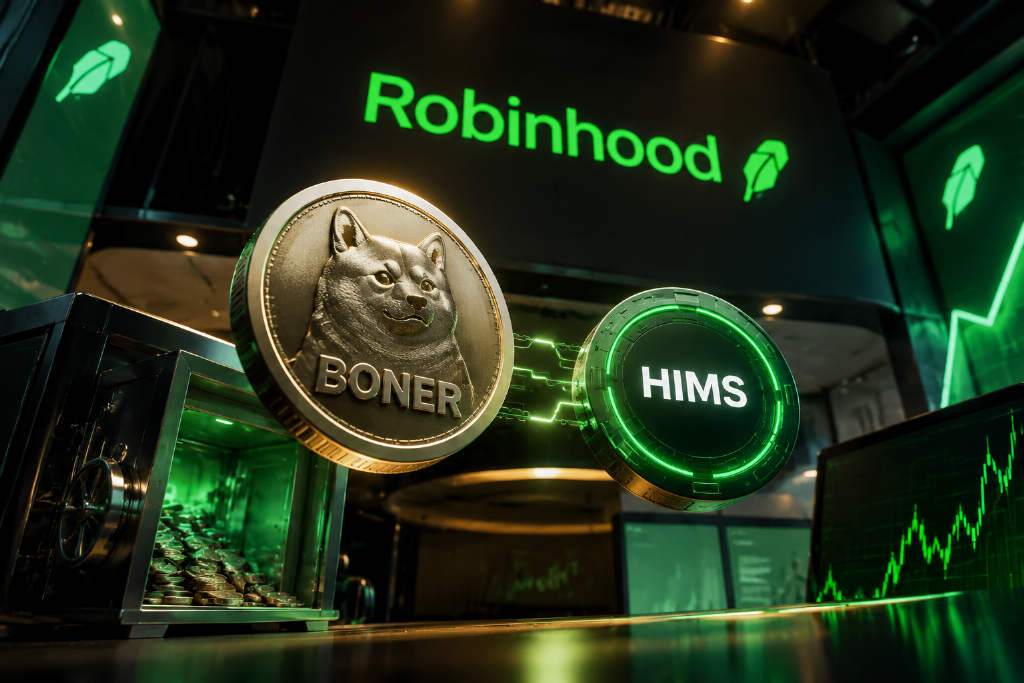
According to GMGN market data, BONER, a stock meme token on the Robinhood chain, briefly surged to a $69 million market cap before retreating to $61 million, with a 24-hour increase of 30.8% and a 24-hour volume of $17 million. The token is paired with the stock token HIMS. This is part of the emerging 'Stock Meme' trend, where meme tokens are directly paired with tokenized US stocks, combining high volatility with real stock narratives. Trading fees partially flow back to community treasuries to accumulate corresponding stock tokens. Investors should be cautious of price volatility.
BlockBeats news, September 3 — GMGN market data shows BONER, a stock meme token on the Robinhood chain, briefly pushed past a $69 million market cap, then slipped back to $61 million. In the past 24 hours, the token posted a 30.8% gain, with trading volume reaching $17 million.
BONER trades in a pair with the stock token HIMS.
BlockBeats note: Stock Meme is a newer idea. It fuses classic meme tokens with tokenized U.S. stocks, straight up. These meme tokens are not paired with USDT or ETH. Instead, they trade against on-chain stock tokens like NVDA, TSLA, or AAPL. The setup keeps the wild swings and community-led speculation that meme tokens are known for, while also borrowing the story and popularity of real stocks. And in many cases, part of the trading fees gets routed to community treasuries to buy up the matching stock tokens, forming a two-part engine: emotion-driven speculation on one side, real-asset backing on the other. Prices for related tokens swing hard, and users should be cautious when investing.
This article was originally published by Bit.Fan. For more cryptocurrency news and market insights, visit www.bit.fan. Disclaimer:
The market information, project data, and third-party content displayed on this platform are for industry information sharing only and do not constitute any form of investment advice or return commitment.
Cryptocurrency trading carries high risks. Users should fully assess their risk tolerance and make independent decisions. All profits, losses, and legal responsibilities are borne by the users themselves.