


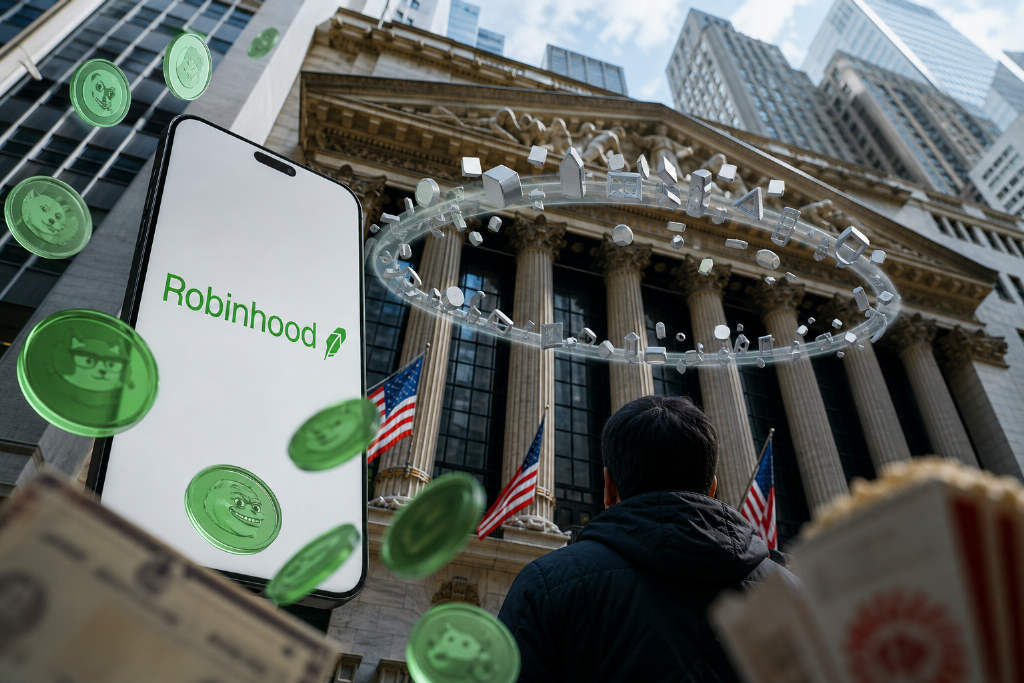
IOSG researcher Mario Chow argues that the current meme-coin trade built on Robinhood Chain’s tokenized equities does not recreate the mechanics behind the 2021 GameStop squeeze, even if it can briefly push real stocks higher.

His central claim is simple: on-chain prices can be forced up fast, and money does reach New York in the form of real equity buying, but the issuer-side creation and redemption process pulls prices back into line, often within hours. The article says its data runs through Sept. 7, 2026, at 02:15 UTC and describes the piece as research discussion rather than investment advice.
The headline takeaway: the buy pressure is real, but the float is no longer fixed
Chow examines three meme tokens quoted in tokenized stocks: $BONER, priced in Hims & Hers; $MEME, priced in AMC; and $AI, priced in Nvidia.
The pitch around these assets has echoed the old short-squeeze script. Traders buy the meme token, that buying pushes up the tokenized stock used as the quote asset, and the institution charged with keeping the token in line is then forced to buy real shares in the secondary market.
After reconstructing the mint and burn history of all tokenized stocks on the chain, Chow says that description gets the first half right and the second half wrong. Prices on-chain can jump hard. What traders cannot do is lock that price in place, because the issuing side can respond by buying the underlying shares, placing them into custody and minting more stock tokens.
In his framing, Robinhood in 2021 stopped retail traders from buying. Robinhood in 2026 leaves the window open and sells into the move.
The AMC weekend: a CEO post, two meme coins and a token that traded at seven times spot
The report begins with AMC. On Thursday, Sept. 3, at 5:18 p.m. New York time, or 78 minutes after the close, AMC CEO Adam Aron posted that Robinhood’s tokenized AMC was 「despicable, outrageous and nauseating」 and said he had retained outside securities counsel.
Crypto traders took that post in another direction. Within six hours, two meme coins named after the message, $CINEMA and $MEME, began trading in pools quoted in tokenized AMC. The New York Stock Exchange was already closed. The token that was supposed to represent the economics of one AMC share traded as high as $18.04.
Real AMC stock had closed that day at $2.54. On the report’s numbers, the tokenized version reached roughly seven times the stock price overnight.
By the next session, the gap had largely disappeared, though not in the way many observers assume. AMC rose to $3.11 in the first 15 minutes of premarket trading, up 22% from the previous close, then slid back and finished the day at $2.65. Chow flags that hour as the most easily misread part of the episode because the move was not just the token collapsing back to stock. The stock itself was pulled higher as well.

That is why he uses AMC as the cleanest test case. The setup had every element a squeeze narrative would want: a real meme-stock ticker, a real CEO, a real crowd, a real depeg and real buy orders hitting the equity tape. Yet the stock ended up back near where it had been a week earlier.
Three layers of the Robinhood Chain setup
The report separates the system into three components that, in this form, did not exist 18 months ago.
Robinhood Chain
This is Robinhood’s own public chain. Chow says the 100 most active pools turn over about $1.65 billion a day, with most of that volume still in standard crypto assets.
Stock tokens
These are issued by Robinhood Assets (Jersey) Limited and track individual U.S. stocks. The report says they are not shares in legal form but debt instruments that deliver the economic return of one share, backed by real stock held with a broker custodian. In practice, one token represents one share of exposure, and licensed intermediaries, or authorized participants, can create and redeem at fair value. Chow describes it as the same machine ETFs use.
Token launchpads
Platforms such as long.xyz let users spin up a meme coin and a trading pool in one click. The shift in August was the quote asset. Meme coins had previously been quoted in dollars. Now some are quoted in tokenized stocks. Traders are not buying a meme coin directly with dollars; they are routed through the stock token first.
That substitution drives the whole story. If traders enter with $ETH or $USDG, the route converts that capital into stock tokens along the way. Pools keep accumulating stock-token inventory, and fees build up in stock rather than cash. A crowd buying meme coins becomes, mechanically, a buyer of an underlying listed stock.
Chow writes that seven stock-quoted pools now rank among the chain’s 100 most active, with about $73 million in combined daily volume.
He also gives a scale figure that matters for the rest of the piece. Across all 50 tokenized-stock underlyings on the chain, the real shares sitting behind them add up to about $138 million. AMC alone traded about $150 million on Nasdaq last Friday. In his words, the entire on-chain stock market is smaller than one busy afternoon in a single mid-cap name.
Why the GameStop comparison breaks
Chow revisits the 2021 episode before turning back to crypto. GameStop worked because of a hard constraint: short interest was about 138% of the float, meaning more shares had been borrowed and sold than the market could readily deliver back. Retail traders bought and held. Shorts had nowhere easy to cover. On Jan. 28, the stock moved from $17 to $483 intraday. The run ended after brokers restricted purchases, with Robinhood becoming the most visible example after a $3 billion clearinghouse margin call.

On Robinhood Chain, the same pressure point does not hold. When tokenized AMC traded at seven times the stock price, the issuing agent did not shut the door. It bought real AMC shares, placed them into custody and minted more tokens against them.
The report says about 3.05 million tokenized AMC shares were created over three days, while about 310,000 were redeemed and burned. Supply rose from 152,106 shares to 2,895,758 shares in 72 hours, a 19-fold expansion.
Hims followed the same pattern at a slower speed. When $BONER launched on Aug. 20, tokenized Hims supply on Robinhood Chain was just 468 shares. By the time Chow wrote the piece, it had reached 130,876 shares, about 280 times the original amount, with around $3.6 million of real Hims & Hers stock reportedly bought and placed into custody.
He adds one more detail from a Sept. 3 measurement. Over four days, $BONER’s share of tokenized Hims supply fell from 81% to 47% even as the token count it held actually increased. The position was not being dumped. The surrounding supply was simply expanding faster.
Chow is careful on intent here. Creation and redemption was not designed to stop squeezes. Its job is to keep the stock token tracking the underlying. That is the entire reason to hold a tokenized stock rather than a meme coin. The inability to corner supply is a byproduct of the mechanism doing exactly what it was built to do.
Yes, money reached New York. No, the flywheel did not keep spinning
The report does not dismiss the retail thesis outright. If a user buys $MEME with dollars, the router turns dollars into a stablecoin, then into tokenized AMC, and only then into the meme coin. In the first half of that path, the order flow is literally a buy order for the tokenized stock.
If enough traders do this, the tokenized stock moves above fair value. That premium creates an arbitrage incentive for the authorized participant, which then buys real AMC on the exchange, delivers those shares to the custodian, receives freshly minted stock tokens and sells them into the pool at the higher on-chain price.
Chow says the retail crowd is right about that part. Crowd money did hit New York in the form of real purchases. He points to roughly $7.6 million of real AMC bought and custodied over the weekend, with the busiest stretch accounting for 7.6% of premarket volume.
The self-reinforcing version of the story breaks in three places.

- First, the scale is too small. A $7.6 million buy program is facing a stock that can trade $150 million in a day. In steady-state conditions, Chow writes, the authorized participant’s footprint is only a tiny fraction of total volume.
- Second, and more important, the process turns itself off. The participant buys because a premium exists. Once the premium is gone, the reason to keep buying disappears.
- Third, the process runs in reverse. If the crowd leaves, redemption unwinds the same path and the stock can be sold back into the market.
That makes the structure fundamentally different from GameStop. A classic squeeze is positive feedback: one forced cover pushes price up, which forces the next cover, and the loop feeds itself. Creation and redemption is negative feedback by design. Arbitrage buying exists only to eliminate the gap that called it into existence.
Chow’s shorthand is that a fixed float turns buying pressure into a spiral. A live float turns that same pressure into a decaying impact cost. Both can lift price. Only one can keep lifting it.
What actually happened in AMC premarket trading
The report spends time on the tape because closing prices flatten the story too much. AMC finished that day up 4.3%, which makes the skeptical read look easy. But if the move is measured from the last pre-event price to the peak, and premarket and after-hours trading are included, the result looks different.
Chow says the clearest window is Sept. 4 premarket. At 4:00 a.m. New York time, when premarket opened, the tokenized AMC price was $4.09 while the last real-stock print was $2.54, a 61% gap. Fifteen minutes later, AMC stock printed $3.11 on 8.35 million shares of premarket volume, while the token was already rolling over.
In the report’s view, about half of that convergence came from the stock rising toward the token rather than the token falling all the way back to the stock. That is the strongest evidence in the piece that on-chain activity can transmit into the listed market.
Then it stopped. By 9:29 a.m. Eastern, the stock had slipped to $2.62 and the token was at $2.61. There was no second loop after the 4:15 burst because the premium that had called the arbitrage trade into existence was already gone. AMC later closed at $2.65.
Chow places several names back into their own trading histories:
- AMC traded 57.2 million shares that Friday, 1.9 times its normal volume, but that only ranked as its 15th busiest day in the last six months. On July 20, it traded 186.8 million shares with no meme-coin connection.
- Hims volume never left its normal range.
- Farmmi traded 872.6 million shares on Sept. 2 versus a usual 45,000 shares, around 19,000 times normal.
The pattern, he says, runs against intuition. The biggest on-chain impact on the equity tape happened where the company was so small that the on-chain crowd was nearly the whole market. That only occurs when the quote asset is fake, because Robinhood does not issue tokenized stocks for companies below a $1 billion market cap.
The scarce seat is the creation and redemption channel
Chow breaks the market down by who sits at the table and what each seat gets paid for. His answer is blunt: the most stable economics belong to the authorized participant.

The participant mints at fair value, sells into a premium created by the crowd, and can later buy back lower when the crowd disperses. During the AMC weekend, the participant bought and custodied about $7.6 million in real stock at prices of its own choosing while facing a market willing to pay up to seven times fair value.
The report does not frame that as misconduct. It treats it as the compensation required to keep the peg mechanism running, including in odd hours. The point, for investment analysis, is where durable returns sit. Chow says they sit in the creation and redemption layer built from the issuing license, custody relationships and the AP whitelist. They do not sit in the launchpad, and they do not sit in the meme coin.
Real quote assets and fake ones are not the same trade
For Chow, the right question is not whether a price spike looks like a squeeze. It is whether the quote asset can be created and redeemed.
Real Robinhood stock tokens come with a Jersey prospectus, real stock held by a custodian, separate series and ISIN codes for each underlying, and a whitelist of intermediaries allowed to create shares. In a block explorer, the report says, the name ends with “• Robinhood Token,” and the exchange-rate field is populated.
Fake versions need only 63 lines of Solidity and about $400 in gas, according to the article. Supply is fixed, there is no issuer, there is no oracle, and the supposed backing is described only as “an operational obligation” of the issuer, which means nothing on-chain verifies it or could verify it.
They can still look nearly identical in a block explorer, appear on the same platforms and show up in the same wallets. Chow says the distinction can come down to a field that may simply be left blank.
That difference also explains why names such as Farmmi can show far more extreme trading behavior than AMC or Hims. Robinhood’s actual tokenized-stock program does not include sub-$1 billion companies. Small-cap episodes are more likely to emerge from fake quote assets.
The real structural weak point is the market-closed window
Even after rejecting the listed-stock squeeze thesis, Chow does not conclude that nothing on the chain can be squeezed. He points instead to weekends and holidays.
The issue is timing. The creation channel works on New York market hours. The token trades 24/7. At the time of writing, he says, the most recent supply increase across Robinhood stock tokens including AMC, Hims, GameStop, Nvidia and SPY had happened on Friday, Sept. 4, at 23:35 UTC, 50 hours earlier. With Labor Day on Monday, the channel would not reopen until Tuesday premarket, leaving an 80-hour window in which tokens could trade but no one could create more.

Inside that window, the earlier conclusion needs to be narrowed. The float is no longer live. For three days, tokenized AMC supply is fixed in the same sense that GameStop’s share count was fixed in 2021. No arbitrageur can force it open immediately, regardless of price.
That leads to a more precise conclusion. Listed stocks cannot be squeezed through this channel in the way the meme narrative suggests, but the tokens themselves can be squeezed, and the opportunity appears mainly when the market is closed. Chow points to two examples: the $18.04 versus $2.54 AMC gap and an August episode in which tokenized Hims closed up 51% in a single hour.
Still, that was not happening at the time he wrote. Over the weekend, tokenized Hims moved in a range of -2% to +4% and was last at +2.9%. Tokenized AMC spent most of the period at a discount, touching -7% at one point. Combined turnover was about $40 million and the peg held.
The explanation returns to the earlier 19-fold supply expansion. After the initial panic, the issuer did not shrink supply back down. So the market that was later frozen was a deep one: 2,895,758 shares rather than 152,106. A thin float is the necessary condition. Market closure is only the amplifier. In Chow’s telling, three days of heavy issuance preemptively defused the next three days.
For holders, the practical read is that the key risk factor is the calendar rather than the company. A long weekend, a public holiday and a relatively neglected token that has not seen much recent minting would be the combination to watch.
Stress test: how large would this need to get?
Chow then asks how far the mechanism is from producing something that looks like a true squeeze.
He leans on two measures. Short interest is the number of borrowed shares that have been sold and must eventually be bought back. Days to cover is short interest divided by average daily volume, or how many normal trading days shorts would need to exit if they were the only buyers in the market.
GameStop’s oddity was that more stock had been sold short than effectively existed in the float. By contrast, the tokenized names in this set have days-to-cover ratios between 3 and 9, according to the report. In Chow’s reading, everyone can still get out through the front door.
That caps the upside. Even if all shorts in these names covered at the same time, he estimates the price gain would be just 7% to 14%. None of them would double.

He adds another ratio: channel conversion. At peak, $BONER was worth about $85 million and forced roughly $3.6 million of real Hims stock to be bought and custodied. That is about 4 cents of forced stock buying for every $1 of meme-coin market value.
At that rate, to push a stock far enough to resemble a complete squeeze, the channel would have to buy close to the entire short position.
The report gives one more benchmark. The largest meme coin in the chain’s history is $AI at $270 million. The lowest hurdle in the table Chow references would still require 13 times that size, and it would buy only about a 9% price move.
There is no easy route through smaller targets, either. The smallest company in Robinhood’s tokenized-stock universe is NuScale at $951 million, three orders of magnitude larger than Farmmi. Chow presents that threshold as both the reason real tokens are relatively safe and the reason fake tokens have appeared.
What would change the conclusion
The report lists several developments that could alter the analysis.
- Robinhood lowers its market-cap threshold or issues real series on genuinely small companies. Chow says the current safety margin comes from the fact that the easiest names to squeeze have not been tokenized.
- A second authorized participant appears, or the existing one becomes faster. Today, the ceiling on premiums is partly a function of how long the channel is closed. A 24/7 creation channel would erase the last real dislocations. A slower or narrower one would magnify them.
- U.S. equities move to 24-hour trading, which would eliminate the non-market-hours gap directly.
- A quiet token meets a long weekend. The vulnerability he describes is dormant because supply was expanded, not because it was fixed. A newly launched token or one with little recent minting could bring the 2021 condition back during a holiday closure.
- Fake quote assets become routine rather than exceptional. The article says two clone contracts appeared within a week, one copycat ticker entered the chain’s most active venues, and this type of spread does not need anyone’s approval.
The final verdict: attention is the payoff, not the squeeze
Chow ends by reframing what these meme coins are actually pricing.
They are not, he argues, leveraged exposure to a listed company. During market hours, the underlying stock explains only about 1% of the token’s move. The company itself is barely present in the price action. A better description is a wager on corporate attention: whether a CEO notices, whether the company responds, and whether the ticker gets pulled into a story large enough that headquarters has to say something.
That wager has paid before, in his telling. Adam Aron’s post was the starting point for the largest price move discussed in the piece. The CEO of Hims & Hers also followed the $BONER account. Neither action was an endorsement, but the attention still carried a price.
That leaves the squeeze thesis as the leg of the story that was sold hardest and holds up least well under arithmetic. The durable framework, Chow says, is not “did it go up a lot” but “did the rise feed itself.” Tokenization turns float into something elastic. The spiral becomes a measurable impact cost that decays, and in these cases it decayed before midday. The same feature that makes tokenized stocks useful infrastructure is the feature that keeps them from being cornered in the way traders imagine.