
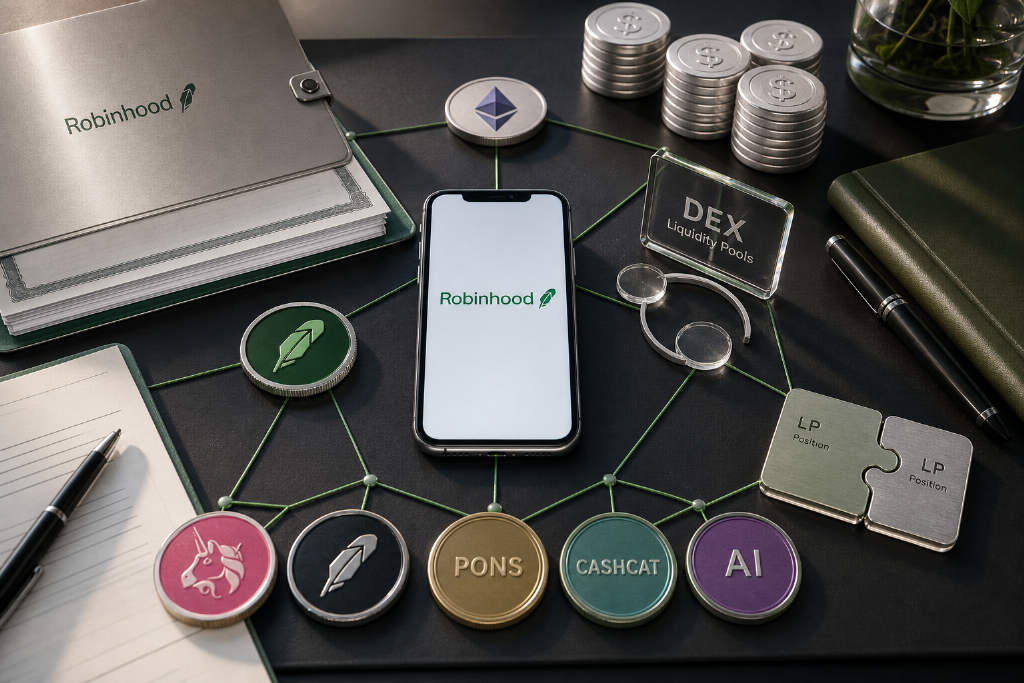
Robinhood Chain has been live for two months and has already crossed $1 billion in total value locked, with daily DEX volume nearing $1 billion and stablecoin supply approaching $770 million. For a Layer 2 built by a listed brokerage, that is a pace many independent chains fail to reach in a full year.
But investors trying to simply “buy Robinhood Chain” face an awkward fact: the network has no native gas token. Gas is paid in ETH. There is no single Robinhood Chain coin that acts as the default entry point for the ecosystem’s upside.
That leaves value capture scattered across eight different asset layers, each with its own risk and reward profile. In TechFlowPost’s framing, the question is not which token has gone up the most, but which assets actually absorb economic value created on the chain.
HOOD is the closest listed-equity proxy, but the link is indirect
Robinhood Markets’ stock, HOOD on Nasdaq, is the nearest traditional asset to the chain. The article puts the share price at about $104, market capitalization at roughly $94 billion, trailing 12-month revenue at $4.93 billion, up more than 38% year over year, and second-quarter revenue at $1.31 billion with EPS of $0.62, well above expectations.
Even so, chain activity does not flow straight into Robinhood’s income statement. The transmission path described in the piece runs from onchain volume to Robinhood Crypto revenue and then into consolidated financials. That path can work, but it is not automatic.
Robinhood Chain is a permissionless Layer 2 built on Arbitrum, and a large share of activity takes place on third-party protocols such as Uniswap and PONS. Fees generated there do not necessarily belong to Robinhood. The article says the clearest revenue channels at the moment are tokenized stock trading and Robinhood Earn, which uses Morpho to provide USDG lending with annualized yields of up to 7%.
That leaves the core HOOD thesis largely where it was before: 23 million active users multiplied by monetization per user. The chain expands the scale of that story, but it does not replace it.
ETH and ARB sit at the base layer, though not with equal economic exposure
Because Robinhood Chain uses Arbitrum Dedicated Blockchain and the Nitro stack, ARB is often pulled into the ecosystem narrative. The article argues that this connection is easier to make thematically than economically.
Under the mechanisms currently disclosed, Robinhood Chain uses ETH for gas, posts data to Ethereum, and runs a sequencer operated by Robinhood. ARB is not required as gas on the network, and the report says there is no evidence that each Robinhood Chain transaction directly drives ARB buying, burning or revenue distribution.
That makes ARB more of a technical-stack and ecosystem mapping trade than a direct value-capture asset.
ETH stands on firmer ground. It is the gas asset for Robinhood Chain and also the settlement and data-availability asset underneath it. As long as the network is operating, it creates hard usage demand for ETH.
Still, the article makes a distinction between certainty and sensitivity. Robinhood Chain’s gas consumption remains small relative to the broader Ethereum economy. ETH may be the clearest beneficiary at the base layer, but it may also be the least price-elastic asset in this round of Robinhood Chain speculation.
PONS and LONG are the ecosystem’s most direct “picks and shovels” trades
Among assets native to Robinhood Chain itself, TechFlowPost describes PONS as the cleanest “sell the shovels” play and the most direct beneficiary of speculative issuance. Pons allows anyone to launch fixed-supply tokens. Its documentation says each project in the current version issues 1 billion tokens that go directly into a Uniswap liquidity pool, with a base trading fee of 1%.
In the current factory model, 70% of the trading fee goes to the creator and 30% goes to the protocol. Of the protocol’s share, 80% is earmarked for automatic buybacks and burns of PONS, while the remaining 20% is used for infrastructure and team operations. The article says roughly 27% of supply has already been burned.
As of Aug. 30, PONS had at one point climbed above a $260 million market capitalization, rising more than 10x خلال the month from roughly $20 million. The platform has launched more than 167,000 tokens and has over 52,000 holder addresses.
LONG, operating at long.xyz, is presented as a differentiated launchpad focused on pairing meme coins with tokenized stocks. That design helped create one of Robinhood Chain’s most talked-about categories: stock-paired meme tokens.
The report also stresses the fragility of the business. Launchpad revenue is tightly tied to speculative intensity onchain. Competition is already picking up. Uniswap Labs launched rival product pools.trade on Aug. 5, and on its first day Uniswap v4 volume on Robinhood Chain exceeded Ethereum mainnet. PONS fell 49% during the week pools.trade went live before rebounding.
The conclusion there is straightforward: the launchpad war is not over, and first-mover status is not the same as a moat.
CASHCAT and AI drove the loudest wealth effect, not the clearest value capture
At the native meme layer, CASHCAT functions as a kind of cultural emblem for Robinhood Chain. The name traces back to the original name Robinhood founders Vlad Tenev and Baiju Bhatt once considered for the company, “CashCat,” a piece of real company history that a community token revived.
The article says CASHCAT surged more than 2,100% in the first week after mainnet launch, briefly reaching a $250 million market cap and still swinging in a wide band between $120 million and $250 million. Robinhood added the token to its app for trading on Aug. 6, and Tenev followed the project’s official account.
Artificial Inu, ticker AI, opened up another category: the stock-paired meme coin. It trades directly against tokenized NVDA, which means the meme token is priced against Nvidia stock exposure rather than ETH. During August, its market cap rose from $1.5 million to a peak of $135 million.
Its NVDA pool holds about $3.3 million in tokenized Nvidia, more than three times the depth of its WETH pool, according to the article.
Yet the piece does not treat these tokens as durable value-capture instruments. They are driven entirely by attention and liquidity. CASHCAT’s own website is quoted as calling the token “fan fiction with a ticker.” In that framing, these are wealth-effect assets, not assets that inherently capture the economic value of the chain.
UNI may be one of the more overlooked layers in the Robinhood Chain trade
If PONS monetizes issuance, Uniswap monetizes the flow of trading across the ecosystem. On day one, Robinhood Chain launched with Uniswap v2, v3, v4 and UniswapX already deployed, making Uniswap the network’s main public AMM venue.
Tokenized stocks, meme coins, PONS graduates and a long list of other ecosystem assets all lean on Uniswap for trading and liquidity formation. That breadth gives UNI exposure that can be easy to overlook when attention is focused on newly issued tokens.
Historically, however, higher Uniswap volume did not automatically translate into value for UNI holders. Most trading fees went to liquidity providers, while UNI served mainly as a governance token. The article says that changed from late 2025, when Uniswap established protocol-fee and UNI burn mechanisms. On Robinhood Chain, fee-extension proposals for v2 and v3 have already been executed. Part of the trading fees now goes into TokenJar, and outside participants must burn UNI to claim the accumulated assets there.
That creates a clearer path from Robinhood Chain activity to UNI than in earlier cycles: more trading volume leads to protocol fees on Uniswap, those fees enter an onchain collector, participants burn UNI to redeem the fee assets, and total UNI supply falls.
The article still adds an important limit. Not all fees earned on Uniswap belong to UNI. Liquidity providers continue to take the main share, and revenue from products such as UniswapX may not fully enter the current burn framework. Even so, compared with assets that rely only on ecosystem narrative, UNI now has a verifiable value-capture path. The tradeoff is scale: Robinhood Chain remains only one piece of Uniswap’s global business, so the marginal impact on UNI still needs to be watched.
Delta, UP and NetNet became high-beta infrastructure bets in August
At the DeFi infrastructure layer, TechFlowPost highlights Delta, UP and NetNet as projects that all recorded valuation gains of more than 10x in August. NetNet at one point rose above a $117 million market cap.
Each protocol fills a different role. Delta is a liquidity-layer protocol compared in the article to Meteora on Base. UP is a ve(3,3) emissions project likened to Aerodrome. NetNet is described as an OHM-style bond project. Together they provide the pipes for Robinhood Chain DeFi, spanning liquidity bootstrapping, token-emission incentives and protocol-level revenue design.
The risks are concentrated as well: contract security, token release schedules and whether real TVL remains once incentives fade. The article points to another date on the calendar. Robinhood Chain’s 90-day gas subsidy is due to expire in early October, a point that could test whether these protocols can hold on to users and capital without the extra support.
Tokenized stocks are scaling fast, but the legal-rights question remains
Robinhood Chain has listed more than 200 tokenized U.S. stocks and ETFs across more than 120 countries. Uniswap controls about 99% of that DEX liquidity, with v4 accounting for around 73% and v3 around 26%. Aggregate tokenized-stock trading volume has already topped $1 billion, and the one-day peak reached $130 million.
PAIR, at pair.fund, is the latest entrant mentioned in the report. It lets a new token launch into liquidity pools paired with as many as five stock tokens at once, so pricing can begin from block one against Apple, Tesla or the S&P 500.
But the article says the central issue with tokenized stocks has never been just volume. It is the structure of legal rights. An onchain NVDA token is not NVDA stock itself. Holders do not receive voting rights or dividend rights. What they own is an instrument representing economic exposure, and its pricing ultimately depends on Robinhood’s credit as issuer and its redemption promise.
When a meme coin such as AI reaches a market capitalization more than 10 times larger than the onchain supply of the NVDA token backing its pair, the resulting liquidity imbalance can itself become a systemic risk, the article argues.
Liquidity positions may be the closest thing to cash-flow exposure on the chain
One category the report says investors often ignore is Uniswap liquidity positions. Whether the pool is ETH/PONS, NVDA/AI or stock-token pairs against stablecoins, liquidity providers earn fees from every trade that passes through.
That creates an exposure closer to cash flow than simply holding a meme token and waiting for price appreciation. But high APR does not erase the downside.
The article lists the familiar pressure points. Market makers can suffer impermanent loss when the two assets in a pair move sharply apart. Concentrated liquidity can turn into a one-sided position once price leaves the active range. If one side of the pair falls to zero, accumulated fees are often nowhere near enough to offset the principal loss.
For that reason, the investment case for a pool cannot be reduced to APR alone. The article says investors also need to judge whether volume is sustainable, whether fees come from real users, and whether the paired assets themselves are credible.
Two types of Robinhood Chain assets are emerging at once
TechFlowPost’s final distinction is between two very different kinds of opportunity appearing on Robinhood Chain at the same time.
- One group consists of high-elasticity assets powered by attention and new money, including PONS, CASHCAT and AI.
- The other consists of infrastructure assets that charge on activity, including HOOD, UNI and liquidity positions.
The first group is better at producing rapid upside stories. The second group is more likely to survive an entire cycle.
To judge whether the Robinhood Chain wealth effect can last, the article says three shifts matter most. Trading needs to broaden from meme coins into tokenized stocks, lending and yield products. Real fees earned by PONS, UNI and Robinhood need to keep growing and flow through to their related assets. And new users need to keep capital onchain after the first speculative wave ends.
If all three happen at once, Robinhood Chain would start to look less like a new-chain speculation trade and more like a financial ecosystem capable of producing assets and cash flow on a sustained basis.
