
Robinhood’s real edge, according to Prathik Desai, is its ability to turn a single customer relationship into a compounding revenue node that diversifies itself over time.
Author: Prathik Desai
Translated by: Block unicorn
A few weeks ago, Desai described Robinhood as a financial supermarket because it aimed to meet a wide range of financial needs for Americans inside one platform. In that earlier piece, “Building the Financial Supermarket,” he argued that as long as Robinhood could connect its dozen-plus business lines and cross-sell products to more than 28 million registered users, its newly launched chain would not need to be profitable on its own.
He still thinks the direction of that argument was right. What changed after Robinhood’s second-quarter earnings call was the scale of the opportunity.
The supermarket comparison, he now says, may actually understate Robinhood’s potential. A supermarket grows by getting more people through the door. Robinhood’s Q2 results suggested something else: the company is expanding because users who first came to the app for product A are buying more of product A, buying it more often, and gradually picking up interest in products B, C and D on the same platform.
That is why the company has been able to grow quickly without relying on a large increase in first-time users.
Desai’s article lays out the mechanics behind that model, why each customer can become a denser revenue node over time, and why two of Robinhood’s least profitable efforts this year — its chain and its social feed — may end up being among its most important products.
How Robinhood says it should be measured
Robinhood has been public for only five years, and its app has existed for just 11, yet annualized revenue has already moved past $5 billion. Desai contrasts that with Charles Schwab, which was founded in 1971 and took close to 30 years to reach $5 billion in annual revenue.
One major force behind Robinhood’s revenue growth is scale. The company has 30 million funded accounts, and its product lineup runs from crypto trading to Gold and retirement accounts, reaching users across age groups. Most companies would lean on those figures as proof of broad reach. Robinhood, Desai notes, does not want investors to stop there.
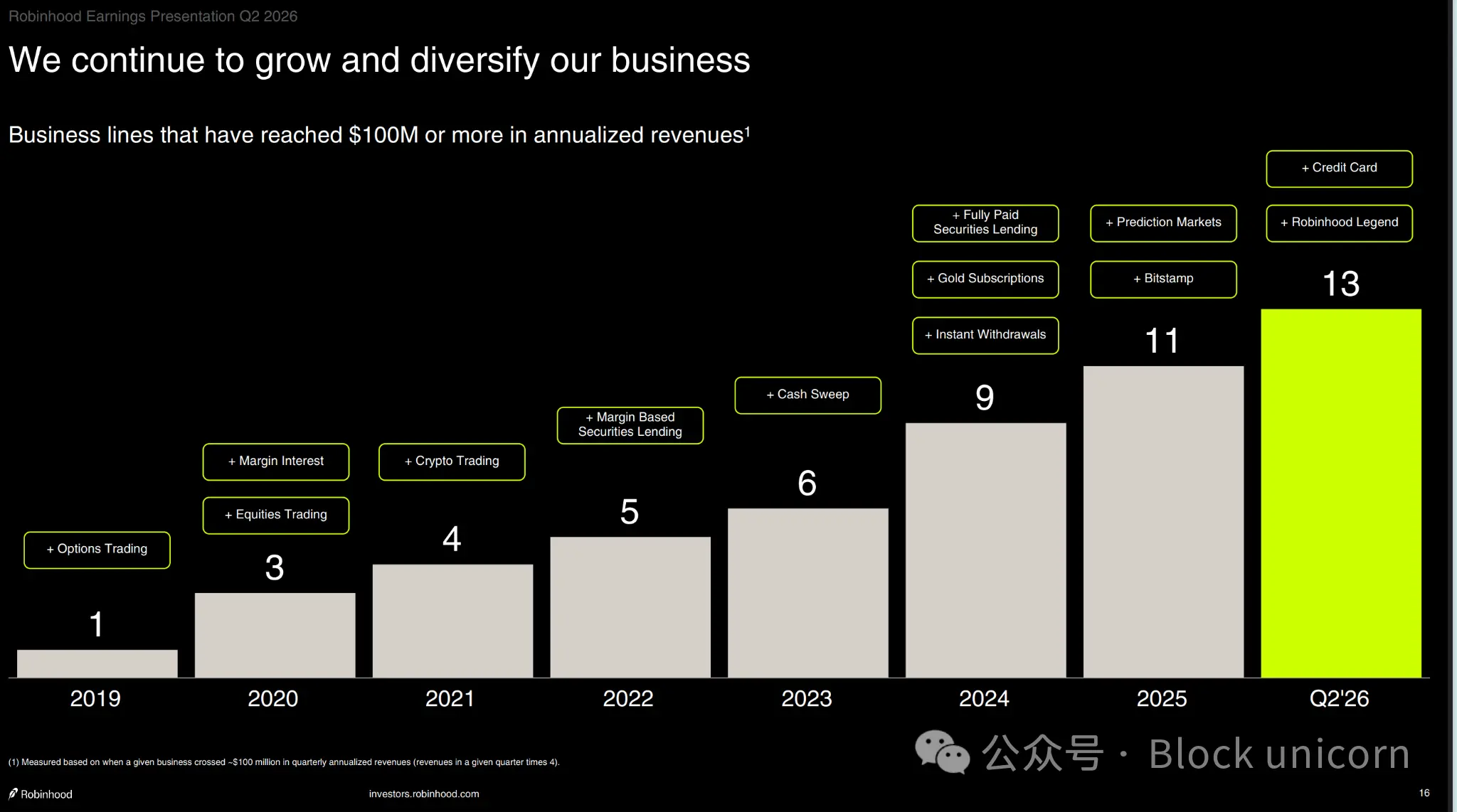
Early in the earnings call, chief financial officer Shiv Verma said investors should judge the company on three metrics: net deposits, the Rule of 40, and the number of business lines generating at least $100 million in annual recurring revenue.
In the second quarter of 2026, desktop trading and analytics platform Legend and the credit card business became the latest additions to that $100 million ARR club. Robinhood now has 13 business lines in it.
Still, Desai sets those headline measures aside for a closer read of the operating data.
Revenue per customer is growing much faster than the customer base
By the end of Q2 2026, Robinhood’s paid users had increased 7% year over year, rising from 26.5 million to 28.4 million. Over the same period, average revenue per user, or ARPU, climbed 24%, from $151 to $187.
That means revenue per customer is growing more than three times as fast as the number of customers.
Trading activity points in the same direction. Stock notional volume per trader rose 56% year over year, while options contract volume per trader increased 43%. Yet the number of customers trading stocks was up only 13%, and the number trading options increased just 3%.
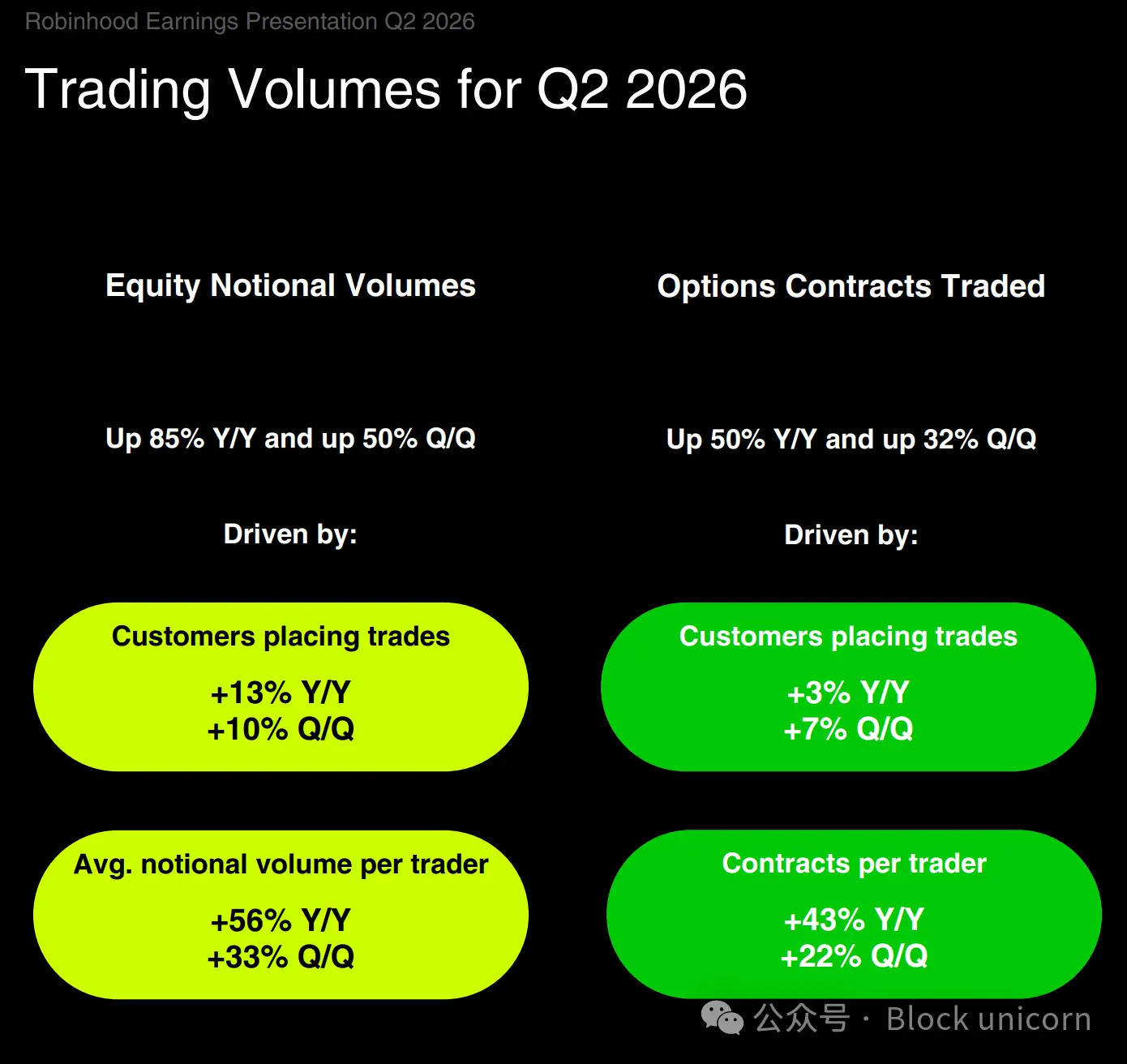
For Desai, that pattern says Robinhood is not primarily adding fresh cohorts at this stage. Existing users are trading more often, using more products and keeping more capital inside the platform.
He also points to the event contracts business, which did not exist 15 months ago and now generates $156 million in revenue, up 50% quarter over quarter. That growth, too, came without the need to acquire an entirely new user base.
Back in May, Desai wrote that Robinhood’s ability to package stocks, options, perpetuals and event contracts together allowed it to offer a better information-pricing platform than its rivals. The implication is that ARPU, in his view, is the cleanest way to judge how much each order inside this financial supermarket is worth over time.
Gold is a key engine inside the system
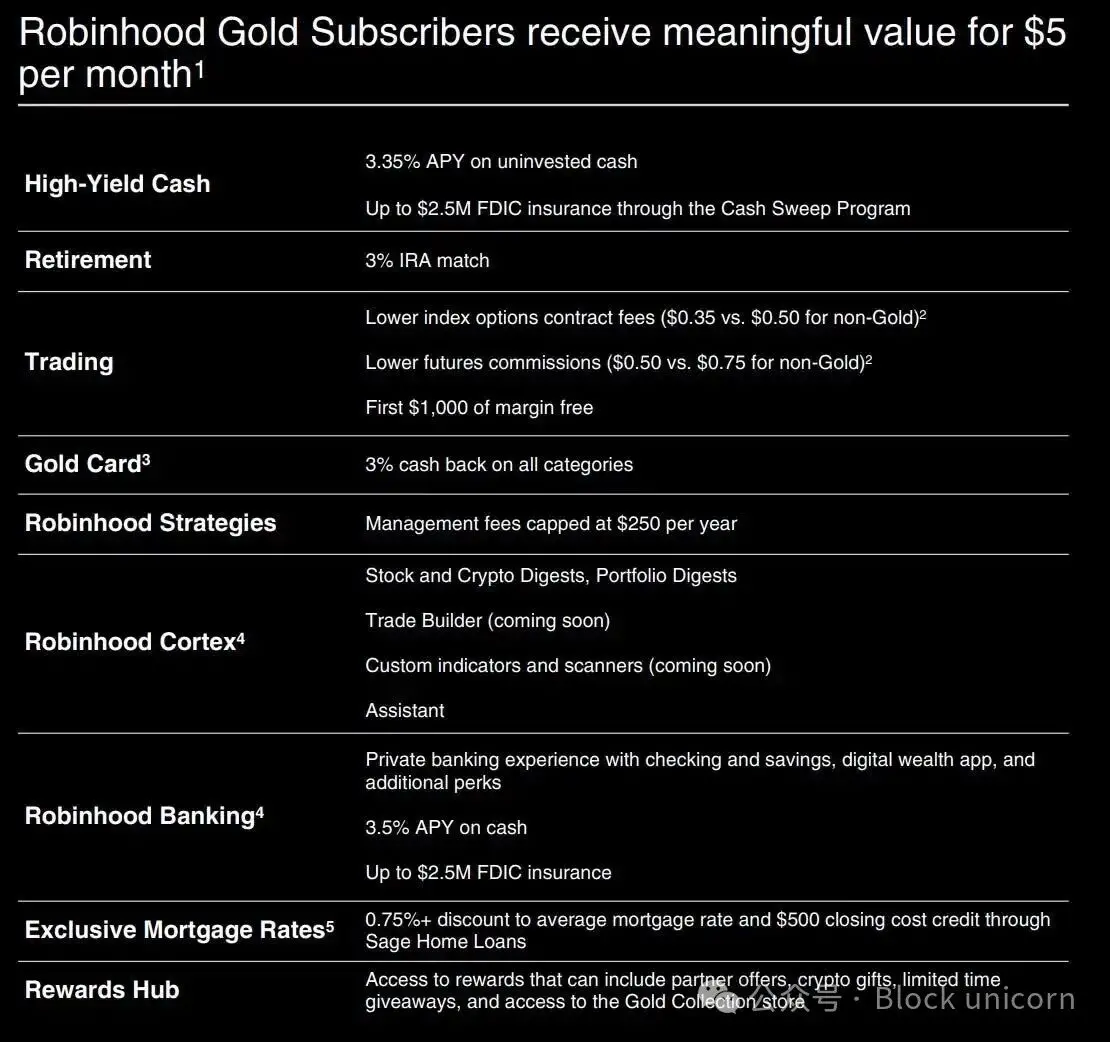
Robinhood now has more than a dozen business lines, but Desai argues that one of the most important growth engines is still the Gold subscription. Over the past two years, Gold penetration among paid users has nearly doubled, moving from 8.2% to 17%.
In Q2 2026, Gold subscription revenue on an annualized basis reached $216 million, or roughly 4% of total revenue. Desai argues that the benefit of a Gold member goes well beyond the subscription fee itself. Compared with regular customers, Gold members hold about 4.2 times the custodial assets and buy retirement products at about 3.1 times the rate.
On the earnings call, Verma said 40% to 50% of new customers sign up for Gold no matter which product first brought them into Robinhood.
That is the company’s cross-sell moat in action. Users may arrive for commission-free stock trading, a World Cup prediction market, or a 3% cashback credit card, yet roughly half of them end up upgrading to Gold. Once they pay $5 a month, they join a 4.8 million-member base and gain access to lower-cost options contracts, a 3% employer IRA match, a 3.5% annual yield on bank deposits, credit card features and other benefits.
Desai says that cross-adoption can be measured. Verma noted that prediction market users are more likely to open retirement accounts on Robinhood as well. In practice, that means a user betting on football through Robinhood’s prediction markets may also be using a Robinhood retirement account to grow an individual retirement account, or IRA.
His conclusion is blunt: Robinhood’s financial supermarket does not divide customers into “gamblers” and “serious investors.” It sells products to the same customer, and each additional product increases the odds that the customer will use more of the platform.
Chain and Social as the next two catalysts
Even with that distribution moat already in place, Desai thinks Robinhood’s most interesting move is still ahead.
In his earlier article, he argued that Robinhood Chain was barely profitable and did not need to be. It functioned as a connective layer meant to increase engagement across the rest of the business. After the Q2 call, he adjusted that view slightly. Robinhood Chain and the upcoming Robinhood Social now look to him like two catalysts that run horizontally across the product suite and strengthen cross-selling across more than ten business lines.
He sketches a simple chain of actions. A customer buys tokenized stock. That token becomes collateral in a lending market. The loan finances a perpetual futures position. One dollar can then work across three products in a single flow without the user leaving the app.
In the older, fragmented brokerage environment, those three actions would have taken place on three separate platforms. Each would come with its own onboarding friction, and the customer would have to make the decision again each time. Composability removes that friction.
That is why Desai sees the chain as infrastructure with cross-selling built into it, allowing customers to buy across products with minimal or even zero friction.
Robinhood chief executive Vlad Tenev said the company plans to open its social feed to all users by the end of the third quarter. Tenev expects that internal feed to make trade ideas more credible by tying them to verifiable portfolios on Robinhood’s trading platform.
At the moment, trade ideas usually come from scattered outside channels. Traders may hear a possible setup on Twitter, from a podcast, or through friends. They form an intention there and then return to Robinhood to place the trade. Robinhood Social is meant to keep that loop inside the company’s own platform.
Desai says that may be the most underappreciated part of the social feed. For a platform with 30 million funded users, trust built on verifiable in-app portfolios is not easily matched by screenshots or podcast commentary from elsewhere. Once the feed is broadly available, the final external dependency in Robinhood’s trade-intent conversion funnel would also be internalized.
For that reason, he does not view Chain and Social as stand-alone business lines. He sees them as catalysts that can lift every other business. A community of 30 million users discussing event contracts, retirement accounts and the latest stock tokens could, in his telling, spark more demand than any user acquisition campaign.
A loyalty playbook compared with Costco
Desai compares Robinhood’s value-capture strategy with Costco. Much of Costco’s profit comes from membership fees, while shelf goods are priced close to cost to bring members into the store. Profit is not concentrated in that neutral layer itself, yet the layer creates adjacent spaces where value accumulates.
Robinhood Chain and Social, in his framing, play a similar role. They act as neutral layers that give investors and traders more reasons to subscribe to Robinhood Gold and purchase several products across the company’s financial supermarket.
One of the biggest long-running questions around Robinhood has been cyclicality. While stock and options volumes both hit record highs in the second quarter, crypto trading volumes have fallen for three straight quarters. Even on Robinhood Chain, more than 80% of volume is still tied to memecoin speculation.
Skeptics may see that as a flaw in the story. Desai does not.
His case is that Robinhood’s growing set of $100 million ARR businesses has made the consolidated company less exposed to market cycles than any single line would be on its own. Trading volumes can fall while interest-earning assets do not. He points to margin balances, which were up 127% year over year to $21.6 billion.
Prediction markets also look different on a platform like Robinhood. Rothera, Robinhood’s joint venture with Susquehanna International Group, holds a prediction-market trading license regulated by the US Commodity Futures Trading Commission, or CFTC, allowing the company to create its own event contracts. That gives Robinhood room to reduce its reliance on seasonal categories such as sports and elections and offer year-round event contracts tied to macroeconomic releases and S&P 500-related announcements.
Gold subscription revenue, meanwhile, is fixed monthly revenue and does not depend on market performance in any given month. Desai argues that Robinhood has spent five years combining businesses whose revenue peaks arrive at different times, leaving the company as a whole less cyclical than any one of those businesses on its own.
Why the argument ends with ARPU
That shows up in ARPU. The 24% increase reflects the fact that the average customer is now connected to more businesses. A customer tied to five unrelated sources of revenue is more stable, Desai argues, than one tied to a single volatile source.
The more products each user touches, the steadier Robinhood’s own revenue curve becomes. A weak period in one line can be offset by a strong period in another, and both may come from the same account.
Desai closes by contrasting Robinhood with Coinbase and traditional brokers. Coinbase reallocates crypto capital that already exists across consumers and institutions, he writes. Traditional brokerages hold assets but do not create the same level of user interaction. Robinhood’s distinct advantage is that it can convert one customer relationship into a compounding, self-diversifying revenue node spanning both traditional finance and crypto, with the two connected and amplified through its native blockchain.