

Robinhood is framed as a model for how enterprises come onchain
TechFlowPost published an article by Ethereum community member @ryanberckmans arguing that, as token-centered narratives fade, real-world businesses moving onchain are likely to favor the Ethereum L1+L2 model. In the piece, Robinhood is presented as one of the clearest examples.
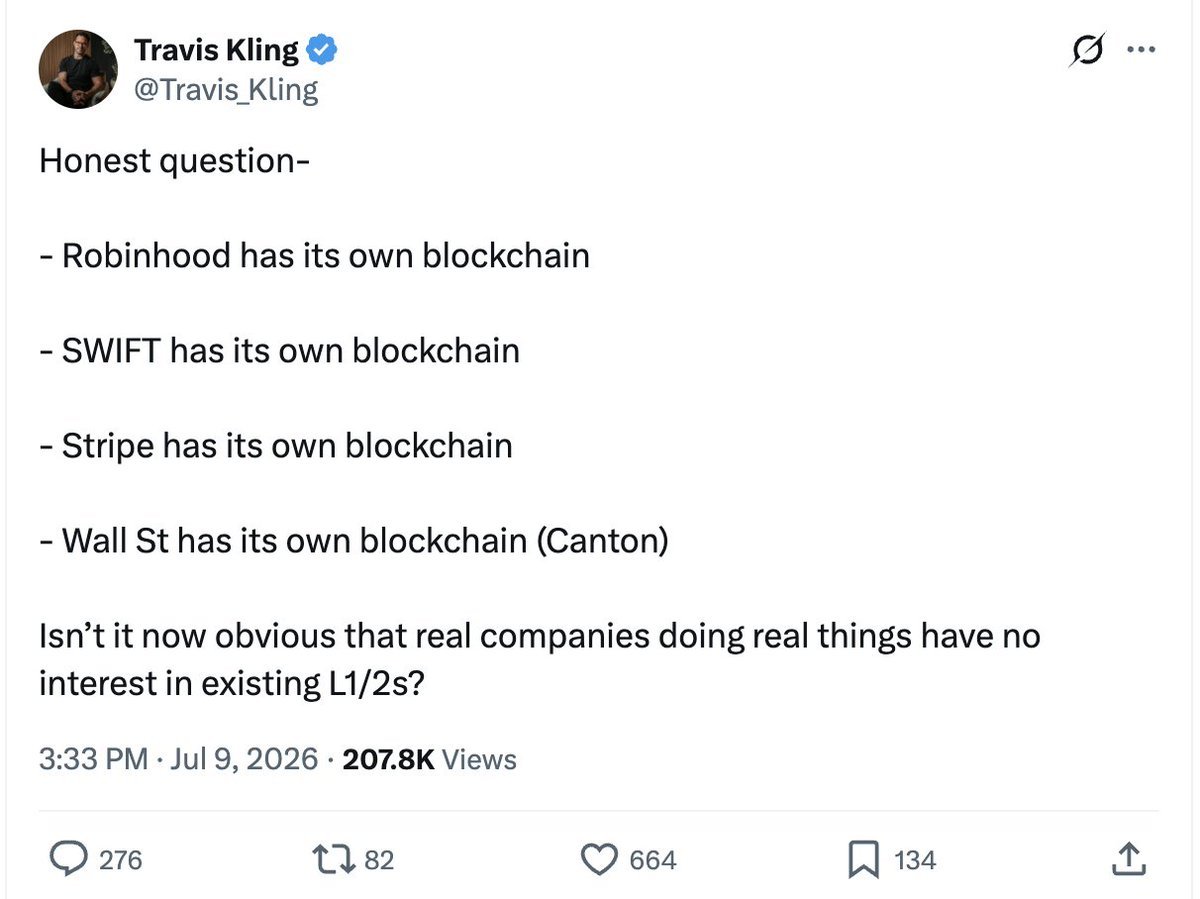
The article responds to a point raised this week by Travis Kling, who asked whether there is now an obvious conclusion that companies focused on running real businesses have little interest in the current set of L1s and L2s. Robinhood was his first example. Berckmans takes the opposite view: when an enterprise makes decisions on commercial grounds, Ethereum L1+L2 is often where it lands.
According to the article, Robinhood chose Ethereum as the base L1 and then used Arbitrum technology to build its own Ethereum layer-2 network, Robinhood Chain. The chain uses Ethereum blobs for data availability, ETH as the native gas token, and a standard bridge secured by Ethereum.
Berckmans writes that this does not weaken the case for Ethereum’s L1+L2 design. In his view, it shows the model working as intended.
Two different incentives: selling tokens versus running cash-flow businesses
The article’s main argument is that different market participants optimize for very different outcomes. Much of early crypto infrastructure building and stack selection was tied to token issuance. The emerging onchain real-world economy, by contrast, is described as one that will increasingly treat Ethereum L1+L2 as the standard base for cash-flow businesses.
Berckmans defines “real businesses serving real users” as companies that follow a conventional operating model: build products people want, generate cash flow by providing services, and increase the value of the equity tied to those cash flows. In that framing, “real users” are users whose demand comes from ordinary economic activity rather than speculation created by a new token launch. He also notes that crypto-native users still count as real users.
The article says the distinction is not moral. It is economic. What matters is the operator’s objective function.
Berckmans breaks token value into three categories: claims on future cash flow, utility value tied to access or control of a valuable system, and monetary premium, meaning a market belief that the asset will continue to be accepted and held over time. He says monetary premium is real but difficult to sustain, requiring strong network effects across confidence, liquidity, adoption, integrations, and actual use. The article names gold, the U.S. dollar, Bitcoin, and Ethereum as assets that have built different forms of monetary premium.
Looking back, he argues that most participants in programmable crypto markets were not conventional businesses built around stable cash flow. Their model, in many cases, was to sell tokens whose value depended on utility expectations, speculative monetary premium, or distant cash-flow narratives. Some projects did this directly by launching a protocol and issuing a native token. Others did it more indirectly by receiving token-denominated ecosystem support and selling those assets. Some did plan to generate revenue in the future, but the article says token valuations were often detached from reasonable cash-flow expectations.
Berckmans points to centralized exchanges and some stablecoin issuers as notable exceptions. Exchanges are described as straightforward cash-flow businesses and therefore naturally multichain. Some stablecoin issuers, he writes, also fit the profile of real cash-flow enterprises, first serving crypto users and then expanding outward into the broader economy. Those exceptions, in his view, support the broader point: businesses that aim to earn money pick infrastructure to maximize business outcomes, not to lift a token price.
Business goals shape technical architecture
The article says an operator’s objective function determines its technical route. If the core mission is to run a cash-flow business, blockchain is infrastructure. A company chooses a chain to reduce risk, improve the product, reach users, and protect margins.
If the main objective is token monetization, the choice becomes much more flexible. Berckmans says projects may build wherever they can secure ecosystem funding, copy a successful design from one chain to another to create a token valuation comparison, or package a new L1, L2, appchain, gas token, governance system, or niche stack as a selling point as long as it helps market a new asset.
He is not arguing against technical variety. The article says crypto will continue to produce new apps, protocols, L2s, and specialized execution environments. What distorted the sector, he argues, was the tendency to wrap every new idea in a separate sovereign ecosystem with its own L1, security budget, liquidity program, and native asset even when underlying demand was not proven.
As the industry shifts toward cash-flow businesses, Berckmans expects experimentation to continue but increasingly on shared foundations. Enterprises, he writes, will differentiate at the application layer and on L2, while Ethereum L1 handles settlement, security, liquidity, and store-of-value functions. The result, in his description, is a barbell structure: wide variety at the edges, concentration at the base.
Regulatory change and institutional entry are presented as the turning point
The article says the future of crypto will look different from its past because the participant base is changing. It points to the previous U.S. administration as having suppressed onchain industry development, and says the direction has now shifted. It cites the GENIUS Act as establishing a federal framework for payment stablecoins and says the European Union’s MiCA regime is now fully in effect.
In that setting, the article says brokers, payment companies, banks, asset managers, and governments around the world are building stablecoin, tokenization, and broader onchain strategies. Berckmans adds that this does not mean every regulatory issue has been resolved. It does mean large institutions can finally plan onchain businesses over a longer horizon.
He describes the market as being at the start of the mass-adoption S-curve. Over time, he says, crypto and traditional finance will stop existing as separate systems. Assets, money, trading, finance, identity, and trust will be carried by both onchain and offchain systems. He also argues that the term “Web3” will eventually fade, much as “Web2” did, leaving everything folded back into the broader internet.
From there, the article expects the share of crypto activity tied to enterprises serving real-economy users to rise sharply. That applies not only to the number of companies but also to capital, users, assets, and institutional influence. These businesses, he writes, are not crypto projects searching for a token story. They are companies using blockchains to improve existing operations or create new cash-flow lines.
How enterprises buy blockchain infrastructure
Berckmans argues that real businesses have a low tolerance for infrastructure trial-and-error. They do not want to take on extra burdens around consensus, bridges, validator systems, gas assets, governance tokens, and liquidity operations unless those parts create clear user value. If not, they are liabilities.
In that sense, the article says, blockchain should serve the business, not the other way around.
Some models still fit multichain deployment. The piece names exchanges, wallets, stablecoin issuers, and asset issuance platforms as cases where broad user reach matters. Even then, Berckmans says companies usually pick a core chain for liquidity, asset issuance, settlement, business data, and deep ecosystem integration.
He groups enterprise choices into three buckets: use Ethereum L1 when the business needs the strongest decentralization, credible neutrality, lowest risk, and deep liquidity; build a custom Ethereum L2 when operational control, customization, compliance, predictable costs, low latency, and high throughput matter; or deploy on a mature shared L2 when scale does not justify a dedicated chain. The article names Base, Arbitrum One, and Robinhood Chain as Ethereum L2 platforms that can serve as common development venues.
That does not mean a core chain is a closed system. Cross-chain assets, product distribution across networks, and external connectivity are already standard features of onchain businesses. But the “home chain” still matters, because it sets the security base, canonical data state, liquidity flows, operating model, and long-term dependency structure.
Why the article favors Ethereum L1+L2 over a standalone L1
Berckmans says Ethereum fits enterprise demand because it separates two needs. L1 acts as a highly decentralized, credibly neutral, liquid global settlement hub. L2s create a market of execution environments with speed, lower costs, customization, and operator control.
The article says that split matters not only technically but institutionally. The base layer can stay stable and neutral while upper layers adapt to different operators, legal jurisdictions, products, and users. In this view, L2s scale Ethereum in a governance sense as well as a technical one, letting institutions run systems under their own rules without asking a global base chain to change for them.
The article does acknowledge that a standalone L1 can also provide autonomy and performance. In some cases, full control over consensus and data availability may matter. But Berckmans argues that sovereignty is expensive. A new L1 has to build and maintain its own security budget, validator set, bridge assumptions, liquidity base, developer tooling, ecosystem relationships, and institutional credibility.
That creates a new island of security and liquidity and raises the friction of interoperability with Ethereum L1 and its broader L2 economy. The article says that only makes sense when an independent consensus system itself creates major business value. For most enterprises, Berckmans writes, the upside does not outweigh the full cost.
A customized Ethereum L2, by contrast, captures most of the advantages of a standalone L1: high TPS, control over execution logic, upgrade autonomy, custom fee design, transaction ordering, latency management, access rules, and product-specific features. At the same time, it gets what a new L1 cannot easily build quickly: settlement and data availability anchored to Ethereum, a standard native bridge, access to Ethereum’s existing assets and capital, and lower-trust interoperability based on the same underlying system.
He adds that L2 design details still matter. Admin permissions, upgrade keys, proof systems, and withdrawal guarantees determine how much of the base-layer security users actually inherit. Even so, the article says a business-focused operator does not need to run and secure an entire base L1 on its own when Ethereum can supply the settlement foundation.
Berckmans describes an Ethereum L2 as both an independent blockchain and part of the Ethereum economy. Operators can define the execution environment while reusing Ethereum for settlement, blob-based data storage, and interoperability. Most will integrate ETH deeply and use it as gas, while the standard native bridge allows L1 assets to enter the L2 economy with lower trust assumptions. Each additional L2, he argues, expands Ethereum’s network effects through differentiated product tracks.
Robinhood and Base are used to make the same commercial case
In the article, Robinhood’s path is presented as especially instructive. The company first launched tokenized stock products on Arbitrum One, a mature shared L2. Once the model was validated and its own needs became clearer, it launched a dedicated chain built on Arbitrum technology.
Berckmans says this could become a common pattern across the industry: validate products on shared infrastructure first, then move to a dedicated L2 once scale, product needs, and the profit model justify it.
The article says Robinhood Chain is built for financial services. Using Arbitrum technology, it delivers 100-millisecond latency, predictable transaction pricing, and high throughput, while fitting Robinhood’s requirements for performance, security, and regulatory compliance. At the same time, it remains an Ethereum L2 at its core: data is published through Ethereum blobs, gas is paid in ETH, and its bridge to Ethereum does not rely on third-party validator nodes.
For Berckmans, that is the template for how a real business should build onchain. Robinhood does not need to invent a gas token and persuade the market that the asset will gain a durable monetary premium. As a listed company, its growth comes from users, products, assets on platform, and transaction-driven cash flow. Blockchain is infrastructure.
He says using ETH as gas is a straightforward business decision. An L2 already needs ETH to pay Ethereum for base-layer services, and ETH comes with deep liquidity and native ecosystem support. Issuing a separate gas token would only add marketing burden, liquidity management, price volatility, and reputational risk without improving Robinhood’s core product.
The article pushes back on the idea that Robinhood building its own chain means it has rejected the current L1/L2 structure. Berckmans says the opposite is true. Robinhood did not want to share one execution environment with everyone else, but it did not leave Ethereum. It chose Ethereum as the parent chain for its own blockchain.
Coinbase is cited as a second example. The article notes that Base made the same architecture choice. It adds that Coinbase co-founder and CEO Brian Armstrong has publicly said he is more bullish on Bitcoin over the long term, yet Coinbase still built Base as an Ethereum L2. For Berckmans, that strengthens the argument because the choice reflects business incentives rather than chain allegiance.
What the article says this means for Ethereum and ETH
Berckmans argues that the shift in participant mix is a major long-term positive for Ethereum. In the earlier phase, competition among public chains was heavily shaped by projects eager to issue tokens, subsidize ecosystems, and rely on token valuation narratives. Going forward, he says, more competition will come from enterprises making decisions around security, user reach, operational control, market coverage, liquidity, and interoperability in support of cash-flow businesses.
That should keep demand moving toward what he calls Ethereum’s barbell structure: L1 for maximum security and liquidity, and L2s for scaling, customization, and autonomous operations. In this view, Ethereum does not win by forcing every business into one shared execution environment. It wins by becoming the common base for settlement, security, liquidity, and assets across many upper-layer environments.
The article extends the same logic to ETH. Berckmans writes that ETH’s growth path rests on building a global monetary network and deepening market consensus rather than generating business cash flow. He describes ETH as the native asset of Ethereum’s global settlement layer and says it serves across the ecosystem as collateral, liquidity, treasury reserve, and productive asset while continuing to develop as a store of value.
As more real businesses build on Ethereum, he says, more users will encounter ETH inside products and services. That broadens usage, deepens liquidity and consensus, and supports ETH’s monetary premium.
The article ends by contrasting two eras. The old crypto economy designed technical architecture around tokens meant to be sold to investors. The emerging onchain real economy, it says, chooses technical architecture around products meant to be delivered to customers. Robinhood, in that framing, is not an exception. It is a signal.