

Robinhood (HOOD) has delivered a strong share-price performance recently. The stock briefly returned above the $100 level overnight, although it failed to close firmly above that mark. The original commentary remains relatively optimistic about HOOD’s future performance, arguing that the latest rally can be explained from several angles, including fundamentals, news-driven catalysts and more visible market signals.
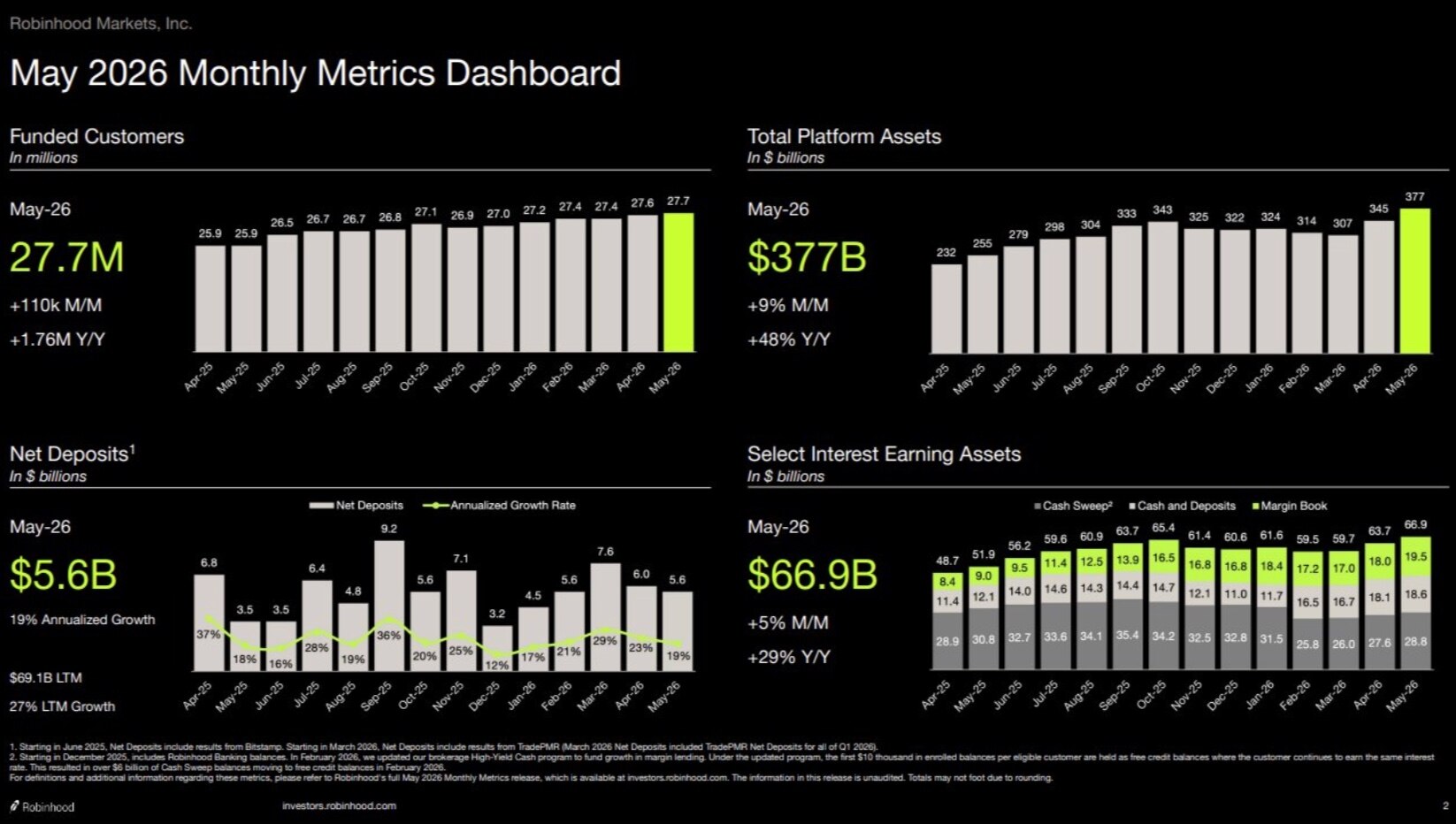
On the fundamental side, Robinhood released its May operating data last week, which provides a starting point for assessing the company’s recent business condition. The source article does not reproduce every data point in text, but it uses the disclosure as part of the broader case for why investors have been paying more attention to HOOD. The argument is not limited to crypto trading revenue; rather, it centers on the idea that Robinhood is building several revenue channels outside the crypto cycle.
Prediction markets, IPO traffic and the “Trump Account” program
One of the most important news-driven factors is Robinhood’s prediction market business. According to the article, Robinhood has begun using its self-built prediction market, Rothera, to intercept flow that would otherwise be associated with Kalshi. The source says related revenue is expected no longer to be shared with Kalshi. It also refers readers to Odaily’s previous article, “The First Prediction Market Concept Stock Has Appeared!”, for a more detailed explanation of that development.
The IPO channel is another part of the story. The source states that SpaceX’s historic IPO brought record-level traffic to Robinhood. More importantly, Robinhood Securities, the company’s brokerage and clearing business unit, was approved last week to act as an IPO underwriter. That approval changes Robinhood’s role in the IPO chain and means the platform has a chance to take on a more central position in future IPO activities, with Anthropic and OpenAI cited in the article as examples.

Robinhood has also been selected by the U.S. Treasury Department to serve as the brokerage platform and initial trustee for the “Trump Account.” The “Trump Account” is described in the source as a tax-deferred investment account program authorized by President Donald Trump on June 9, 2025, under the “Big and Beautiful” bill. The program is designed to create government-funded savings accounts for children who are U.S. citizens born between January 1, 2025 and January 1, 2029. Under this arrangement, the article says tens of millions of U.S. newborns over the next several years will use Robinhood by default as their brokerage platform. It also points to Odaily’s article “Robinhood Has Gained a New Group of Shareholders, the Oldest Is 1 Year Old and the Youngest Is -3 Years Old” for further background.
From a Q2 earnings trade to a portfolio rotation thesis
The author’s initial reason for building a HOOD position was tied to expectations for the company’s Q2 earnings. The first part of that thesis was that, during what the article calls an epic rally in U.S. equities, stock-trading-related revenue for the quarter was expected to see a major surge. The second part was the expected jump in prediction market trading volume linked to the World Cup, along with the revenue-interception effect of Rothera.

Later, however, the author moved a relatively large portion of holdings into HOOD, mainly from remaining crypto assets. The reason for that switch is the real focus of the article. In early May, a friend asked what the author had been buying recently, and HOOD was mentioned. At that time, HOOD had just fallen from above $90 after a Q1 earnings report that missed expectations, mainly because of an unexpected $100 million expense related to the “Trump Account.” Its short-term chart looked poor.

After hearing the explanation, the friend said most positions were already trapped and there was little cash left. When asked what the holdings were, the answer was mostly altcoins. The author’s response was direct: “Instead of remaining attached to altcoins, it is better to switch directly into HOOD.” That statement is the core of the article. It does not simply express bullishness on Robinhood’s stock price; it reflects a view that the relationship between Robinhood and the crypto market is changing.
HOOD’s link to crypto is no longer the same
For a long period, crypto-related revenue was an important part of Robinhood’s total revenue, and HOOD’s share-price movement had a strong correlation with cryptocurrencies. The source highlights Robinhood’s crypto-related revenue over the past five quarters and says the revenue share has generally been declining. It also notes that the Q1 share fell to its lowest level since 2025.

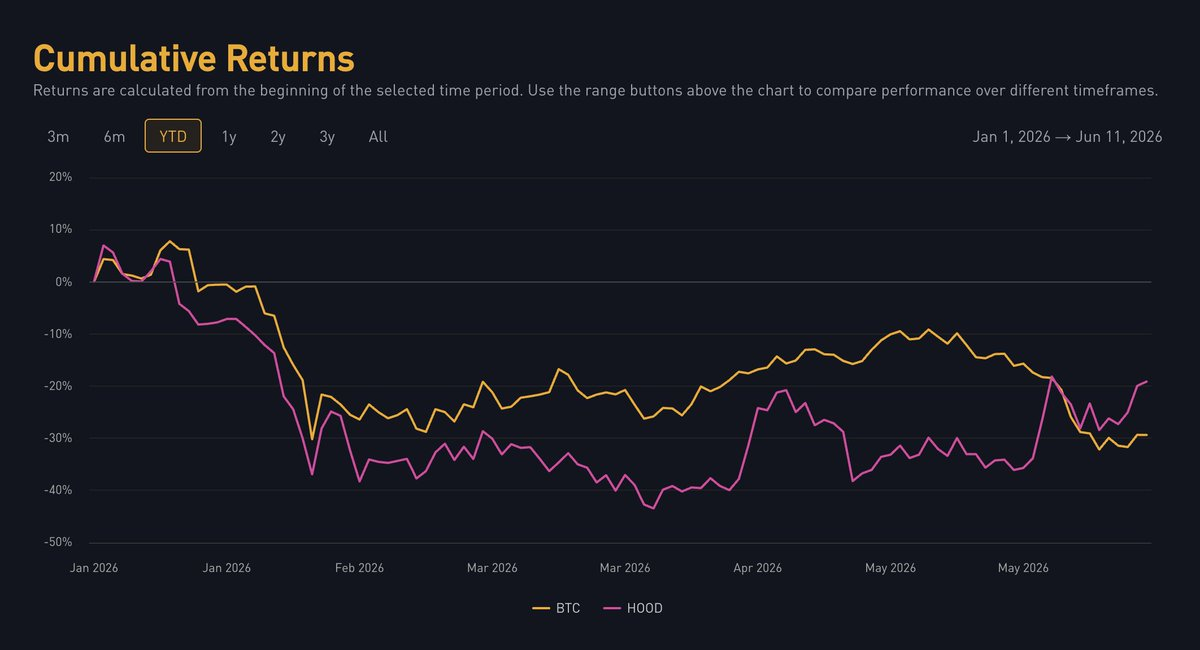
The article then compares HOOD with BTC price movement. Since the beginning of the year, HOOD had mostly moved in a similar direction to BTC, but a clear divergence has recently appeared. The point of emphasizing these two observations is to show that the valuation logic around HOOD has begun to change. In the past, HOOD was often treated as a “shadow stock” of the crypto market. Its business performance showed an obvious cyclical relationship with crypto bull and bear markets: when crypto prices surged, retail traders rushed into Robinhood to trade altcoins, fee income rose sharply and the stock price took off; when crypto cooled, retail traders left and Robinhood’s revenue declined quickly.
The current Robinhood is described as less dependent on crypto than before. Even if the crypto market remains in its current weak state, stock trading, prediction markets, Pre-IPO access and the newly added underwriting business can still support performance growth, according to the article’s reasoning. This does not mean crypto will no longer affect HOOD. On the contrary, if the crypto market returns to a bull cycle in the future, Robinhood’s crypto trading revenue would still very likely expand at the same time, allowing HOOD to benefit from the industry’s growth.
The source summarizes the idea in more direct terms: crypto can still influence HOOD, but HOOD is no longer dependent on crypto. If a crypto bull market returns, HOOD can still rise with it; if crypto remains stagnant, HOOD has other business lines to rely on. For investors who still have expectations for altcoins but are increasingly worried about drying liquidity, failed narratives and value-capture problems, the article argues that HOOD currently offers a higher margin of safety than continuing to rely on a token waiting for its next narrative cycle.