


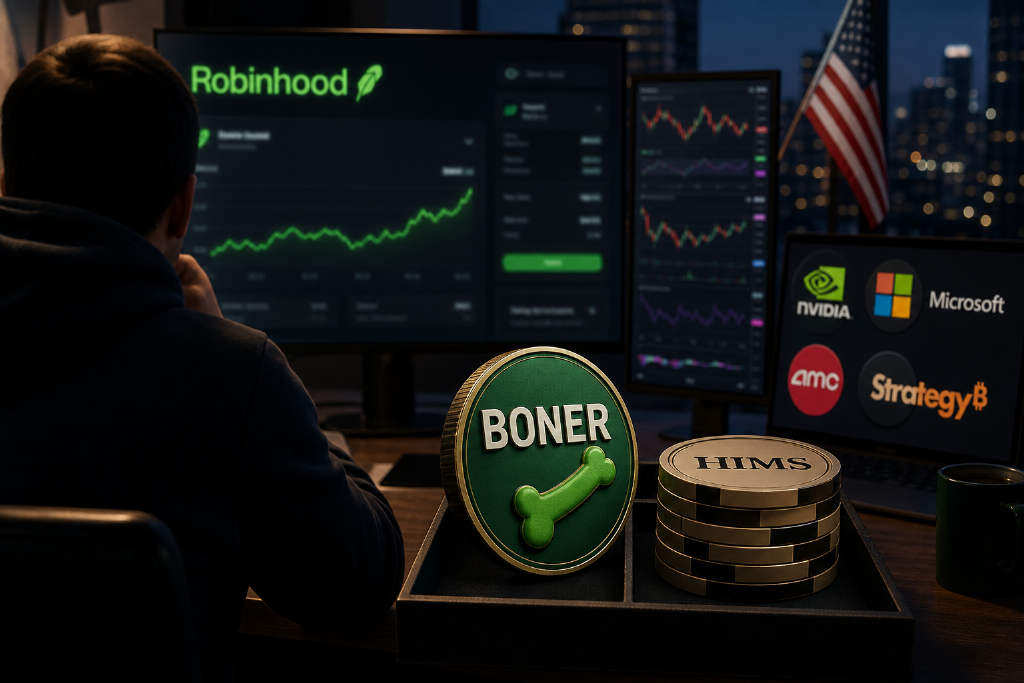
A new crypto-stock trading experiment is gaining traction on Robinhood Chain. Instead of pairing meme coins with stablecoins, traders are matching them directly against tokenized equities.
Over the weekend of August 30, a meme coin called BONER locked up more than half of the tokenized Hims & Hers Health supply on the network. The move briefly sent the wrapped version of HIMS to $132.64, more than four times the stock’s real Friday close of $28.84.
The actual HIMS shares barely moved. Traders on-chain, however, appear undeterred.
Robinhood Chain, which went live in July, is described in the report as a permissionless layer-2 network where developers can build a wide range of applications. That includes meme coins that trade directly against tokenized stocks rather than stablecoins.
Tokenized stocks are digital tokens designed to track real shares on a one-to-one basis. When traders buy a meme coin in this setup, the stock tokens used in the trade are locked into the liquidity pool, the crypto reserve that determines the market price.
How the BONER-HIMS trade moved the wrapped price
After 10 days of buying, 31,198 of the 58,714 tokenized HIMS shares in existence had been absorbed into the BONER pool alone. Robinhood permits only one licensed partner to mint or burn those tokens, so supply remained fixed at roughly one tokenized share for every 4,000 real shares.
With the New York Stock Exchange closed for the weekend and no live market price available as a reference, just a few thousand dollars in trading was enough to shift the token price sharply.
The stated goal was a short squeeze: forcing traders who had bet on a decline in HIMS to buy back at rising prices, which would push the price up even more. HIMS is a popular short target, with about a quarter of its real shares sold short on the NYSE.
But BONER’s own website concedes that the structure is too small to matter at that scale. All tokenized HIMS shares combined equal only 0.1% of the real short position.
More meme coins are being paired with Nvidia, Strategy, Microsoft, and AMC
BONER is not the only token using the model. According to the report, meme coins on Robinhood Chain have already surpassed tokenized stocks themselves in trading volume.
Artificial Inu is pegged to tokenized Nvidia stock. Saylormoon is tied to tokenized Strategy shares. Clippy XP is linked to Microsoft. The chain also hosts many other low-liquidity meme coins aimed at traders willing to take on higher risk.
The structure recalls the 2021 GameStop episode, when Reddit’s WallStreetBets forum piled into a real short squeeze that forced hedge funds to cover at major losses. That event moved actual shares on an actual exchange. The BONER trade, by contrast, moved a thinly traded IOU that reset after the market reopened and new tokens were minted.
So while these meme-stock pairs are not squeezing the target equities in the same way GameStop traders once did, they are attracting attention and liquidity to the newly launched Robinhood Chain.
Size of the leading meme-stock pair trades
The report says Artificial Inu, trading under the ticker AI, leads the trend with a $203 million market cap and $16.3 million in 24-hour volume. Its main AI/NVDA pool holds about $5.2 million in liquidity.
Saylormoon, which uses Strategy’s MSTR ticker, has a $1.75 million market cap and $2 million in daily volume, with roughly $450,000 in its primary MSTR pool.
Clippy XP, tied to tokenized Microsoft stock, stands at $1.69 million in market cap, with $641,000 in volume and about $395,000 in its main MSFT pool.
The newest entrant is MEME, paired with tokenized AMC stock. It now carries a $56 million market cap and $73.5 million in 24-hour volume, the highest among the group, with $2.6 million in its main pool. Even so, the pools still hold only a negligible portion of the underlying tokenized stock supply.
Robinhood’s CEO backs the trend, AMC’s CEO attacks it
Robinhood CEO Vlad Tenev has leaned into the phenomenon. The report says he previously said the company’s chain “works great for memes too,” even though it was built to bring real-world assets on-chain.
Criticism has come from AMC CEO Adam Aron, who posted on X yesterday to rebuke Tenev and Robinhood over tokenized AMC shares trading in the app. Aron said the practice was “contemptible, outrageous, disgusting, detestable, inexcusable, vile,” added that AMC has no connection to it, and questioned whether the arrangement is legal.
Robinhood did not appear rattled. Tenev’s response was blunt: “What’s the concern?”