
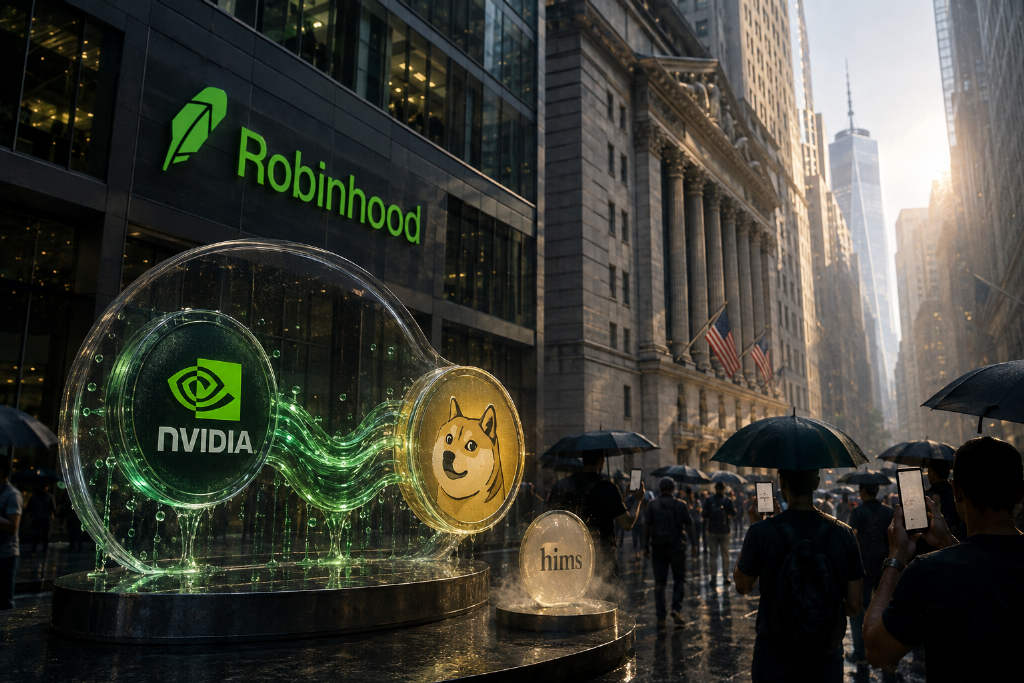
On Robinhood’s chain, the hottest trade is simple: buy NVDA first, then buy the dog
If you want the dog coin, you first buy the NVIDIA stock token. That is the format now drawing the most attention on Robinhood’s chain. Artificial Inu, a meme coin paired against tokenized NVDA, had a market value of $1.5 million on Aug. 1, reached $135 million on Aug. 30, and briefly topped $320 million in early September.
The chain’s activity has accelerated with it. About two months after launch, DeFi TVL rose from nearly zero to $700 million-$800 million. According to DefiLlama, daily DEX volume hit $1.686 billion on Sept. 3.
From CASHCAT to Pons, then to stock-linked meme pairs
Robinhood Chain went live on mainnet on July 1, built on Arbitrum Orbit, with ETH for gas and block times of about 100 milliseconds. The company’s original pitch was straightforward: build a 24/7 route for tokenized stocks and RWAs.
The first draw for retail users was not a stock token at all. It was CASHCAT, a project that borrowed the name of the original company Robinhood’s two founders used in 2010. It had no official link to Robinhood, but its market cap still climbed above $300 million. Robinhood’s CEO even posted that the chain was also “good for memes.”
That was enough to show the pattern. If the story looks rich enough, retail traders will bridge assets, set up a new wallet and provide liquidity to a contract they do not know.
Then came Pons, a token launch pipeline that bundled issuance, pricing and pool creation into a standard flow. Once the bonding curve sells out, it automatically sends the raised funds and reserved tokens into permanent Uniswap V4 lockup.
By Aug. 31, Pons had launched about 389,000 tokens and collected $46.27 million in fees. Of that, $10.23 million went to the protocol, and about $3.61 million was used to buy and burn PONS. On Aug. 30 alone, PONS traded $67.38 million and reached a market cap of $233 million.
The money was no longer just betting on a single meme. It was betting on the casino itself.
The weekend HIMS trade showed where the price really comes from
Stock-linked meme coins are the next step. Artificial Inu pairs directly with tokenized NVDA, which means every buy order creates demand for the stock token itself. SPACEHOOD is paired with SPCX and borrows Elon Musk’s name. MOO pairs with MU, leaning on a pun and the “memory supercycle” narrative. Each token has two drivers: meme enthusiasm and the underlying stock’s move. Buying one is really making two bets at once.
The Index is even more direct. It charges 3% on both sides of the trade, then uses the fees to buy a basket of stock tokens and distribute them to holders. Cumulative fees have already passed $1.7 million.
Traditional RWA products often have one problem: once bought, they rarely trade again, like stocks locked in a safe. Stock-linked memes pull them back into the market and force them to act as tradable chips. Every turnover in the dog coin adds another trade to the stock token underneath.
The recent HIMS action exposed the limit of that model. According to The Defiant, there were only 58,700 HIMS tokens onchain, equal to 0.025% of the company’s real 233 million-share float. A meme coin called BONER locked 31,200 of those tokens into its own pool, or 53% of the total.
On Sunday night, HIMS traded onchain at $132.64, while Friday’s NYSE close was $28.84. Why was there no arbitrage? Because there could not be. Under Robinhood’s design, only one authorized participant, BBVI, can mint new tokens. In the prospectus, that role is Robinhood’s own Bitstamp. Minting requires buying shares in the real market first as a hedge. With the NYSE shut for the weekend, no one could create new HIMS out of thin air.
After noon ET on Monday, BBVI minted about 4,000 tokens within an hour and added them to the market. The premium disappeared and the price fell back to around $29. Chain finance has promised 24/7 trading for a decade, but pricing power still belongs to New York’s opening bell. Those 4,000 tokens were the real market-making order, and the person placing it had to wait for Wall Street to get back to work.
If the weekend move had been a panic selloff instead of a squeeze higher, it would not just have hit the meme. The stock-token supply sitting in that pool would have been drained as well, and the replenishment would still have to wait until Monday. A constrained supply asset that pauses two days a week is being used to price something with unlimited volatility. That is not an accident; it is the design.
Big volume, but not many real people
A breakdown of all 63.5 million trades from July 16 to July 28 looks more like a treadmill than a market. Of 823,700 wallets, 61% appeared only once. Of the 10,000 to 26,000 new tokens created each day, 84% never traded again after day one. The median trade size was just $48.42.
Trading bots made up only 1.7% of wallets, but accounted for 51.3% of volume. The 9,003 wallets that traded every day for 13 days represented 1.1% of all wallets and captured 37.3% of volume.
There is another side to the same data. Holders of tokenized stocks rose 155% over 30 days, and cumulative DEX volume topped $3 billion. Next to the casino, the regular counter is also getting customers.
Capital is split in the same way. As of Aug. 31, onchain stablecoins totaled about $775 million, with Paxos’ USDG making up 57.6% and Ethena’s USDe making up 42%. Of more than $700 million in TVL, $480 million sat on Morpho, earning the roughly 7% annualized return promoted by Robinhood Earn, mainly from USDG vaults managed by Steakhouse.
The capital actually churning inside the casino is much smaller than what the $1.5 billion daily volume suggests, and the same money often turns over many times in a single day. At the same time, Robinhood’s tokenized stocks are blocked for residents of the U.S., Canada, the U.K., Switzerland and the UAE. Wall Street stocks are out of reach for Wall Street users. Half of the chain’s trading is driven by scripts.
Can stock memes become the next bull market engine?
Bulls have a case. RWA has been discussed for three years, but tokenized stocks were mostly buy-and-lock products until memes gave them real trading depth for the first time. The last Solana run also started with memes, and serious applications followed later. NVIDIA, Elon Musk and Apple are symbols almost everyone recognizes. They can pull people into crypto who have never touched a chain before, something ZK and restaking never managed to do.
Bears focus on two things. First is fuel: a bull market needs persistent net inflows from outside the system. That was the job spot Bitcoin ETFs performed in the previous cycle. Stock-linked memes, by contrast, exclude the most purchasing-powerful retail base in North America and rely on Europe, Asia-Pacific retail and existing Ethereum capital recycling among themselves. One estimate for The Index showed that a 3% fee on both sides means 5.9% disappears on a round trip, before slippage. Without fresh money, it is a negative-sum game burning its own fuel.
Second is speed: 61% of wallets show up for one day only, half of volume is bot-driven, and every weekend the system has to idle until the NYSE opens again. Regulation sits over both sides of the trade. The SEC’s three divisions previously said in a joint statement that tokenization does not change the substance of a security. The NVDA that retail users buy onchain is, in legal terms, a debt instrument issued by Robinhood’s Jersey-based special purpose vehicle, with no voting rights and no direct claim on dividends. Products like The Index, which collect fees to buy stocks and redistribute them to holders, remain hard to classify.
Both sides have arguments. The difference is how you define the engine: the match that lights the fire, or the fuel that keeps it burning. Memes have changed skins many times, from animals to celebrities, and now to stock tickers. Each version can start a fire. Whether this one spreads beyond the chain will depend on the next few months, and on whether the money comes from outside or just keeps circulating inside.
The fire is already lit. The source of the fuel is still unanswered.