
By Zen, PANews
On Sept. 8, U.S. startup Antioch closed a $32 million Series A led by Greylock. Including an $8.5 million seed round completed earlier this year, the company has now raised $40.5 million in a little over a year since it was founded.
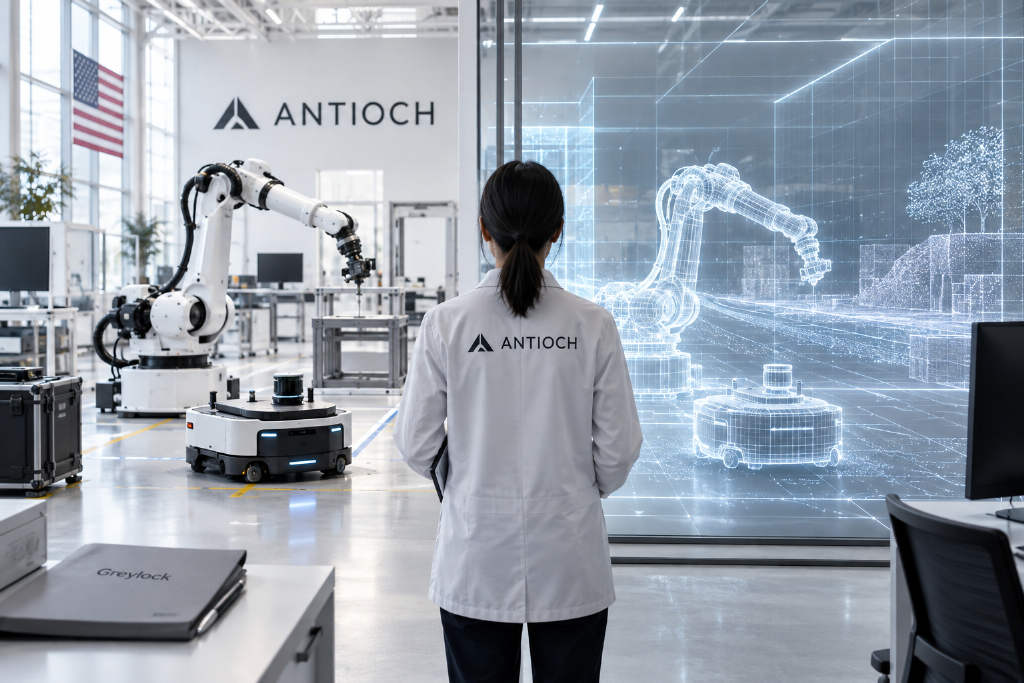
Antioch’s core approach is to bring real-world robots, sensors, software systems and operating environments into a computer-based setting, then train, test and validate machines at scale inside a digital world designed to stay as close to reality as possible. Failures and edge cases that are expensive, hard to reproduce or dangerous in the physical world can be repeated there again and again.
Antioch is not alone. As Physical AI becomes a new investment theme in the AI sector, companies working on 3D space, digital twins, physics simulation and synthetic data are drawing renewed attention from investors. What they are trying to solve is essentially the same problem: how to create a world inside a computer that is close enough to reality.
Descriptions such as “building virtual worlds” and “replicating real-world scenes” naturally recall the last metaverse cycle. The difference is that Antioch is not building a place for users wearing VR headsets to roam around. This time, the entities that need to live in virtual worlds for long periods are robots.
The virtual world did not disappear. Its residents changed.
Humans never moved into the metaverse
In August 2021, at SIGGRAPH, NVIDIA announced an expansion of the Omniverse platform. At the time, the company described Omniverse in clear terms: a platform for simulation and 3D collaboration that was “providing the foundation for the metaverse.”
The central idea was to bring 3D content that had been scattered across different software tools into one shared virtual world.
One of the key technologies underneath that effort was USD, or Universal Scene Description. Originally developed by Pixar for complex animated film production and later open-sourced, USD works like a common language for 3D worlds. It can organize what objects exist in a scene, where they are, what materials they use, how they move and how they relate to one another.
That allowed designers using tools such as Blender, artists creating textures and materials in Adobe Substance 3D, and engineers working in different software environments to connect their work to Omniverse through USD and collaborate inside the same 3D world.
NVIDIA even described that future as a “3D Internet”: today’s internet connects webpages, while a future internet could connect countless 3D spaces that people can enter and interact with in real time.
In October of the same year, Facebook changed its corporate name to Meta, pushing the metaverse into its most feverish phase.
Compared with NVIDIA, Mark Zuckerberg’s vision was broader. In that version, people would no longer use the internet through flat screens alone. They would enter digital worlds with spatial presence, where they could meet, work, shop, socialize and spend leisure time. Meta said at the time that the metaverse could reach 1 billion people over roughly the next decade and support a large digital economy.
Over the next two years, VR, AR, digital humans, virtual office tools, 3D games, digital twins and NFT-based digital asset narratives were all folded into one shared idea of a large-scale digital world.
That consumer metaverse industry still has not materialized, and many early participants have quietly exited. Meta has not abandoned VR, AR or smart glasses, but Reality Labs remains an extremely expensive long-term effort. In 2025, Reality Labs generated about $2.207 billion in revenue while posting an operating loss of $19.193 billion. Meta also expects the unit’s operating loss in 2026 to remain broadly in line with the 2025 level.
Omniverse has changed in a more revealing way. Five years ago, NVIDIA called it a foundation for the metaverse. Today, NVIDIA’s website defines it as “a set of libraries and microservices for developing Physical AI applications.”
The platform’s top-level narrative and product focus have shifted toward industrial digital twins, robot simulation and autonomous driving development. It now connects tools including Isaac Sim, Isaac Lab, Cosmos, PhysX and Warp. The platform is still there, but the main story it carries is different.
In fact, robot simulation, industrial digital twins and physics engines all predate the so-called first year of the metaverse. The last metaverse wave mainly bundled together technologies that had been relatively separate before, including 3D modeling, real-time rendering, digital twins, virtual collaboration, open 3D standards and NFTs, under one broad vision of a large-scale digital world.
After the metaverse cooled, that infrastructure did not vanish. What changed was the realization that robots may need a virtual world more than humans do.
Why robots need a virtual world
At this year’s GTC conference, NVIDIA again used a simple “robot data pyramid” to explain how humanoid robots are trained.
At the bottom is the largest layer: internet and human data, including webpages, images, videos and records of human behavior. That data is abundant. It can tell robots what the world is and what humans do, but it usually does not contain the joint angles, force, touch and control signals needed when a robot actually performs an action.
At the top sits real robot data. Letting robots grasp, carry and walk through teleoperation or autonomous operation produces data that is closest to the final task, but it is also the most expensive. A robot can only experience 24 hours in a day, and collecting that data also requires machines, facilities, operators and maintenance.
Between those two layers is simulation and synthetic data. It is less accurate than real robot data, but it can be replicated and generated in parallel at high speed on GPUs. It also goes beyond simply showing “what humans do” in internet videos, because it can directly produce the action, state and sensor data needed for robot tasks.
NVIDIA’s position is that the synthetic-data layer in the middle should keep expanding and become a major source of robot training data.
The trade-offs are straightforward:
- Internet and human data is cheap and massive in scale, but farther from real robot execution.
- Real robot data is closest to deployment and offers the highest physical fidelity, but it is expensive and slow.
- Simulation data sits in the middle. It gives up some realism, but wins on scale, cost and controllability.
That is one reason simulation is becoming one of the main areas attracting capital and large-company backing in U.S. Physical AI infrastructure.
It is not only about data volume. The defining feature of the real world is that it cannot be copied at will. If a company has 100 robots, it can run only 100 robots at the same time. A warehouse cannot be rearranged every 10 minutes, with shelves, lighting, floors and goods all reset for training. In a virtual environment, the same robot can be copied into thousands or even tens of thousands of digital instances.
A robotic arm can face 1,000 table layouts at once. Object position, mass and material can keep changing. Lighting, camera placement, ground friction and even sensor error can all be randomized by design. In robotics, this method is known as domain randomization. The point is not to make a robot memorize one perfect virtual environment, but to keep changing the environment so the model learns to complete the same task under many conditions.
Developers also need data for abnormal situations, not just normal operation. A camera suddenly failing, a slippery floor under a robot’s feet or a robot falling over are all cases that need to be addressed. The real world cannot stage accidents every day just to collect data. A virtual world can.
That is why some people argue robot development cannot rely on physical test grounds indefinitely. Real-world testing takes equipment, facilities and engineering time, and extreme failures are hard to reproduce. In simulation, one system update can be tested in parallel against thousands of conditions right away.
The biggest question the metaverse once faced was why humans needed to enter a virtual world at all. Robots now offer a different answer. For humans, a virtual world is an optional substitute for parts of real life. For robots, it can serve as a training ground before they enter reality.
The virtual world is becoming a business again
A new industry of virtual-world infrastructure is taking shape around Physical AI, and the division of labor is becoming more specialized.
In August 2026, Munich-based NavVis raised $85 million. NavVis is a spatial data company. Its core business is not robot training itself, but using mobile scanning devices to turn factories, buildings and infrastructure into high-precision 3D data. The company said that in 2025 alone, its system processed and distributed more than 1 billion square meters of real-world space.
NavVis now positions that business directly as a “data foundation” for Physical AI. If robots are going to work in real factories, computers first need an accurate understanding of what those factories look like.
South Korean startup NdotLight addresses a different layer. It is a Physical AI data company focused on 3D assets for robot simulation. In August this year, it raised KRW 15 billion, or about $10.6 million, in new funding led by Korea Development Bank, or KDB.
Ordinary 3D models only need to look realistic enough for games or animation. That is not enough for robot training. A robot also needs to know how heavy a chair is, where collisions occur, how much surface friction it has and which parts can move.
NdotLight’s TRINIX converts ordinary 3D content into what it calls SimReady assets, meaning 3D assets that can go directly into robot simulators. Beyond appearance, it adds mass, friction, joint structure and collision data, and connects with NVIDIA Omniverse and Isaac Sim. The problem it is solving is how to make virtual objects not only resemble real ones, but also behave like real ones when robots interact with them.
On Sept. 17, Iceland-based Treble raised $18 million. Treble is an acoustic simulation company. Once it builds a virtual space, it can simulate how sound propagates through rooms, buildings and other environments, then generate synthetic acoustic data.
As robots, smart glasses and other Physical AI devices rely more heavily on microphones to understand their surroundings, the company has started applying its acoustic digital twin technology to Physical AI training. The question it addresses is how robots can hear sound in a virtual world in a way that is close to reality.
Taken together, these companies are rebuilding a digital world that looks very close to what people were calling a virtual world five years ago. The difference is that the metaverse pursued immersion, while Physical AI is pursuing realism.
That leads to one of the most important concepts in robot simulation: Sim-to-Real. The issue is whether what a robot learns in a virtual world still works after it returns to the physical world.
That is why NVIDIA’s Isaac Sim emphasizes more than visual rendering. It also includes rigid-body dynamics, joints, collisions and a range of virtual sensors to narrow that gap as much as possible. Isaac Lab goes a step further by letting developers run large numbers of robot environments at the same time and train robot policies in parallel on GPUs.
The core difference between today’s robot-oriented virtual worlds and many consumer metaverse projects is simple: the value of the former has to be tested in the real world.
Humans did not end up living in the metaverse as once imagined. But the roads built for virtual worlds were not abandoned. Robots are now using them to make their way back into reality.