

Volatility in U.S. semiconductor stocks has widened sharply since July, and RockFlow says the recent selloff is less about AI demand suddenly disappearing than about a change in how the market is willing to price AI-linked assets.
In the team’s view, the past year was so strong for the AI trade that even cautious investors came to see it as more than a standard thematic run. The issue now is that markets often test the strength of a consensus with abrupt price swings just when that consensus looks strongest.
RockFlow said the industry trend behind AI has not vanished because of one drop in semiconductor shares. What has changed is the market’s willingness to pay high multiples for distant expectations alone. The stage of buying AI with little discrimination has, in its words, basically passed.
First, investors need to identify what kind of asset they actually own
During violent drawdowns, the same questions tend to come up: whether to sell, whether to buy the dip, whether Nvidia, AMD, Micron, TSMC and Broadcom are still worth holding, and whether the AI trade is over.
RockFlow argues that these questions all lead back to the same point: what category a stock belongs to. In rising markets, investors often put every AI-related company into one basket. If a company can attach itself to AI, compute or Nvidia’s supply chain, it may be rewarded with a re-rating. In falling markets, that broad grouping starts to break apart.
Some stocks are falling because valuation is compressing. Some are losing trading momentum. Others are being questioned on business logic. RockFlow says those are very different situations and should not be handled the same way. In this kind of tape, the more useful question is not always whether to sell immediately, but what exactly the original purchase was based on.
Was it a bottleneck asset in the supply chain, a follower in a leader-driven rally, a cyclical name with upside beta, or a trading vehicle supported mainly by narrative? RockFlow says investors need to answer that first. Otherwise, the next move is likely to be driven by noise rather than discipline. Holdings that deserve patience should not be shaken out by panic. Positions that need to be cut should not be defended blindly. And a mistaken short-term trade should not be repackaged as long-term conviction after the fact.
AI demand still looks firm, but stock prices trade against expectations
RockFlow says many investors are confused because the industry backdrop does not appear to have deteriorated in step with the price action. Nvidia GPUs are still in short supply. HBM orders remain full. Cloud companies are still putting money into AI infrastructure. Data center construction has not stopped.

That, the team says, can all be true while semiconductor shares still come under pressure. The hard part of growth-stock trading is that the market does not reward a company simply for being good. It asks whether the business is better than expected.
When valuations are low, strong earnings are often enough. At high valuations, with crowded positioning and aggressive assumptions already embedded in prices, good results become the minimum requirement. What keeps a stock moving higher is another upward revision, faster growth, or evidence that exceeds an already optimistic consensus.
That is why a company can post a doubling in earnings and still see the stock stall or fall. RockFlow says the market may have already priced in that growth. What investors really care about is whether the next revision is still higher, whether revenue growth can keep accelerating, whether margins can beat again, and whether orders can come in stronger than expected.
In the most crowded phase of the AI trade, good results are merely the entry ticket. To keep premium valuations, companies have to keep producing stronger proof. RockFlow sees this as one of the key reasons semiconductor stocks are under pressure now. The issue is not a collapse in demand. It is that expectations became too full, and the market is now rechecking the slope of future growth.
Higher capex has shifted from a clear tailwind to a tougher test
One of the biggest drivers of the AI hardware trade over the past year, according to RockFlow, was the steady increase in capital spending by major technology companies. Microsoft, Google, Meta and Amazon all kept raising investment in AI infrastructure, and markets naturally treated that as positive for the semiconductor chain.
The logic was straightforward. More capex from cloud companies meant more GPU purchases. More GPUs meant more HBM demand. More HBM demand then fed through to advanced packaging, advanced process nodes, semiconductor equipment, optical modules, power systems, cooling and data center infrastructure. That chain of reasoning held together well for a long stretch and helped lift valuations across the AI hardware ecosystem.
RockFlow says the market is now in a more demanding phase. Capex upgrades once acted like a stimulant. Now they look more like an exam. Investors are asking whether Copilot subscription revenue can cover the depreciation and operating costs of Microsoft’s AI infrastructure, whether Meta’s spending on AI recommendation systems and generative AI can turn into higher advertising ROI, whether Google’s AI search products and Gemini can defend search ads while creating new revenue, and whether AWS’s AI services can generate enough incremental cloud revenue.
There is another concern behind those questions. If AI application revenue takes longer to materialize than infrastructure expansion, free cash flow could come under pressure. RockFlow says that creates a delicate setup. If cloud companies keep increasing AI capex aggressively, semiconductor suppliers benefit in the short term, but investors may worry that the payback period is too long and that spending has been pulled too far forward. If cloud companies slow capex, the supply chain may start worrying that orders are nearing a peak and that growth expectations need to come down.
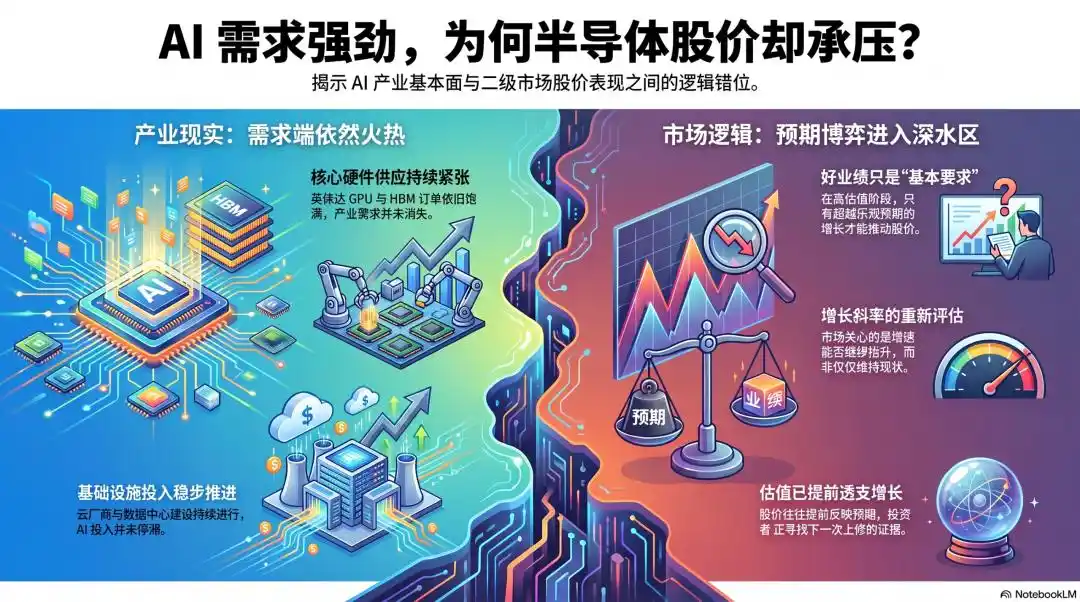
That is why capex can no longer be read as a one-way positive. The market now wants to know whether those investments can be converted into high-quality revenue. RockFlow frames it with the classic shovel analogy: the story for those selling shovels can only last if the gold miners are actually making money. If the miners keep spending without showing a sufficiently clear return, the valuations of the shovel sellers will also come under review.
Earnings season is a validation phase, but strong numbers may not be enough
RockFlow says many investors are looking to earnings as the trigger for a rebound in semiconductor stocks. The team argues the situation is more complicated in a crowded AI trade where expectations are already elevated.
In this setting, a solid report may not be sufficient because the market is focused on the gap between results and prior assumptions. Cloud company earnings matter especially because they are the largest buyers of AI compute.
Their capex guidance affects order expectations across the supply chain. Their explanation of AI monetization shapes confidence in returns on AI investment. Their free cash flow profile also influences how investors judge the durability of the current AI infrastructure expansion.
If cloud companies continue to spend heavily on AI but cannot clearly explain the business return, the market may worry that too much future demand has already been pulled forward through capex. If they begin to slow spending, chip suppliers then face concerns that order growth is peaking. RockFlow says that tension sits at the center of the AI trade right now.
RockFlow splits AI semiconductor holdings into four groups
For investors trying to respond to the selloff, RockFlow says blanket calls to run or to buy aggressively are the least useful kind of advice. Different semiconductor assets require different handling. The team groups AI-related semiconductor holdings into four buckets.
Toll-taking assets
TSMC is the main example. RockFlow describes companies in this category as toll booths in the supply chain. Whether the chip is an Nvidia GPU, an AMD GPU, a Broadcom ASIC, a Google TPU, an Amazon Trainium product or a future custom AI accelerator, advanced process technology and advanced packaging remain hard to separate from core manufacturing capabilities such as TSMC’s.
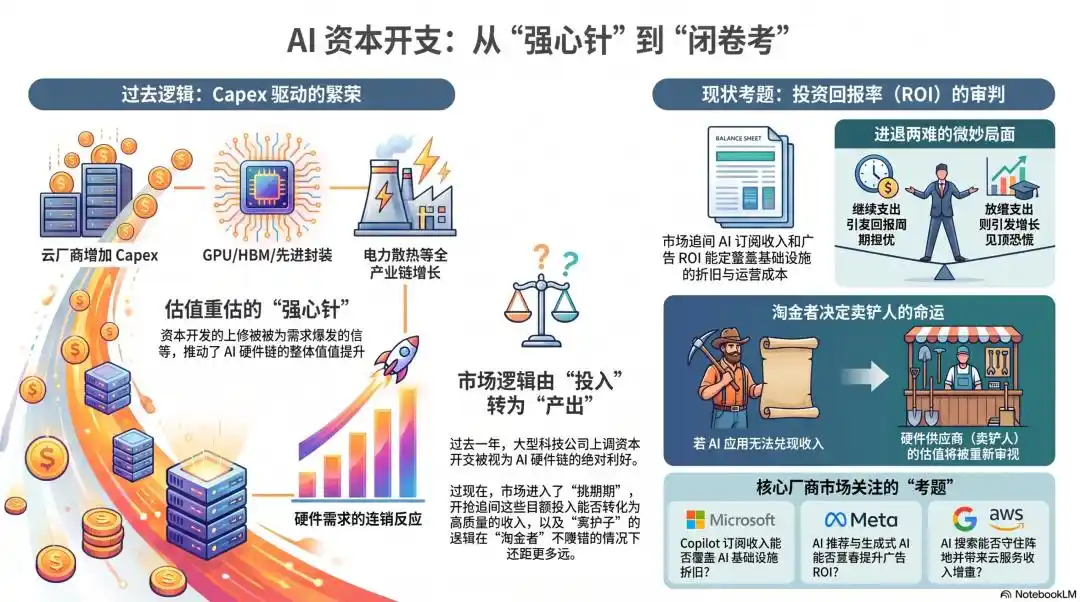
These companies typically hold a strong position in the chain, serve a broad customer base, maintain high technical barriers and generate relatively solid cash flow. Multiple AI technology paths still depend on their capabilities.
They are not without risk. RockFlow cites capex cycles, gross margin swings, geopolitics, customer concentration and the pace of advanced packaging capacity expansion as factors that can affect valuation. Even so, a sharp short-term decline in this group does not usually mean the long-term thesis has collapsed. It often reflects a mix of macro conditions, sector sentiment and valuation rebalancing. If the company’s position in the industry has not changed, the stock may deserve closer tracking after a selloff.
Shovel-selling leaders
Nvidia is the clearest example here. RockFlow says Nvidia’s central issue is not demand but expectation. From an industry standpoint, it remains one of the most important companies in the AI supply chain. GPU product strength, the CUDA ecosystem, customer lock-in, hardware-software coordination, data center revenue and cash flow all support that standing.
But after a large run-up in the share price, the market has already priced in a substantial amount of future growth. The question becomes tougher: can Nvidia keep beating what is already a very high bar?
RockFlow says names in this category can remain core watchlist candidates for the AI theme and can serve as major long-term base positions. Still, chasing them with high leverage when sentiment is hottest and valuations are fullest often leaves the risk-reward balance looking uncomfortable. A good company and a good price are not the same thing.
Cyclical high-beta assets
This group includes parts of memory, equipment and optical module suppliers. RockFlow says these names combine an AI growth story with cyclical behavior. When the market is rising, they can show strong upside beta. When the market turns lower, valuation, cyclicality, orders and supply expectations can all compress at once.
That means investors cannot look at them through a pure long-term AI lens. They also need to track supply and demand, inventory, pricing, order durability, expansion plans, customer concentration and gross margin trends. RockFlow says these assets can be used for upside leverage to a theme, but long-term rhetoric should not be used to hide cyclical risk. In many cyclical names, the most vulnerable point arrives when earnings expectations are at their richest and the market is most convinced that strong conditions will continue.
Pure narrative assets
RockFlow sees this as the category that requires the most caution. Some companies have no clear orders, no realized profits, no stable cash flow and no real pricing power. Even so, in a market with strong risk appetite, a convincing AI story can still push the share price sharply higher.
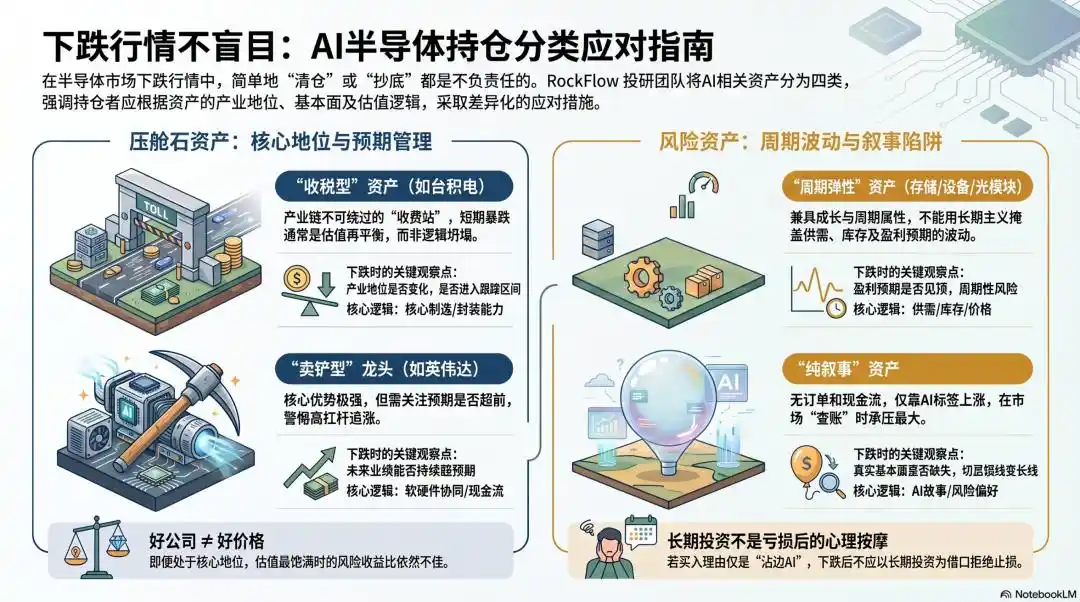
Once the market starts checking the numbers, these are often the first stocks to come under pressure. RockFlow says retail investors make a common mistake here: the trade begins as a short-term speculation, but after losses appear, it gets reframed as a long-term investment. If the original reason to buy was simply that a company was “also related to AI,” and the market no longer pays for that label, then the decline should not be rationalized with a long-term mindset after the fact. Long-term investing is not psychological relief after a loss. It has to rest on real fundamentals.
RockFlow says the AI trend remains intact, but indiscriminate buying is over
RockFlow does not view the semiconductor pullback since July as a simple sign that the AI bubble has burst. The market used to pay for AI imagination. It now wants more evidence of business return across the supply chain.
For investors, the team says, the practical task is not to cut positions on emotion or rush to average down after a sharp drop. It is to examine the portfolio again. Is the holding a toll-taking asset, a shovel-selling leader, a cyclical high-beta name or a pure narrative company? Is the stock down mostly because of multiple compression, or because something in the business thesis has changed? Does the original reason for owning it still hold?
If those answers are clear, short-term volatility does not need to become long-term fear. If the answers are vague, investors should not hide weak research behind a broad statement that they remain bullish on AI.
RockFlow said there is no reason to turn pessimistic on the AI industry trend itself. Real bottleneck assets will continue to be studied by the market after volatility. Real leaders will go through valuation rebalancing. High-beta names with genuine earnings support will wait for the next round of validation. At the same time, companies that rose mainly on narrative without earnings support may gradually be pushed out in this shakeout.
Its conclusion is straightforward: AI demand has not broken. The market has simply become less patient with linear extrapolation. The AI trade is not over, but the era of buying anything tied to AI with eyes closed has passed.
This article is based on a post from the WeChat public account “RockFlow Universe,” authored by RockFlow.