
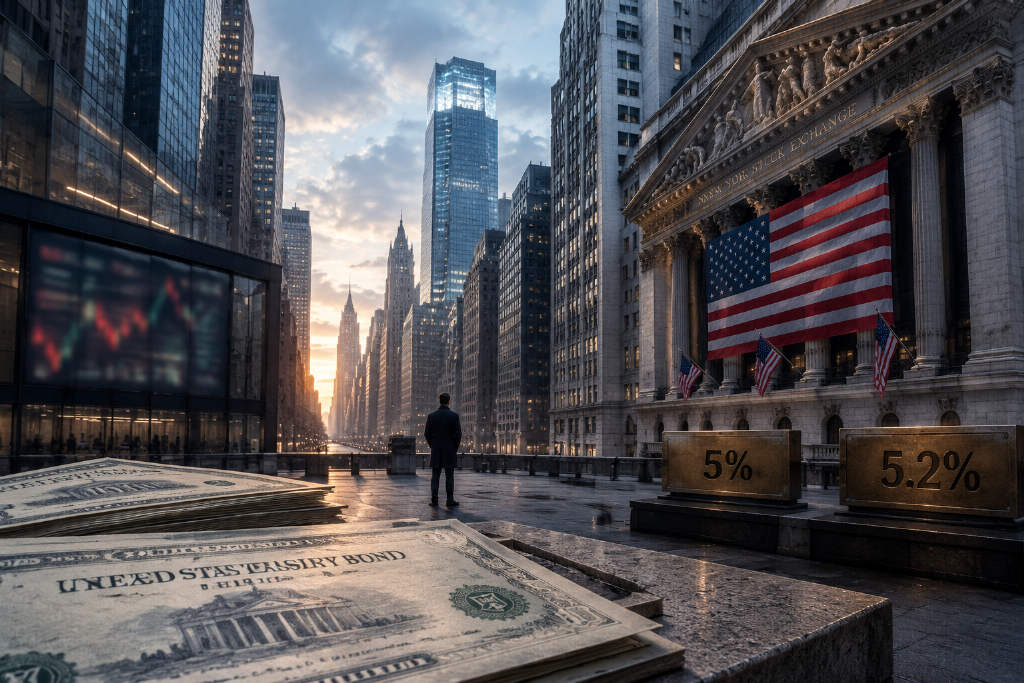
U.S. 10-year Treasury yields closed at about 5.21% on Monday, the highest level since 2007. In an interview on Bloomberg Television, Rockefeller International Chairman Ruchir Sharma said that if 5% stops being the ceiling and starts becoming the floor, the easy-money era is effectively over. In his view, that shift would hit the AI boom at a vulnerable point because the trade has been supported by cheap and abundant capital.
If 5% becomes the floor, the whole rate regime changes
Sharma framed the issue through a historical range. For roughly the past 20 years, he said, the 10-year Treasury yield has tended to top out around 5% to 5.25%. That band acted as a ceiling for markets. Now that yields are above 5.2%, a move toward a new range of 5.5% or even 6% would mean the interest-rate backdrop has shifted to a higher level altogether.
He said the problem is not limited to bonds. After reviewing historical data, Sharma’s team found that once yields rise above 5.25%, the relationship between stocks and bond yields turns negative for equities. Put simply, each move higher in yields tends to hurt stocks, and the effect gets stronger as yields climb. He added that markets have already started to show that pattern in recent weeks, even before 5.25% has been fully reached.
Why this is different from the 1990s
Some investors argue that the U.S. economy handled 10-year yields in the 5% to 6% range during the 1990s, so today’s market could do the same. Sharma said the key difference is debt.
According to him, government debt as a share of GDP is now close to three times the level seen then. A large portion of that debt is short-dated, which means it has to be refinanced quickly and at higher rates year after year. That pushes interest costs up fast. He said the wave of AI-related debt issuance is being layered on top of that government borrowing, creating another channel for higher rates to persist.
Oil prices and geopolitics add another source of pressure
Bloomberg also reported that oil prices moved higher and the bond selloff extended after Donald Trump rejected Iran’s latest proposal to reopen the Strait of Hormuz. Sharma said the correlation between yields and oil prices is now stronger than he has seen before because markets entered this Iran war crisis with inflation, debt, and fiscal deficits already elevated. Any additional shock, he said, would only make the damage worse.
SoftBank’s $11.1 billion junk-bond deal became part of the discussion
The interviewer pointed to SoftBank as an example. Last week, SoftBank completed an $11.1 billion high-yield bond sale, described as the largest junk-rated corporate bond deal on record globally. The dollar bonds carried yields of 9% to 10%, and the proceeds are set to support the company’s third $10 billion investment in OpenAI.
The host asked whether refinancing risk in data-center deals, many of which run only a few years, could become the factor that ends the boom. Sharma did not offer a timetable.
The “four O’s” can identify a bubble, not its breaking point
Sharma said he has studied 300 years of bubbles and uses what he calls the “four O’s” to judge whether a market is in bubble territory: overvaluation, overownership, overleverage, and overinvestment. He said AI already shows several of those traits.
Still, he stressed that the framework can only tell investors whether a bubble exists, not when it will burst. He pointed to former Federal Reserve Chair Alan Greenspan, who warned about “irrational exuberance” in December 1996, only for stocks to keep surging for another three years.
For Sharma, the one factor that has ended every major boom over the past 300 years is rising interest rates. Once rates move up, the risk of mistakes rises with them. Government debt, AI borrowing, and oil prices are now stacked together in a way that leaves markets exposed, he said.
The index looks calm, but the market underneath does not
On the surface, U.S. equities still look steady. Bloomberg data show the S&P 500 has gone 41 straight trading days without a daily drop of more than 1%, and the index is only about 1% below its record high.
Sharma said the picture below the index is very different. The median S&P 500 constituent is about 15% below its own 52-week high. A Goldman Sachs report went further, saying roughly 45% of S&P 500 members now have negative beta, meaning they fall even when the broader index rises.
He said he has watched markets for 30 years and has never seen that kind of setup. The figure was first highlighted by Goldman Sachs, and his own team checked it as well. In his words, the old saying used to be that the stock market is not the economy. Now, the index is not even the stock market.
The transmission channel he is watching is corporate credit
When asked why retail investors who only buy index funds should care about weak breadth, Sharma said returns tend to be weaker when the market becomes this narrow. He pointed to the period before the 2000 peak, when only a small group of stocks held up the index before the broader market rolled over. He also cautioned that markets are not a science and that these are signals to watch, not a final verdict.
The main transmission channel he is focused on is whether stress in Treasuries spills into corporate bonds. He said yields on CCC-rated debt and other junk bonds are already showing signs of strain, though the pressure is not yet widespread. If Treasury yields stay above 5% for long enough, stress in credit markets will build and could slow the spending surge that has been financed through debt issuance and equity sales.
His conclusion was direct: AI is no longer just a technology story. It is also a capital-markets story. If higher rates start to weigh on borrowing and stock issuance, the AI boom will begin to reverse.