
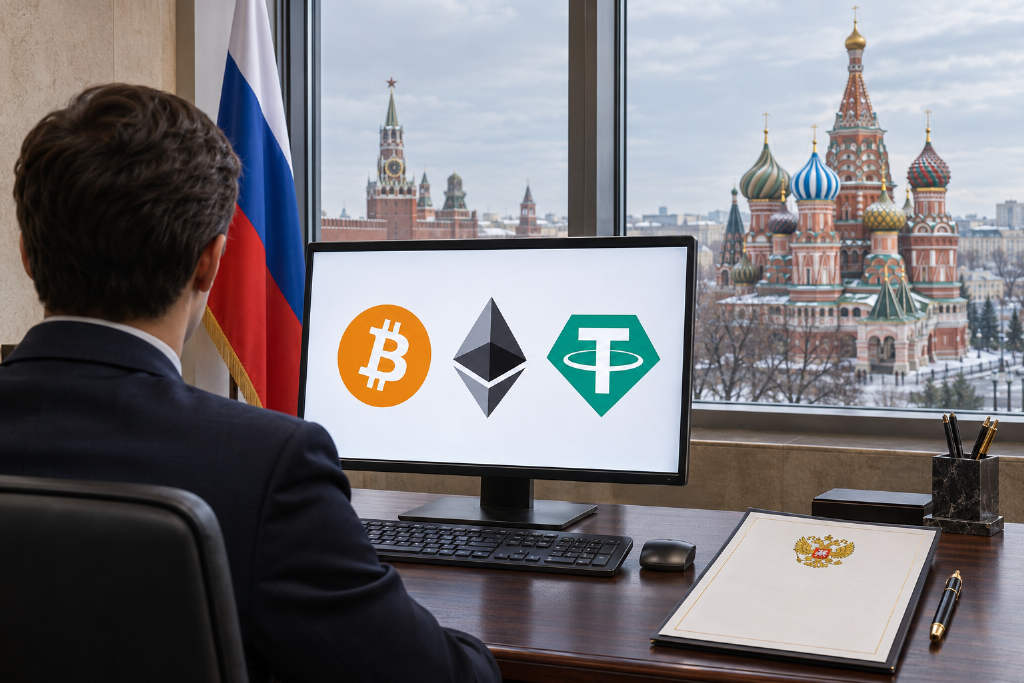
The Bank of Russia said exchanges may begin organized cryptocurrency trading on Nov. 22, once the central bank has approved the rules governing those markets. The date comes just ahead of Moscow Exchange’s planned Dec. 1 launch of bitcoin trading.
The ordinance amends the Bank of Russia’s rules for organized trading. The Justice Ministry registered it on Nov. 3, and the regulator published it on its website on Wednesday. It will take effect 10 days after publication, on Nov. 22.
Exchanges must clear their trading rules first
Exchanges that want to run cryptocurrency markets will have to register the brokers, trust managers and central counterparties involved in the trades. They must keep registers of orders and transactions and monitor the activity connected with those trades.
The venues will also have to calculate a current price, a weighted-average price, a market price and a closing price. Trading activity must be reported to the Bank of Russia in the same way exchanges already report activity involving other assets.
The regulator set out the sequence clearly. Exchanges may open crypto markets from Nov. 22, but they must first agree with the regulator on the rules for conducting the trading. The Bank of Russia did not say whether any venue has already completed that review.
What ordinary investors can buy
A separate ordinance, published on Nov. 6 and scheduled to take effect on Nov. 17, sets the assets available to ordinary buyers. The Bank of Russia approved bitcoin, ether and Tether’s USDT for purchase by non-qualified investors. Exchanges may admit those assets to public trading from that date.
Non-qualified investors can buy through a broker, a trust manager or a registered crypto exchange office. They can trade on an exchange or over the counter. Purchases through a single intermediary may not exceed 300,000 rubles a year, which is roughly $3,600 at the official exchange rate.
Qualified investors will be able to access all cryptoassets without a purchase cap. Both categories must pass a knowledge test and read a risk disclosure before trading.
The list for non-qualified investors is limited to the most liquid assets that meet the legal tests. Those tests cover market capitalization, average daily trading volume and at least five years of pricing history on foreign exchanges.
Moscow Exchange keeps its Dec. 1 target
Moscow Exchange, Russia’s largest trading venue, announced on Nov. 2 that it plans to offer trading in bitcoin, ether and USDT from Dec. 1. The initial rollout will be a pilot while participants connect to the system.
Trading would use the exchange’s existing stock-market systems and run from 6:50 a.m. to 11:50 p.m. Moscow time. The National Clearing Centre would clear the transactions, while clients could settle on the same day or the following day.
Bitcoin Magazine reported the Dec. 1 plan last week and noted that U.S. sanctions already cover the exchange and its clearing house. Boris Blokhin, a senior managing director at Moscow Exchange, said in early October that the venue would not need additional licenses to start. He said it would use a partner settlement digital depository.
Wednesday’s notice still requires the central bank to approve the trading rules themselves. Moscow Exchange has not publicly said whether it has already received that approval.
SPB Exchange, the St. Petersburg venue, has said it wants to start organized crypto trading by the end of the year. It is building its own settlement digital depository, according to Russian newspaper Vedomosti in an October report.
The framework rests on Federal Law No. 282-FZ
Russia’s organized crypto market is based on Federal Law No. 282-FZ, titled On Digital Currencies and Digital Rights. The law’s main provisions took effect on Sept. 1.
The law licenses exchanges, brokers, managers, depositories and exchangers. It recognizes crypto as property and creates a supervised channel for cross-border trade. It still bans the use of crypto to pay for goods and services inside Russia.
Officials spent the fall putting the remaining market infrastructure in place, including a self-regulatory body for crypto exchanges and digital depositories.
Bitcoin Magazine wrote that the central question is no longer whether Russia will have a legal exchange market for bitcoin. It is when the first venue will actually open, and whether the 300,000-ruble retail cap will be enough to draw traders away from the offshore desks they already use.
This post first appeared on Bitcoin Magazine and was written by Micah Zimmerman.



