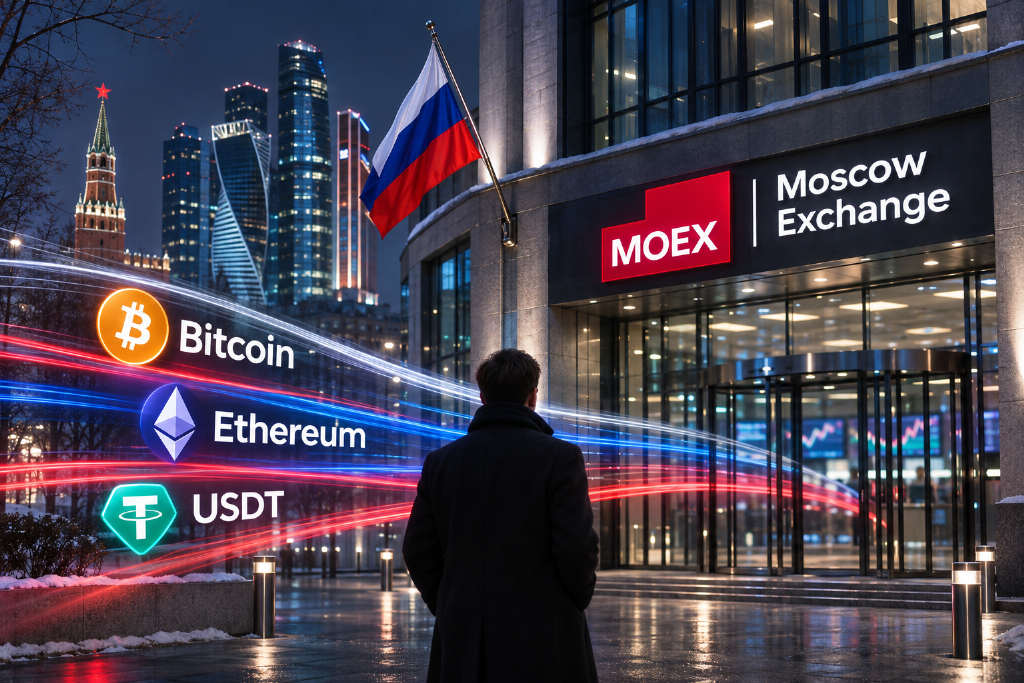
Russia is preparing to bring Bitcoin, Ether and USDT into regulated domestic trading, but the opening comes with limits on who can buy, how assets can move and where crypto can be used. On November 11, 2026, the Bank of Russia published rules allowing securities exchanges to trade cryptocurrencies from November 22, provided they receive regulatory approval. The central bank had announced the first assets available to ordinary investors a few days earlier; those provisions take effect on November 17.
The Moscow Exchange, Russia’s largest securities exchange, plans to start crypto trading on December 1. Sberbank, one of the country’s largest banks, has also secured regulatory registration for related activities. The article was written by KarenZ for Foresight News.
BTC, ETH and USDT make the first approved list
On November 6, 2026, the Bank of Russia named Bitcoin (BTC), Ether (ETH), Ethereum’s native token, and Tether’s US dollar stablecoin, USDT, as the first crypto assets available to non-qualified investors. From November 17, the assets may be publicly traded on exchanges. Individuals can buy them through brokers, asset managers or cryptocurrency exchange services, either on exchanges or over the counter.
Retail access is capped. A non-qualified investor may spend no more than 300,000 rubles a year on crypto through a single intermediary, equivalent at the time to about 24,182 yuan. Qualified investors are not subject to that purchase limit. All investors, regardless of status, must pass a test before trading and demonstrate an understanding of crypto investment risks.
The central bank selected the assets based on market capitalization, average daily trading volume and the availability of at least five years of price records on foreign trading markets. The criteria favor assets with larger markets, stronger liquidity and longer trading histories. They do not amount to an endorsement of crypto as low-risk. In a regulatory proposal published in December 2025, the Bank of Russia said crypto assets remained high-risk instruments because they lack a clearly identified issuer and jurisdictional backing, have volatile prices and face sanctions risks. Russia continues to prohibit cryptocurrency payments for goods and services inside the country.
Banks, custodians and exchanges prepare to enter
The main provisions of Russia’s Law on Digital Currency and Digital Rights took effect on September 1, 2026, establishing a framework for crypto trading, exchange, custody and related intermediary services. On October 6, the central bank announced that five digital custodians and four cryptocurrency exchange services had entered its first regulatory registers.
The five custodians were Sberbank; VTB Bank; Voltari, a digital financial asset infrastructure company; Atomyze, part of T-Technologies; and Cloud Infrastructure. The exchange-services register named VTB Bank, T-Invest Lab, a T-Technologies subsidiary, crypto exchange service Zefir and Sistema-Crypto. Sberbank was added to the exchange-services register on October 12. The initial announcement did not represent the full market: by November 6, the digital custodians’ register had grown to nine, while the crypto exchange-services register contained 25 firms.
Sberbank and VTB already have large customer bases, financial-product distribution channels and compliance systems. If their crypto services expand, Russian investors will be able to use familiar financial institutions rather than relying entirely on overseas platforms. Securities exchanges are preparing their own offerings. The Moscow Exchange plans to test the business with professional market participants at the outset, using partner digital custodians to handle asset records and settlement arrangements.
On November 11, the central bank set out additional operating requirements for exchanges. They must register trading participants, retain order and transaction records, monitor trading activity and report transactions to regulators.
New trading channels, but limits on P2P transfers remain
The transitional arrangement permitting direct peer-to-peer (P2P) crypto trading between individuals under current law ends on July 1, 2027. Under the Bank of Russia’s explanation of the rules, residents who are not designated market operators will generally have to trade through legally recognized institutions or transact directly with those institutions after that date.
The rules also constrain transfers from digital accounts. Individuals may not move crypto assets held in a digital account to their own non-custodial wallet, and direct transfers between individuals using address identifiers managed by a digital custodian are prohibited. These provisions cover specific operations defined by law; they should not be read as a blanket ban on individuals holding non-custodial wallets. The broader regulatory direction is to route more activity through registered financial institutions that identify customers and keep transaction records.
Cross-border trade follows a different set of rules. Exporters and importers may use cryptocurrency for international settlement when they comply with applicable law, including by using different types of wallets directly. Russia is therefore treating domestic investment trading and cross-border trade settlement as distinct regulatory areas.
Trading demand and sanctions shape the policy shift
Western financial sanctions are part of the backdrop, but they do not explain the entire shift. In February 2026, CoinDesk reported that Ivan Chebeskov, a deputy finance minister, disclosed an estimate at the Alfa Talk conference: Russia’s domestic crypto market handled about 50 billion rubles a day, then roughly $650 million, and more than 10 trillion rubles a year, then about $130 billion.
A blanket restriction may not eliminate demand. It could leave a large share of trading outside the regulatory system, making it harder for authorities to gauge volumes, monitor the source of funds or investigate illegal activity. Bringing transactions into banks, securities exchanges and digital custodians gives regulators identifiable entities to oversee and creates a new line of business for traditional finance. When it proposed an experimental framework for crypto trading in 2025, the central bank said the goals included improving market transparency, setting service standards and widening access for eligible investors.
Cross-border payments present a separate pressure. After the Russia-Ukraine conflict began in 2022, Russia faced broad Western financial sanctions. In June 2024, the United States imposed sanctions on financial infrastructure including the Moscow Exchange. Restrictions on conventional banking channels led some Russian businesses to look for alternative settlement methods. In July 2024, the State Duma passed legislation allowing Russian importers and exporters to use cryptocurrency for foreign trade settlement within an experimental legal framework. That measure addressed cross-border payments; the later opening to ordinary investors is aimed at creating a regulated domestic crypto market. The policies are related, but they serve different purposes.
Crypto assets have already appeared in some Russian trade settlements. In March 2025, Reuters cited four people with direct knowledge of the matter who said some Russian oil companies used BTC, ETH and USDT in oil trades with China and India to help convert funds involving yuan, rupees and rubles. The report said crypto still accounted for a small share of Russia’s overall oil trade at the time, though its use was growing. Crypto can offer another route for some cross-border transfers, but it does not resolve all of Russia’s international payment problems.
Legal access to USDT for Russian residents does not mean Russian companies can use it for international settlement without restrictions. Russia has also begun examining ways to reduce reliance on dollar stablecoins. In June 2026, the central bank published a consultation report on ruble stablecoins, asking whether a dedicated legal framework was needed. It said dollar-backed stablecoins still dominated the global market and that more countries were studying domestic-currency stablecoins to protect monetary sovereignty. Russia did not yet have a mature ruble stablecoin market. The report discussed issuance, redemption, reserve assets and requirements for issuers; it did not announce the launch of a ruble stablecoin.
The two policy needs do not line up neatly. Cross-border settlement depends on international liquidity and acceptance by counterparties. Domestic oversight prioritizes customer identification, compliant intermediaries and control over fund flows. Russia’s challenge is to manage the tension between those demands and the market’s actual needs.
Four years of change, without domestic crypto payments
The shift has unfolded over several years. In January 2022, the Bank of Russia issued a consultation paper titled “Cryptocurrencies: Trends, Risks and Regulation.” It warned that wider crypto adoption could threaten household wealth, financial stability and economic security, and recommended restricting crypto circulation, trading organization and mining in Russia. Those were recommendations, not a declaration that individuals were already barred from holding or trading crypto. The paper nevertheless showed that the central bank then viewed crypto mainly as a source of risk to contain, rather than a financial market to develop.
The stance began to soften. In 2024, Russia passed legislation supporting crypto cross-border settlements under a specific experimental framework and established a mining oversight regime. At that stage, policymakers focused on the use of crypto in international trade, not on whether ordinary investors could legally buy Bitcoin.
In March 2025, acting on a presidential instruction, the Bank of Russia proposed a three-year experimental framework for crypto trading, initially limited to a small group of “specially qualified investors.” The proposed threshold was high: individuals needed more than 100 million rubles in securities and deposits and more than 50 million rubles in income in the previous year to qualify. The source’s statement of the value of the 100 million rubles at the time is incomplete, so no conversion is supplied. The initial approach was to admit only a small number of investors considered able to bear substantial risk.
Nine months later, the central bank took another step. In December 2025, it published a more comprehensive market proposal that would allow both ordinary and qualified investors to buy crypto assets under different access rules. On July 21, 2026, the State Duma passed a crypto regulation bill. President Vladimir Putin signed Federal Law No. 282-FZ on August 4, with its main provisions taking effect on September 1. The first custodians and exchange services then entered the registers, banks and securities exchanges prepared new services, and the first assets for ordinary investors were selected.
Russia moved from discussing restrictions on trading and mining to permitting cross-border settlement, then to an experiment for wealthy investors and, ultimately, a regulated trading regime for ordinary investors. One position has remained consistent: the central bank has not accepted cryptocurrency as a domestic payment instrument. In a public statement in December 2024, Bank of Russia Governor Elvira Nabiullina said the central bank supported crypto cross-border settlement projects but opposed using crypto for payments inside Russia. That position remains in place. The policy shift is from restricting circulation and trading toward permitting specific uses within a regulated financial system, not toward unrestricted acceptance.
Investors gain more legal trading channels; traditional financial firms get a new potential business line; regulators may be able to bring activity that was difficult to monitor into the existing supervisory framework. But the law’s entry into force does not mean the market is mature. It remains to be seen whether the system attracts users who previously traded on foreign platforms, whether exchanges can provide enough liquidity, whether tight intermediary controls affect market activity, and whether settlement difficulties under sanctions can be eased.
Disclaimer: Markets involve risk, and investors should exercise caution. This article is not investment advice. Readers should assess whether any views or conclusions here suit their circumstances. Investment decisions are their own responsibility.