
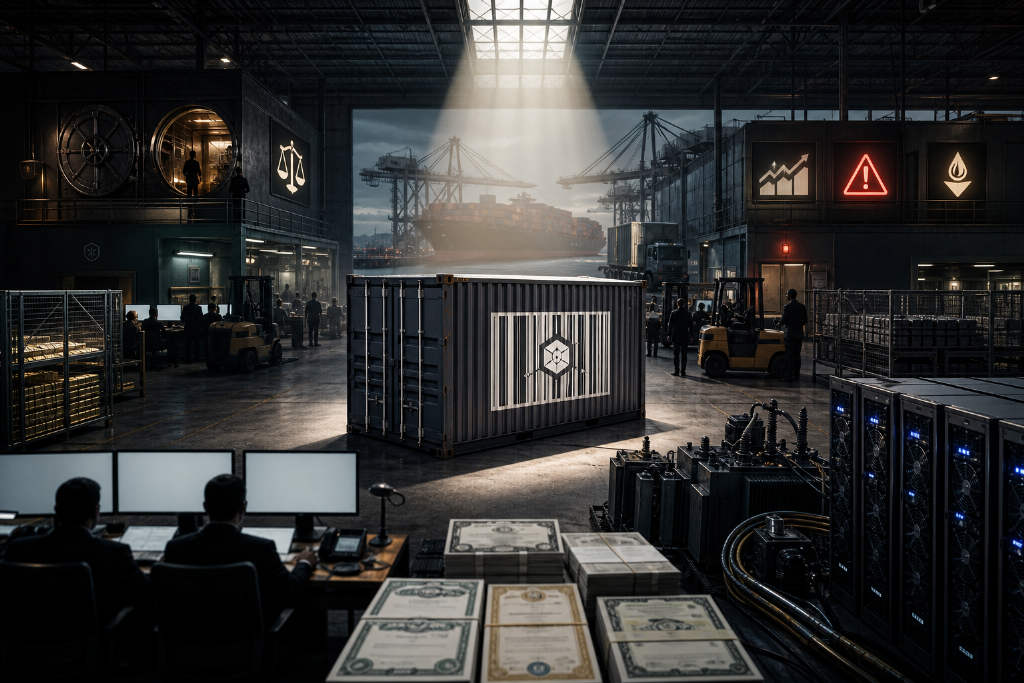
Sentora co-founder Jesus Rodriguez says the RWA debate often starts with a simple vision: take a Treasury bill, a fund share, a stock, an invoice, a megawatt-hour, or an hour of GPU compute, then mint a token that represents it. Useful, yes. Transformational, not yet.
He compares tokenization to putting a barcode on a shipping container. A barcode makes the container identifiable and machine-readable, but it does not create ports, cranes, customs, insurance, financing, shipping routes, or distant buyers. In the same way, a token is only an addressable claim, while decentralized finance is the market operating system. The question that matters, he argues, is not how many assets can be brought onchain, but how many can be valued, financed, hedged, traded into cash, and worked through after losses under stress without an offline meeting every time a trade needs to happen.
Tokenization represents claims, but it does not build the market around them
Rodriguez points to mortgage finance as an older version of the same lesson. Mortgages did not scale simply because paper records became digital records. They scaled because a full operating stack emerged around them: underwriting, servicing, securitization, ratings, warehouse finance, repo, hedging, clearing and settlement, and rules for allocating losses.
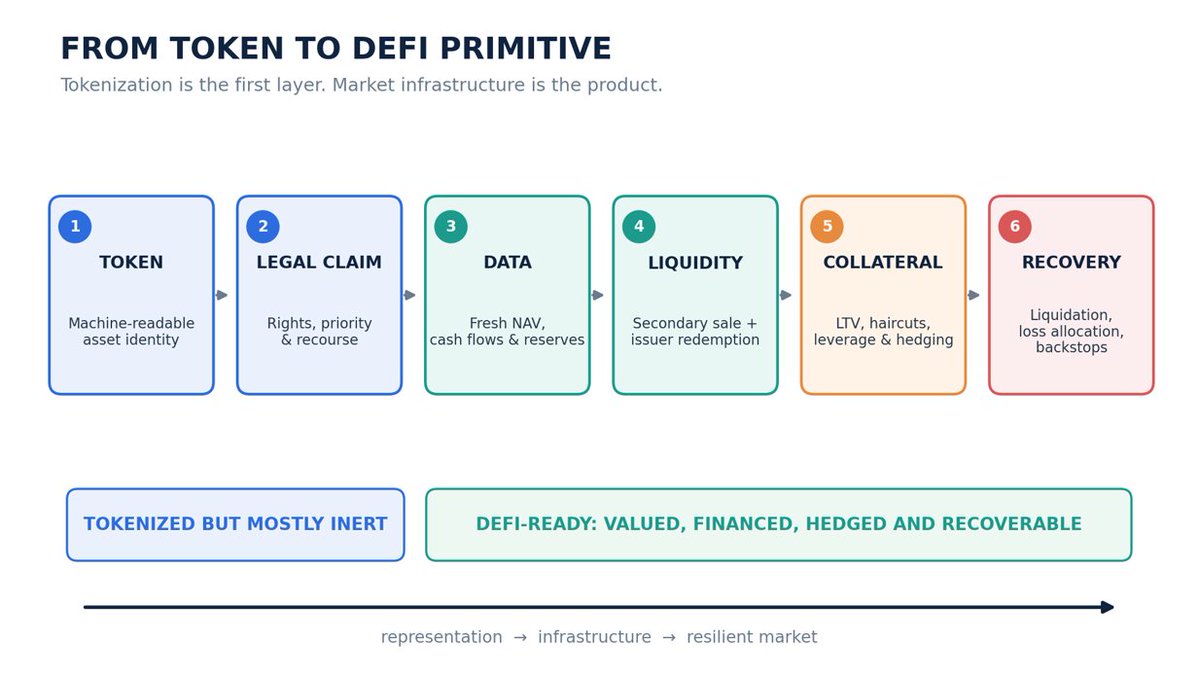
He says RWAs need the same kind of evolution. For an asset to fit DeFi in a meaningful way, six layers have to be in place: legally enforceable rights, reliable data sources, clear transfer and redemption rules, executable secondary-market liquidity, collateral parameters that reflect real-world behavior, and a credible path for liquidation and loss resolution.
Most tokenized projects, he writes, stop before that final layer. He offers a simple test for asset maturity built around three questions: What is the asset worth right now? Can the protocol exit and realize that value right now? If both answers turn out to be wrong, who absorbs the loss? Only when a smart contract can answer those questions deterministically does an RWA become a real financial building block. Before that, it is mostly a digital wrapper.
RWAs run on multiple clocks at once
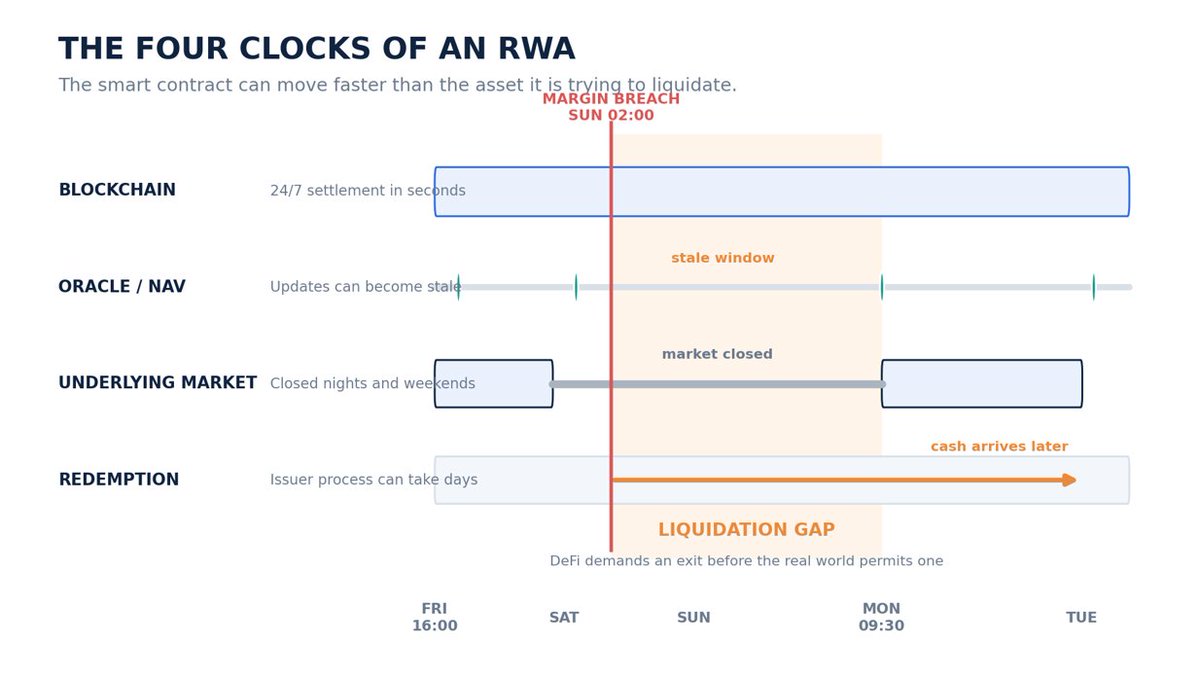
The deepest technical tension, in his view, is that RWAs operate across several different time systems. A blockchain can settle in seconds and run 24/7. An oracle may update every hour or every day. A traditional exchange closes at night and on weekends. A custodian follows banking business days. A redemption process may take 1 day, 5 days, or 30 days.
Use an asset with that slow rhythm to support fast-maturing DeFi liabilities such as stablecoin borrowing, and the structure turns into maturity transformation. That model has been at the center of banking for centuries: short-term liabilities funding longer-duration, slower assets. Rodriguez does not dismiss it. He argues that it can be useful, but the risk has to be priced properly.
He gives a weekend example. At 2 a.m. on Sunday, an asset hits a liquidation threshold. The smart contract can seize the token immediately, but the real-world market does not open until Monday, and the issuer may not process redemption until Tuesday. Onchain liquidation is finished before offchain disposition even starts. The result is a liquidation gap: DeFi demands an instant exit, while the real world does not allow one.
That gap can produce a counterintuitive result. Even a low-volatility tokenized Treasury may be riskier as collateral than a more volatile crypto-native asset. ETH may swing sharply, but it trades around the clock. An RWA can look stable simply because it has gone many hours without a fresh price mark. A smooth price can reflect safety, or it can reflect stale data.
Liquidity is an exit path, not a TVL number
Rodriguez also argues that liquidity is widely misunderstood. It is not the same as total value locked, not the same as listing a trading pair, and not the same as an issuer saying redemption will eventually happen at NAV. Liquidity is the ability to turn a position into the settlement asset you need, within the liability window you actually face, at a discount you can tolerate.
He compares it to a crowded theater. The size of the hall does not tell you whether people can get out safely during a fire. The width of the exits does. For an RWA, he says, there are at least three exit routes: sell to another market participant, redeem with the issuer, or borrow against the asset and delay the sale. Each route comes with its own lag, capacity, permission limits, and failure modes.
A market maker willing to warehouse RWA inventory over a weekend is, in his framing, bridging two financial clocks. That balance-sheet service should be identified clearly and paid for explicitly.
As a result, strategy models should estimate exit value under stress rather than rely on official book NAV. What matters is the actual realizable price after spreads widen, market makers cut inventory, redemption queues form, and stablecoin funding costs jump. The key question is not what the asset was worth yesterday. It is how much cash the position can be turned into before the protocol runs out of tolerance.
Leverage creates utility, and it also exposes hidden assumptions
Rodriguez says tokenization gets most of the headlines, but leverage is what produces economic utility. Homes become valuable collateral through mortgages. Treasuries become foundational through the repo market. Stocks unlock more value once they support margin trading, lending, shorting, and hedging.
Once an RWA can be pledged to borrow stablecoins, it stops being only a tokenized object and becomes balance-sheet infrastructure. That is also the point where hidden assumptions begin turning into realized losses.
He says collateral ratios cannot be set from historical volatility alone. Haircuts also need to reflect legal enforceability, oracle freshness, redemption delay, concentration of holdings, market-maker capacity, custodian risk, governance permissions, and correlation with the borrowed asset.
That framework can lead to another result that looks odd at first glance: in some market conditions, a tokenized Treasury should carry a lower collateral factor than ETH. Not because the Treasury has greater economic risk on its own, but because its liquidation path is slower and less tested in practice. In Rodriguez’s formulation, DeFi risk is not just asset risk. It is asset risk multiplied by market-structure risk.
RWA risk should be modeled as a dependency graph
On risk management, Rodriguez contrasts traditional finance with DeFi. Traditional systems can rely on periodic reporting and manual escalation. DeFi needs something closer to an aircraft cockpit: continuous monitoring, explicit thresholds, and automatic responses before the engine catches fire.
He argues that RWA risk should not be compressed into a single score. It should be modeled as a graph of relationships. The nodes include underlying cash flows, legal entities, issuers, custodians, oracles, secondary markets, redemption mechanisms, stablecoin pools, lending protocols, governance keys, and backstop capital. The edges between them represent dependency.
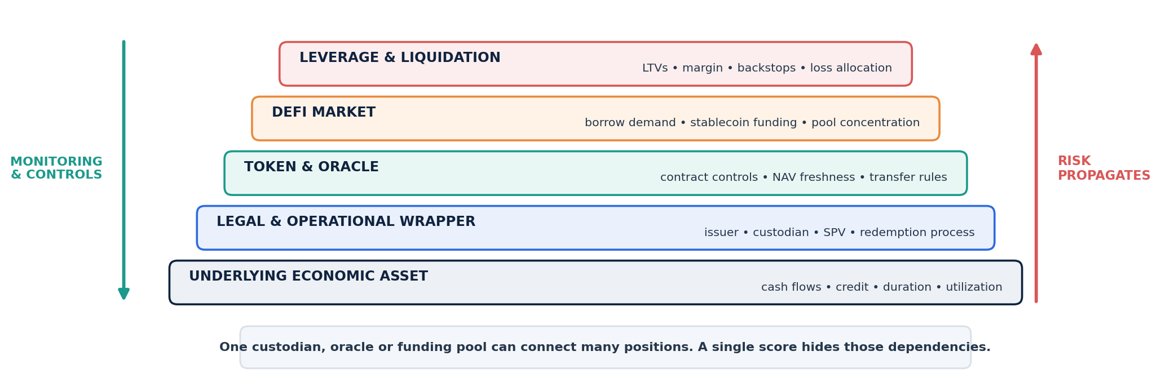
Failures, he writes, rarely happen in isolation. One custodian may serve several tokens. One oracle may feed multiple pools. One stablecoin may support a large set of leveraged positions. A small operational problem can move through that graph and end as a liquidity crisis.
His proposed approach combines asset research, strategy construction, ongoing monitoring, exposure management, and risk protection into one operating loop. The system should continuously track redemption queues, market depth, concentration of positions, lending utilization, oracle deviations, reserve changes, deteriorating cash flow, and market-maker behavior.
He adds that the first signs of trouble often appear offchain before they show up in token prices. Waiting for price declines before acting is like waiting to see smoke before checking whether a wire is overheating.
Treasuries are the opening test, not the destination
Rodriguez describes tokenized Treasuries as the natural entry point. The product is standardized and easy to understand. He compares it to a ping packet on a network: a basic test of whether custody, minting, redemption, compliance, pricing, and the broader settlement chain work end to end.
Still, he says a financial internet that can only circulate short-term Treasuries has limited ambition. The more demanding frontier lies in compute and energy assets.
Compute-based RWAs can represent GPU hardware, lease receivables, prepaid compute, utilization-linked income, or claims on data center operator revenue. Those assets bring a different risk set, layered with equipment finance, commodity-style pricing, technology obsolescence, and operating performance. A new chip generation can change GPU revenue curves overnight, and the economic aging process is much faster than it is for physical buildings.
Energy assets raise a similar identity problem. Rodriguez asks what exactly the token stands for: infrastructure, a power purchase agreement, a megawatt-hour of output, grid capacity, project revenue, or a green credit instrument. Each version would require its own oracle design and its own liquidation and resolution plan.
He says DeFi can build programmable revenue distribution, transparent collateral pools, global distribution, and dynamic funding tools for assets that are slow and locally constrained in traditional markets. But the token has to map precisely to the underlying economic logic. Saying an asset is backed by energy is not the same as having a risk model.
Tokenized stocks and perpetual futures will be a major live test
Rodriguez sees tokenized equities as one of the biggest real-world tests ahead because they connect two very large systems: global stock ownership and crypto-native leverage.
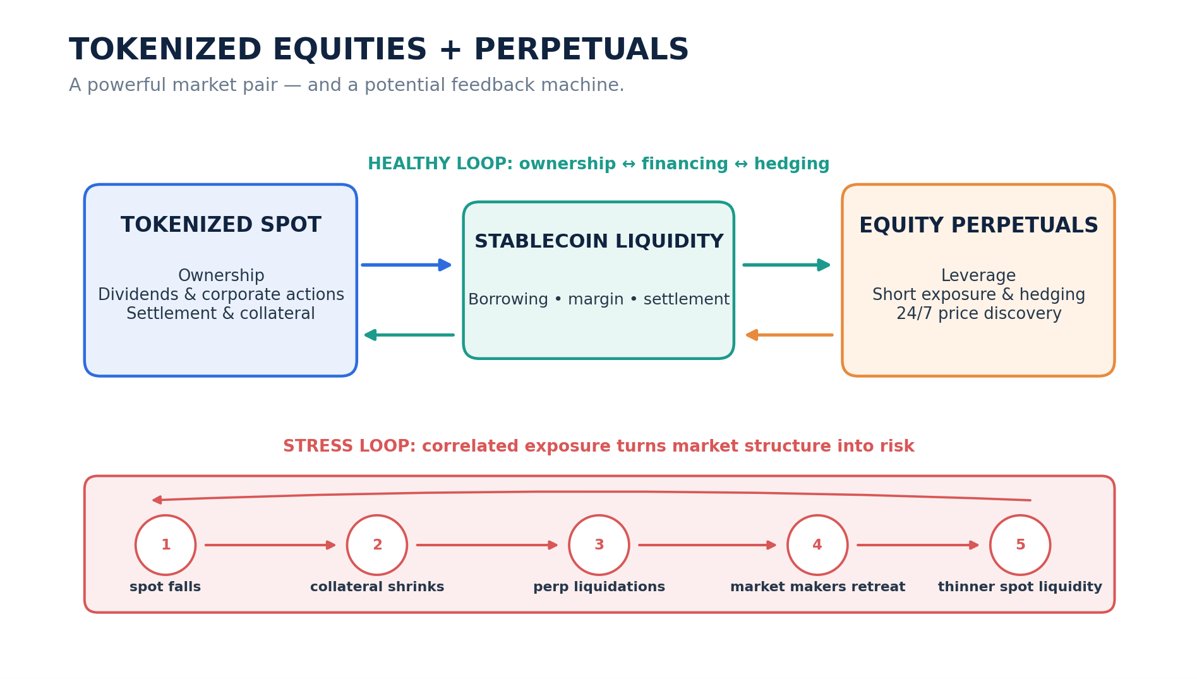
The first question, he says, is not which stock is already onchain. It is what the holder actually owns. Direct ownership, an economic interest, a structured note, and a synthetic tracking product may show similar price behavior, but they produce very different outcomes for voting rights, dividends, corporate actions, redemption rights, and bankruptcy treatment.
That leads naturally to perpetual futures. In his view, tokenized spot equities and equity perpetuals should complement each other in the same way spot and futures markets do in commodities. Spot anchors ownership, dividends, settlement, and collateral. Perpetuals provide leverage, short exposure, hedging, and ongoing price discovery. Together they allow richer market expression than either instrument can provide alone.
The combination also creates tightly linked risks. He sketches one scenario: a tokenized stock is posted as collateral to borrow stablecoins, and those proceeds are then used to build a leveraged long in a perpetual tied to the same stock. The underlying U.S. equity market is closed, token prices fall over the weekend, collateral value drops, perpetual liquidations begin, and market makers pull back. Thin spot liquidity gets thinner, which drives prices lower still.
His answer is architectural. He points to isolated margin domains, concentration limits, dynamic weekend haircuts, liquidity-aware oracles, circuit breakers, cross-market monitoring, and clearly defined backstop capital. High efficiency, in this framing, does not mean the absence of constraints. It means placing constraints where the system is most likely to fail.
The larger opportunity begins when assets enter programmable capital markets
Rodriguez closes by saying RWAs still matter without DeFi. Tokenization can improve distribution, settlement, transparency, and access. Even so, the value is limited if the asset goes no further.
The larger opportunity appears when the asset enters an open, programmable capital market. At that point it can become collateral, obtain funding, support hedging, and serve as the base for structured strategies.
Under that standard, an RWA is not truly DeFi-ready the moment the token is minted. It becomes DeFi-ready when the full market built around it can survive a weekend risk event. That is the core argument of the piece. The next phase is not about stacking more RWA logos. It is about building the operating layer that turns legally valid claims into resilient financial strategies.
The long-term goal, he writes, is not that everything becomes tokenized. It is that productive real-world assets can be addressed by software, capital can move continuously across asset classes, and risk can be managed at market speed. The token is only the barcode. The market is the machine that does the real work.