



Ryan Watkins, co-founder of Syncracy Capital, says the crypto economy is going through the biggest transition he has seen in eight years of working in the sector. In his telling, institutions are still accumulating digital assets while early cypherpunk participants are dispersing wealth and cashing out. Companies are positioning for S-curve growth. Many native market participants, after years of disappointment, are worn down.

Watkins frames the current period as a moment when governments are pushing the global financial system toward blockchain rails even as short-term traders stay focused on daily price charts. He says emerging markets are embracing financial democratization, while critics in the U.S. continue to dismiss the whole sector as little more than a casino.
He notes that two broad historical comparisons tend to dominate discussion around crypto today. The bullish camp sees a post-bubble recovery similar to the period after the dot-com crash, with speculation fading and long-duration winners eventually emerging in the way Google and Amazon did. The bearish camp compares crypto to an emerging market, using 2010s China as a rough parallel, and argues that weak investor protections plus a shortage of patient long-only capital could leave asset prices lagging even if the industry itself keeps growing.
Watkins says both views capture part of the picture, but neither is enough on its own. History can guide investors, he writes, yet the crypto economy has to be understood within its own macroeconomic and technological context. It is not one monolithic market. It is a collection of people, assets, and narratives that connect in some places and diverge in others.
2021 pulled too much of the future forward
To explain the mismatch between expectations and outcomes, Watkins turns to the Red Queen. In Lewis Carroll’s Alice in Wonderland, the Red Queen tells Alice, “Now, here, you see, it takes all the running you can do, to keep in the same place. If you want to get somewhere else, you must run at least twice as fast as that!” He notes that evolutionary biologist L. van Valen used the image in 1973 to describe relentless competitive pressure in nature.
Watkins applies the idea to markets. Expectations matter most. If reality beats expectations, prices rise. If it falls short, prices fall. Over time, he argues, expectations swing like a pendulum, and long-term returns often move inversely to the level of optimism already embedded in prices.
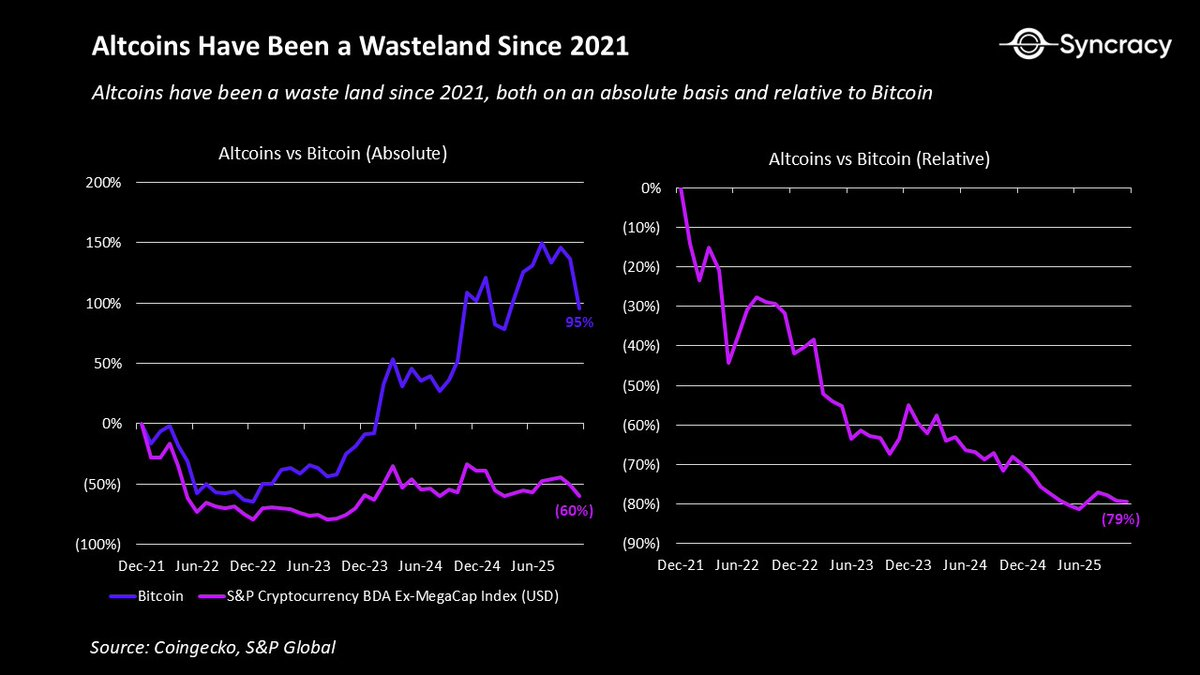
In his view, the crypto economy in 2021 embedded expectations that were far beyond what most people realized at the time. He points to DeFi blue chips trading at price-to-sales multiples of 500x, and to a market environment in which 8 smart contract platforms were valued above $100 billion. He also cites the excesses around the metaverse and NFTs. Still, he says the clearest illustration is the performance of Bitcoin relative to gold.
Watkins writes that, despite the progress made across the sector, Bitcoin has not set a new high against gold since 2021 and has in fact declined relative to that point. He frames that as a striking outcome given what he describes as a “crypto capital” under Trump, the most successful ETF launch in history, and a period of systemic debasement in the dollar. In that setting, he asks why Bitcoin, as digital gold, has still failed to outperform its own level from four years earlier.
For the rest of the market, he says conditions have been worse. Most projects entered the current cycle with structural weaknesses already in place, and those flaws became harder to ignore once extreme expectations met reality. He identifies several of the main fault lines:
- Revenue for most projects has been highly cyclical and dependent on ever-rising asset prices.
- Regulatory uncertainty has limited institutional and enterprise participation.
- Dual ownership structures have left equity insiders and public token investors misaligned.
- Weak disclosure practices have created information asymmetries between teams and communities.
- A lack of shared valuation frameworks has produced extreme volatility with no clear fundamental floor.
According to Watkins, these problems have left most tokens bleeding lower for years, with only a small number even getting close to their 2021 highs. He says the psychological impact has been severe, particularly for speculators and opportunists who approached crypto as a shortcut to wealth. Over time, that struggle has produced broad fatigue across the industry.
He does not see that cleansing process as a bad thing. Returns generated by minimal effort were never likely to last, he argues, and the period before 2022, when loosely packaged concepts could turn into large fortunes, was not sustainable.
At the same time, he says the setup has changed in one important respect: these weaknesses are now widely recognized, and prices reflect them. Beyond Bitcoin, he writes, very few crypto-native participants still want to seriously defend long-term fundamental stories for other assets. After four difficult years, he argues, the asset class now has the conditions needed to surprise to the upside again.

A crypto economy waking up
Watkins says the positive side of entering this cycle with structural flaws is that many of those flaws are now being addressed. He argues that, outside the digital gold thesis, several use cases are already compounding, while others are still in transition but moving in a clear direction.
He lists a range of applications that the crypto economy has produced over the past few years:
- Peer-to-peer internet platforms that let users transact and enforce contractual relationships without relying on a government or corporate intermediary.
- Digital dollars that can be stored and transferred anywhere with an internet connection, offering billions of people a cheaper and more reliable form of money.
- Permissionless exchanges that let anyone, anywhere, trade top global assets across any asset class in a single transparent venue, 24/7.
- New forms of derivatives, including event contracts and perpetual swaps, which he says provide useful predictive insight and more efficient price discovery.
- Global collateral markets that use transparent, automated infrastructure to provide credit without permission while reducing counterparty risk.
- Democratized asset creation platforms that let individuals and institutions issue publicly traded assets at very low cost.
- Open financing platforms that let people anywhere in the world raise capital for their work without being fully constrained by local economic conditions.
- Physical infrastructure networks built through crowdfunded capital and operated by independent participants, with the aim of producing infrastructure that is more scalable and resilient.
He says the list is not exhaustive. His main point is that many of these categories are already creating real value and continue to grow regardless of swings in crypto asset prices.
Watkins also argues that some of the sector’s institutional problems are beginning to ease. As regulatory pressure softens and founders come to better understand the cost of misaligned incentives, he says the dual model of equity and tokens is being corrected. Some projects are folding assets and revenue into a single token structure. Others are making a cleaner distinction, with on-chain revenue allocated to token holders and off-chain revenue left to equity holders.
At the same time, he writes, the rise of third-party data providers is improving disclosure practices and reducing information asymmetry, making analysis more dependable than it was in prior cycles.
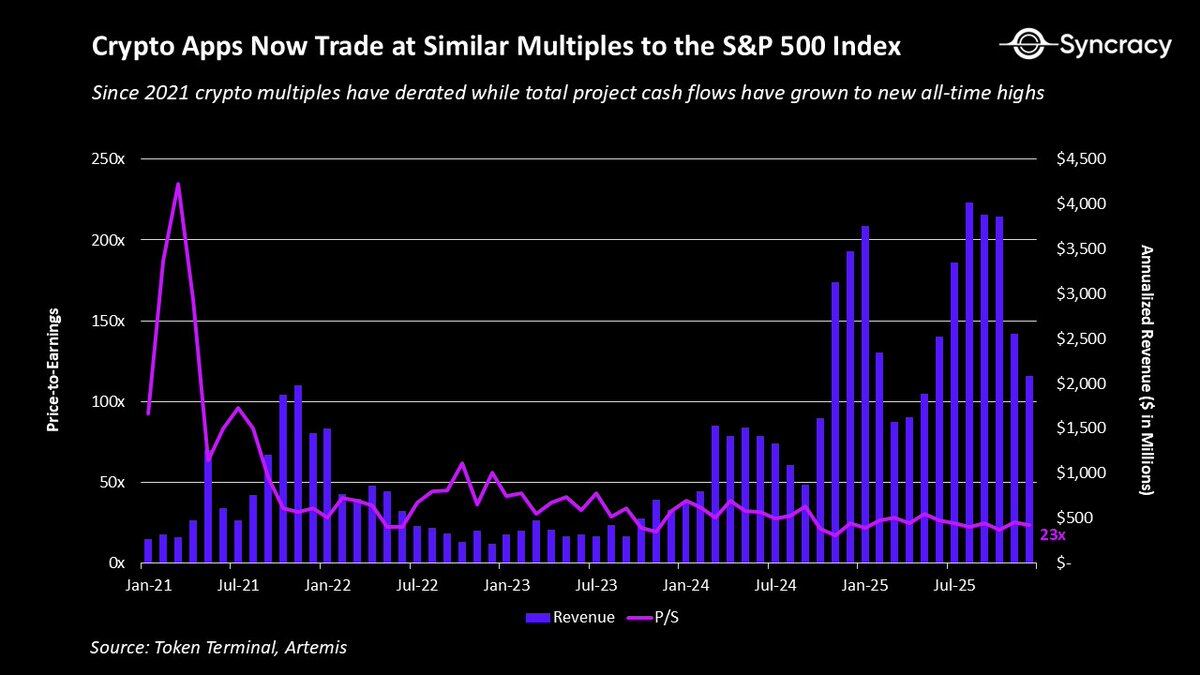
A broader valuation consensus is also taking shape. Watkins says the market is converging around a simple principle: 99.9% of assets need to produce cash flow, with only a very small set of exceptions for store-of-value assets such as BTC and ETH. As more fundamentally driven investors enter the category, he expects those frameworks to strengthen and pricing discipline to improve.

He pushes the idea further by arguing that self-sovereign ownership of on-chain cash flow may, over a long enough time horizon, come to be seen as a breakthrough on the same order as self-sovereign ownership of digital value storage. He poses the question directly: when in history has it been possible to hold a digital bearer asset that pays you autonomously whenever a program is called anywhere in the world?
Ethereum, Solana, and Hyperliquid as candidate financial base layers
Within that framework, Watkins says the blockchains that emerge on top are becoming the monetary and financial base layer of the internet. He specifically names Ethereum, Solana, and Hyperliquid, arguing that their network effects are deepening as their ecosystems of assets, applications, businesses, and users expand.
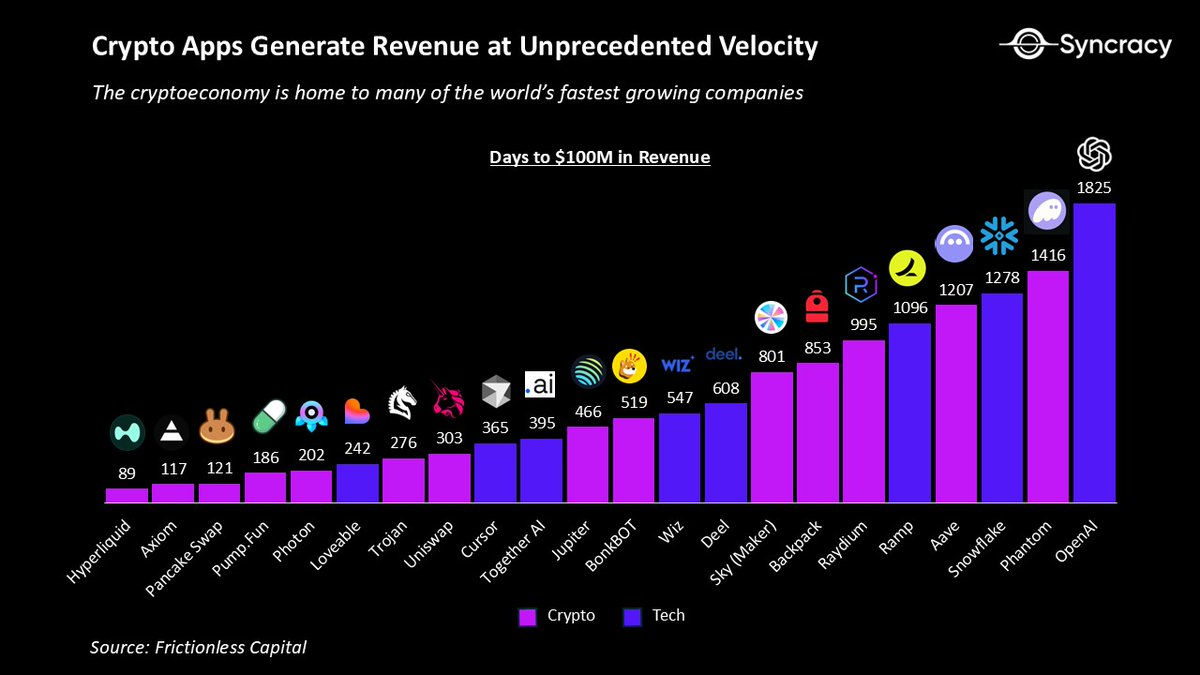
He says their permissionless design and global distribution are helping applications built on them become some of the fastest-growing businesses in the world, with unusual capital efficiency and revenue velocity. Over the long run, he believes those platforms could support much of the total addressable market for the “financial super apps” that leading fintech companies are trying to build.
That backdrop, in his view, helps explain why established firms on Wall Street and in Silicon Valley are moving aggressively into blockchain-related products. Watkins says there is now a fresh wave of launches almost every week, spanning tokenization and stablecoins. Unlike in earlier crypto cycles, he argues, these are no longer experiments. They are production-grade products, and most of them are being built on public blockchains rather than isolated private systems.
He expects this activity to accelerate as the lagged effect of regulatory change spreads through the system over the coming quarters. Under clearer rules, he says, companies and institutions can shift attention away from asking whether blockchain activity is legal and toward asking how it can expand revenue, cut costs, and unlock new business models.
Watkins also says one revealing sign of the current moment is how few analysts are willing to model exponential growth. Based on his own intuition, many peers on both the sell side and the buy side are reluctant to use annual growth rates above 20% for fear of appearing too optimistic. After a four-year valuation reset, he argues, this is exactly the point at which investors should ask what happens if these markets do grow exponentially.
The sector may be underpriced, but individual tokens can still go to zero
In the final section, titled The Twilight Zone, Watkins quotes Ursula LeGuin: “To light a candle is to cast a shadow.” He then recalls a conversation from a cool autumn day in 2018, before another exhausting day in investment banking, when he stopped by an older professor’s office to talk about blockchain.
According to Watkins, the professor recounted a discussion with a skeptical equity hedge fund manager who had described crypto as entering a nuclear winter and dismissed it as “a solution still looking for a problem.” After giving Watkins what he describes as a quick lesson on unsustainable sovereign debt burdens and collapsing trust in institutions, the professor shared the line he had used in response: “In ten years, the world will be grateful that we built this parallel system.”
Watkins says it has not yet been ten years since that exchange, but the statement now looks prescient as crypto increasingly resembles an idea whose time has come. That is the core argument of the piece: the world is still underestimating what is being built in this sector, and for investors the practical implication is that multi-year opportunities in leading projects are undervalued.
He is careful, though, not to turn that into a blanket defense of every token. Even if the broader crypto economy proves unstoppable, he writes, a favorite coin can still go to zero. The same forces making crypto hard to stop are drawing in tougher competition, and the pressure to execute has not been higher. As institutions and large enterprises enter the field, he says many weaker players are likely to be washed out.
Watkins does not argue that incumbent giants will simply capture everything, nor that they will fully absorb the technology into closed systems. But he does argue that only a very small number of native crypto players are likely to become the major winners around which a re-anchored global order is built.
He adds that this should not push investors into cynicism. In emerging technology, he writes, 90% of startups fail. More visible failures may surface over the next few years. That should not obscure the larger pattern.
Watkins ties that larger pattern to broader conditions: declining trust in institutions across developed societies, unsustainable government spending across G7 member states, overt currency debasement by the largest fiat issuers, deglobalization, fragmentation in the international order, and growing demand for a system viewed as fairer than the old one. Add AI as an accelerator for software and a generational transfer of wealth from aging baby boomers to younger cohorts, and he believes the moment is well suited for the crypto economy to move beyond its own smaller bubble.
He also pushes back on the use of classic technology-adoption frameworks such as the Gartner hype cycle or what Carlota Perez describes as a post-mania phase. Those models, he says, imply that the best returns are already behind the market and that what comes next will be a flatter period of practical deployment. He thinks the reality is less neat and much more interesting.
For Watkins, the crypto economy is not a single market maturing in unison. It is a collection of products and companies sitting at different points on different adoption curves. Just as important, once a technology enters a growth phase, speculation does not disappear. It rises and falls with shifts in sentiment and with the pace of innovation. Anyone claiming the speculative era is over, he writes, is probably either demoralized or unfamiliar with history.
His closing position is straightforward. Skepticism is reasonable. Cynicism is not. He says the sector is reimagining money, finance, and the governance of core economic institutions, a process that is exciting, difficult, and consequential at the same time. The task from here is not to keep writing endless posts about why everything is doomed, but to figure out how best to engage with a reality that is already taking shape.
Behind the fog of disillusionment and uncertainty, Watkins argues, sits a rare opportunity for those willing to back the beginning of a new era rather than mourn the fading of the old one.