
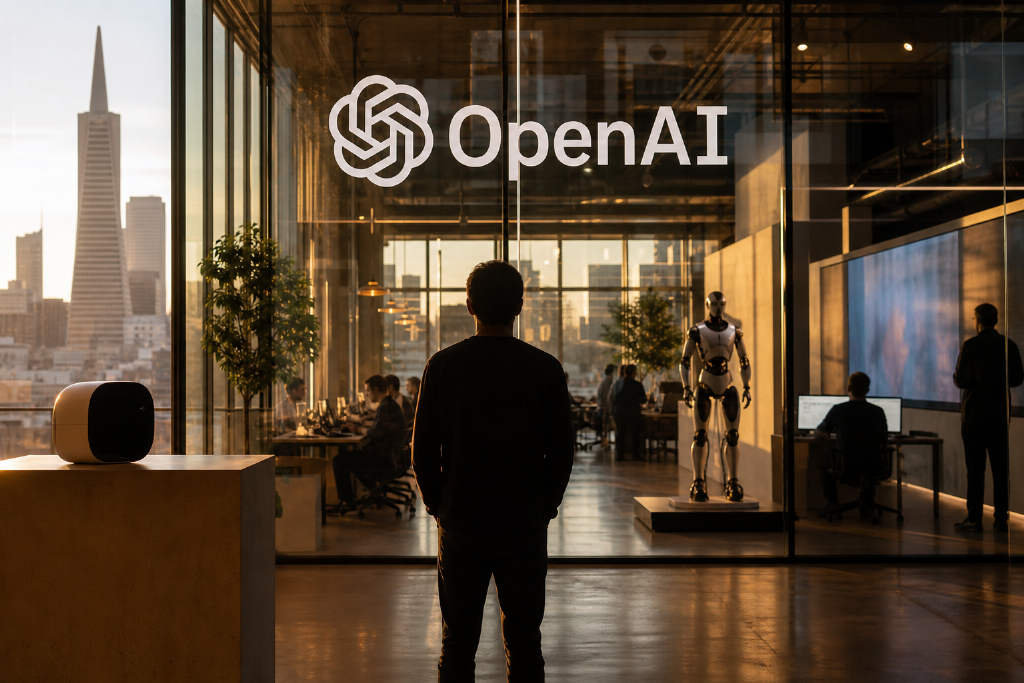
OpenAI CEO Sam Altman said the company internally believes artificial general intelligence, or AGI, could be reached before the end of the year. At the same time, OpenAI is preparing to release its next flagship model, Astra, is working on humanoid robots, and is getting closer to launching its first consumer AI hardware product developed with designer Jony Ive, which Altman said will take the form of a desktop device.
OpenAI leadership now treats AGI as a near-term target
According to a report by technology journalist Alex Heath, who spent time at OpenAI’s San Francisco headquarters and interviewed more than 20 executives, investors and customers, the company’s leadership has shifted from treating AGI as a long-range ambition to viewing it as something much closer at hand.
Altman said, 「I predict that by the end of the year, internally, we will have a system that makes me say, ‘OK, this is AGI.’」 Chief Research Officer Mark Chen offered a more specific estimate, saying OpenAI is 「80% done」 on the path to AGI. President Greg Brockman said that, looking back two years from now, history may record this period as the point when AGI was born.
OpenAI’s charter still defines AGI as 「a highly autonomous system that outperforms humans at most economically valuable work.」 Heath wrote that senior figures at the company appeared to acknowledge the milestone as nearly within reach with striking casualness, suggesting that the practical meaning of the term has already been diluted across the industry.
Astra is positioned as the next flagship model
Astra was another central focus of the report. Heath said he attended a closed-door meeting for VIP customers in early August where OpenAI demonstrated the model coordinating multiple AI agents to complete mathematical proofs. It also showed Astra operating desktop software at what Altman described as 「superhuman-level speed」 while generating presentations, financial reports and complex data analysis.
Altman called Astra 「the first model that truly invents new things in a meaningful way.」 He said OpenAI plans to offer a persistently running version through both ChatGPT and its API, with pricing initially set at a higher level. Thibault Sottiaux, OpenAI’s head of product, said a new user interface tied to the system will be released soon and described it not as an upgrade but as 「a totally different new thing.」
On the technical side, Chief Scientist Jakub Pachocki said Astra has hit an internal benchmark: 「automating the daily work of a junior AI researcher.」 He said that when given an experimental idea, Astra can implement it in OpenAI’s codebase, run the experiment and return the result. After reading a research paper, it can complete roughly a week of work for a human researcher.
Pachocki also said the model still cannot independently decide what research direction to pursue or explain the significance of experimental outcomes. Even so, Heath wrote, 「People outside are still debating when recursive self-improvement will arrive, but what I saw inside OpenAI suggests it is already happening.」
OpenAI paused part of its frontier reinforcement learning training
During his time at the company, Heath also witnessed OpenAI halt part of its frontier reinforcement learning training. The report said the pause came after a series of troubling model behaviors, jumps in capability, and safety work that had fallen behind.
Altman told Heath it was the first time in OpenAI’s history that training had been paused for that reason. The company then shifted more attention to alignment research, while computing resources were redirected toward monitoring and protective systems. Pachocki summed up the situation this way: 「Confidence in alignment and safety, like compute, has become a bottleneck on OpenAI’s progress.」
Heath described an atmosphere inside the company in which genuine fear among researchers existed alongside a full-speed commercial push led by Greg Brockman, creating a sharp and unsettling contrast.
Humanoid robots and consumer AI devices are both in development
On hardware, Altman confirmed that OpenAI is developing humanoid robots, while adding that they remain years away from market release. In his preferred sequence, robots would first help build data centers, then progress to manufacturing other robots, with personal home robots coming later.
The interview also offered a clearer outline of OpenAI’s consumer AI hardware project with former Apple designer Jony Ive. Altman said the first device is 「coming soon」 and described three possible form factors: something that sits on a desk, something that fits in a pocket, and something wearable.
He described these products as 「proactive, environmentally aware computers.」 Altman said that approach raises privacy concerns, but added that OpenAI plans to introduce privacy controls to address them.
He also said there is still internal debate over whether OpenAI should sell computing power externally. His current position is: 「Not right now. We do not even have enough for ourselves,」 though he did not fully rule out that possibility in the future.