
OUSD Unveiled: A Consortium of 140 Firms to Build an Open Stablecoin
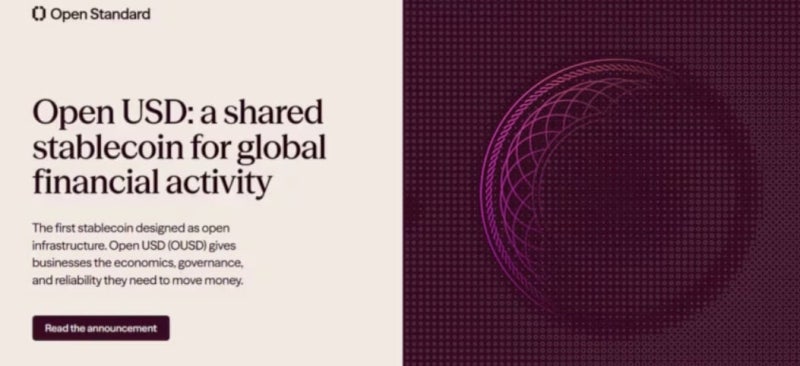
On June 30, 2026, the global stablecoin alliance Open Standard officially introduced OUSD, a dollar-pegged stablecoin, with a planned launch before the end of the year. According to its public roster, the consortium includes over 140 leading financial and payment companies, such as Visa, Mastercard, and BlackRock. In South Korea, household names like Samsung Electronics, Upbit operator Dunamu, Shinhan Financial Group, KakaoBank, K-Bank, Hyundai Card, KB Kookmin Card, BC Card, Hana Card, Samsung Card, Woori Card, NH Nonghyup Card, and Hanwha Group were all listed as participants. Open Standard clarified that the consortium is not structured as a decentralized autonomous organization (DAO) or shareholder entity but rather as an industry collaboration aimed at building an open payment infrastructure.
The arrival of OUSD was quickly interpreted by the crypto industry as a direct challenge to the current duopoly of Tether (USDT) and Circle (USDC). By adopting a multi-stakeholder operating model rather than a single-issuer framework, the project seeks to enhance transparency, compliance, and trust. Open Standard argues that only direct involvement from payment processors and financial institutions can create a stablecoin network truly suited for global commerce.
Korean Companies Push Back: No Official Talks, Only Casual Inquiries
The celebratory tone was soon undercut by swift denials from multiple Korean firms. A Samsung Electronics official stated unequivocally that “no official discussions have taken place, and we are not aware of any specific role within the alliance.” Shinhan Financial Group, Dunamu, and K-Bank similarly explained that Open Standard had merely reached out to gauge interest, and they had answered with a non-committal “we will consider it if the project goes well.” One unnamed executive noted that his company only learned of its inclusion through domestic news reports and described the situation as “embarrassing,” adding that the original response was little more than “we’ll review it if it succeeds.”
The awkward retractions from major credit card and banking groups cast doubt on Open Standard’s early momentum. While the consortium continues to claim backing from over 140 enterprises, the practice of equating preliminary interest with formal membership has drawn skepticism about the project’s ability to deliver on its operational goals. As of now, global payment leaders like Visa and Mastercard have not commented on the controversy, leaving their true level of commitment uncertain.
How OUSD Works and How It Plans to Redistribute Revenue
Mechanically, OUSD follows the classic fiat-backed model: when a partner institution deposits one U.S. dollar into Open Standard’s reserve account, the consortium issues one OUSD. When the token is returned, an equivalent dollar amount is sent back to the institution’s bank account. For consortium members, both minting and redemption are completely free of charge and come with no transaction limits—a significant operational advantage compared to the fees and constraints often associated with USDT and USDC.
The more radical departure lies in the profit-sharing structure. Tether and Circle generate tens of billions of dollars annually by investing customer deposits in U.S. Treasury bills and other safe assets, keeping the proceeds almost entirely for themselves. In contrast, OUSD pledges to distribute all investment income from reserve assets—minus a small operational management fee—among network participants. This revenue-return model is designed to incentivize compliant institutions to join the ecosystem and to foster a more decentralized, community-aligned financial infrastructure. Nevertheless, the recent membership controversy underscores that even a well-intentioned design cannot succeed without solid partnership foundations and transparent communication.