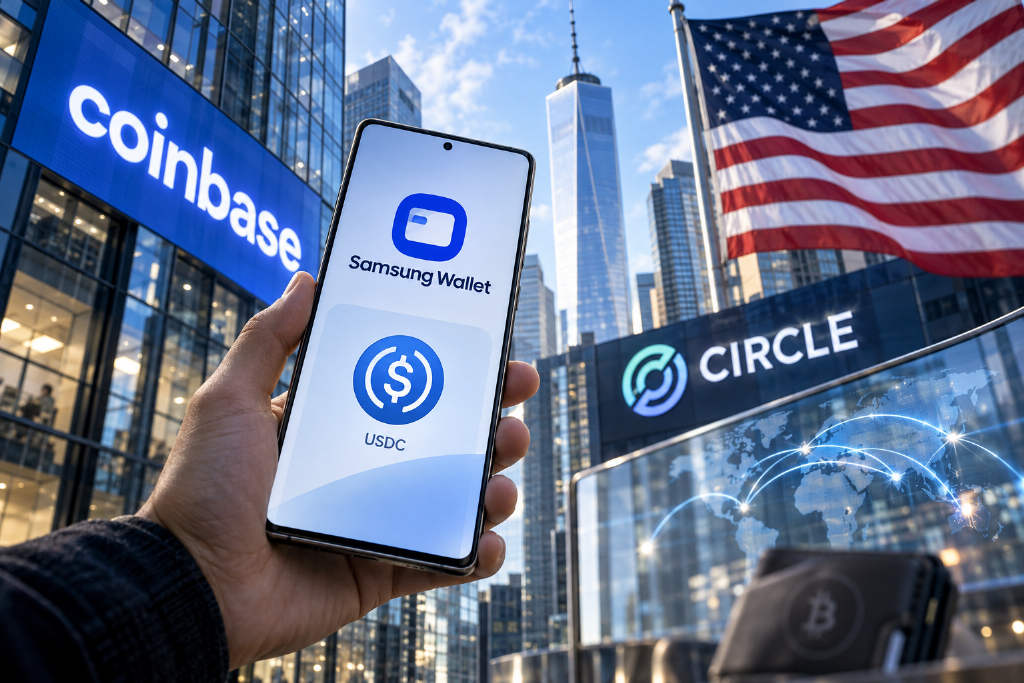
Coinbase said on Oct. 8 that, starting in the last week of October 2026, USDC will automatically appear as the default option when U.S. users add stablecoin balances in Samsung Wallet. Samsung Wallet is preinstalled on Galaxy devices, and the company said about 82 million compatible devices in the United States will be in scope when the feature launches.
Samsung first said in July that the wallet would support stablecoins, but it did not name an issuer or give a launch date at the time. Three months later, the first partner and the default stablecoin have been identified. What has not been disclosed is how much balance this entry point may bring in, or how the economics will be split.
Where USDC in Samsung Wallet can go
Based on what has been disclosed so far, USDC held in Samsung Wallet will initially have two destinations. Users can send it to compatible external crypto wallets, or remit funds to overseas bank accounts, with recipients receiving local currency.
The underlying service is provided by U.S. stablecoin infrastructure company Bastion, and the related USDC is custodied by Coinbase Prime. Bastion’s developer documentation says its withdrawal service covers bank accounts in more than 60 countries. The account holder must be a U.S. person, and customers in New York are currently unable to withdraw to bank accounts.
Those limits come from Bastion’s own product. Samsung has not fully disclosed the exact rollout scope, fees, or settlement times for Samsung Wallet itself.
In a written response in August, Samsung said it would begin rolling out stablecoin accounts, cross-border remittances, and payment functions in selected countries within this year.
Circulation fell, but transaction volume stayed strong
Coinbase disclosed that USDC circulation grew 72% in 2025 to more than $75 billion.
In the second quarter of 2026, USDC circulation fell from about $77 billion at the end of the first quarter to $73.3 billion, a decline of about 4.8%. Over the same period, USDC’s adjusted transaction volume in June was about $1.21 trillion, accounting for roughly 67% of adjusted stablecoin transaction volume.
So circulation has eased, while on-chain activity remains active. The question for USDC is whether it can move into more everyday money movement scenarios beyond exchanges and DeFi. Samsung Wallet offers a direct test: users can initiate stablecoin transfers from a phone wallet instead of first relying on a standalone crypto wallet.
Distribution, transaction and other costs were close to 60%
Stablecoins do not pay interest to holders. About 95% of revenue at USDC issuer Circle comes from returns on reserve assets.
In the second quarter, Circle reported $701 million in total revenue and reserve income, while distribution, transaction and other costs came to $412 million, or 59%. For full-year 2025, that cost line was about $1.4 billion, or about 51%. The article notes that not all of that spending goes to channel partners, but distribution payments are a major component.
Coinbase is Circle’s largest distribution partner. On Aug. 18, the two companies renewed their agreement for another three years through 2029, with terms unchanged.
USDC in Samsung Wallet will be custodied by Coinbase Prime. Coinbase’s announcement did not say whether those balances fall under the companies’ existing distribution arrangement, or whether Samsung receives a share.
A new mobile entry point, but value depends on retained balances
What Samsung brings is a new mobile distribution channel. Coinbase gets custody and a commercial partnership opportunity, while Circle may gain a way to push USDC into more cross-border transfer use cases.
Still, 82 million compatible devices do not equal 82 million stablecoin users. The commercial value of this channel will depend on how many people actually open accounts after launch, how many make transfers, and how much balance remains in the system.
If Samsung Wallet does bring sustained growth in USDC balances, the next issue will not only be user acquisition. It will also be how the business value generated by those balances is allocated. The partnership terms that have not yet been disclosed may become the key point then.
This article is for reference only and does not constitute investment advice. Markets involve risk, and investment decisions should be made with caution.