
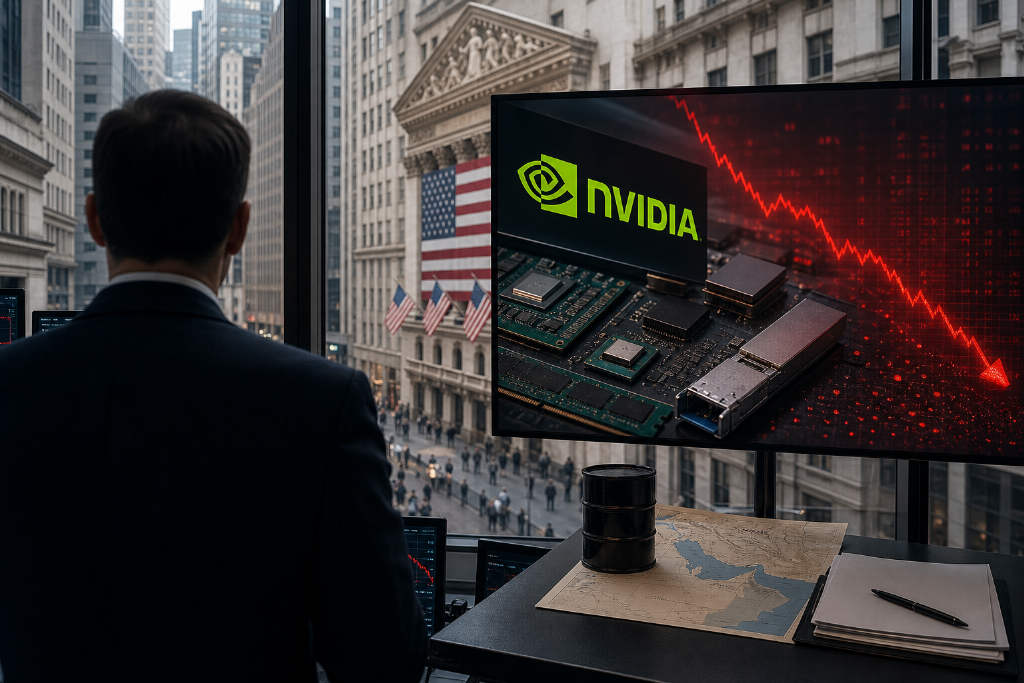
U.S. stocks ended Monday on a split note, with the Dow Jones Industrial Average up 0.26%, the S&P 500 down 0.28%, and the Nasdaq Composite off 0.76%. Financials, consumer staples and other defensive blue chips helped hold up the Dow, while AI hardware was the main pocket of selling pressure.
Iran sanctions talk pushed oil lower, but fiscal concerns stayed in focus
Scott Bessent rolled out what the report called an 「economic orphan action」 on Monday, targeting five Iranian economic lifelines: digital assets, technology, gold, aviation and shipping. He also threatened secondary sanctions on countries that continue dealing with Tehran. Trump was described as speaking with foreign leaders to press for a cut in economic ties with Iran, with counterparties to be given time to comply before the Treasury Department acts on its own.
Iran pushed back quickly. Mohber, identified in the report as an adviser to Iran’s supreme leader, said the response would be firmer than before and that sanctions and war had failed over the past 47 years. He said Iran now faced the situation with internal unity and deterrence in the Strait of Hormuz. Iran’s speaker, meanwhile, said trading partners 「would not take seriously」 what he described as U.S. nonsense.
Markets reacted with a classic buy-the-rumor, sell-the-fact move. Brent crude fell 2.35% to $92.17 a barrel, while WTI dropped to around $85.01, easing some inflation premium for the moment.
Goldman Sachs said the risk would return if the Hormuz crisis lasts into winter. In that case, pressure on European gas inventories could intensify, and TTF gas might need to rise above EUR100 per megawatt-hour to attract enough LNG supply. European gas storage is currently around 62%, which the report described as a seasonal low for the period in nearly 20 years.
Treasury buyback expectations met skepticism on Wall Street
Bessent also sounded restrained on Treasury market operations, saying, 「We haven’t even bought a single bond,」 and adding that the next buyback is scheduled for Sept. 9. Earlier reports had suggested the Treasury could tap nearly $1 trillion from the Treasury General Account, with the balance estimated at about $935 billion to $950 billion, to fund expanded long-dated bond buybacks.
Morgan Stanley rates strategist Martin Tobias estimated the usable size at roughly $80 billion to $200 billion.
Goldman Sachs, Deutsche Bank and Citadel Securities were all skeptical. Their view, according to the report, is that buybacks cannot fundamentally reset long-end yields. The deeper problem remains the combination of $40 trillion in U.S. debt, persistent fiscal deficits and inflation. Citadel Securities went further, calling the move a form of 「financial repression」 that would only shift pressure onto the dollar, inflation and other assets.
In the rates market, the 10-year Treasury yield slipped about 3 basis points to around 4.70%, and the 30-year yield moved down to 5.24%. The U.S. dollar index rose about 0.20% to around 99. The report said the initial support for the dollar came from safe-haven demand linked to sanctions headlines, but traders are also starting to worry that if the Treasury forces long-end yields lower, the dollar could face pressure later. One sign of that shift: the premium on one-month dollar downside options versus upside options has risen to its highest level since February.
Gold extended gains as banks watched inflation and Jackson Hole
Gold kept rising and touched $4,696 intraday, the highest level in nearly three months. New York gold futures pushed further to $4,755. Citigroup raised its 0- to 3-month gold target to $4,800 an ounce and kept its 6- to 12-month target at $5,000 an ounce.
JPMorgan said gold could first pull back if PCE inflation comes in above expectations. If the data is softer and Jackson Hole does not deliver a strongly hawkish signal, the bank said prices could move quickly toward $5,000.
Trade pressure on Canada added another layer of uncertainty
Trump also kept pressure on trade markets, saying Canada was 「taking advantage of the United States」 and warning of more serious consequences if it did not follow the rules.
Market chatter cited in the report suggested the U.S. could raise tariffs on Canadian autos, auto parts and steel to 50% starting in 2027, a move that would affect costs across the North American auto supply chain.
AI hardware sold off sharply, with Nvidia down for a seventh straight session
AI hardware and semiconductor stocks were hit hard overnight. The Philadelphia Semiconductor Index dropped nearly 3%, memory shares lost about 5.5% as a group, and optical networking names led the decline.
Nvidia fell 2.91%, marking a seventh straight trading-day loss, its longest slide since 2022. The report said the stock move stood in visible contrast to fundamentals. Nvidia executives said Groq 3 LPX racks had entered full-scale production for low-latency AI inference and would be deployed at Nebius data centers alongside the Vera CPU and Rubin GPU. Over the past three months, Wall Street earnings forecasts for Nvidia have actually been raised by about 13%, and most of the 82 analysts tracked still rate the stock a buy.
Traders, though, are focused on earnings risk ahead of this week’s results. The market concern is that even strong numbers may not be strong enough to justify the current valuation. Goldman Sachs said demand data in Wednesday’s report could be 「absurdly strong,」 but argued the real issue is memory costs and financing for AI infrastructure. If hardware costs keep rising, Nvidia may eventually have to choose between absorbing the cost, raising prices for customers, or reducing reliance on memory.
On the session, Nvidia closed down 2.91% and has lost more than 7% over the streak. The report added that while analysts have raised profit forecasts by 13% over the past three months, and most still see more than 50% upside in target prices, the stock’s forward price-to-earnings ratio has fallen to about 18x.
Credit risk concerns spread through AI infrastructure, memory and networking
Wall Street is paying closer attention to credit risk tied to AI infrastructure. Broadcom’s 5-year CDS has widened by 28 basis points since August, and the yield on its 2031 bonds has risen by about 14 basis points over the same period. The report said that risk premium has even moved above Oracle and SpaceX. JPMorgan strategists warned that off-balance-sheet credit support in the AI ecosystem, including leases, purchase commitments and residual value guarantees, could eventually reach the trillions of dollars. That has sharpened concern over compute-linked lending and hidden leverage.
Semiconductor stocks fell broadly. Broadcom dropped 2.63%, the Philadelphia Semiconductor Index fell 2.7%, AMD lost more than 3%, Intel fell more than 3%, and TSMC lost more than 2%.
Memory was one of the hardest-hit groups. Samsung Electronics’ shareholder return plan came in below expectations, triggering a second wave of selling across global memory names. Investors are questioning whether the pricing cycle driven by HBM and AI servers had already been priced too aggressively into these stocks. Micron fell nearly 6%, SanDisk dropped 6.45%, Seagate fell more than 6%, Western Digital lost more than 5%, and SK Hynix fell nearly 5%.
Optical names, Tesla and China EV ADRs also weakened
Optical communications stocks were also under pressure. Applied Optoelectronics launched its third at-the-market offering of the year, aiming to raise $600 million. That triggered worries about cash flow and dilution, and the stock plunged nearly 14%. Ciena, Lumentum and Coherent moved lower in sympathy.
Applied Optoelectronics fell nearly 14%, Ciena lost more than 6%, Lumentum fell more than 4%, Coherent dropped more than 4%, and Marvell Technology fell more than 3%.
Tesla closed down 3.83% after a voluntary recall in China of about 3 million vehicles tied to door-handle and driver-monitoring risks, which the report described as a record recall for a single brand. Tesla is scheduled to hold its Cybercab event on Sept. 3, but traders put the probability of retail delivery this year at only 17%. In related names, XPeng fell more than 8% and NIO lost nearly 6%, with the broader U.S.-listed China new-energy vehicle chain under pressure.
Platform tech was more resilient, led by Meta
Large platform stocks held up much better than AI hardware. Meta rose 1.66%. The company plans to launch its 「Hatch」 AI agent platform in the coming weeks, described as a smart shopping tool inside Instagram, and then release its latest AI model, 「Watermelon,」 in October. The premium subscription tier could cost as much as $199.99 a month.
Amazon rose 1.33% after AWS introduced Glue 6.0 with a 30% price reduction. Microsoft gained 0.84%, Google added nearly 1%, and Apple edged up 0.32%.
SpaceX fell 1.44%. The report said SpaceXAI will use Nvidia’s Vera CPU for Agentic AI and plans to extend an optimized Vera Rubin NVL72 system into space for Starmind AI satellites. Separately, NASA’s Roman Space Telescope is scheduled to launch on Aug. 30 aboard a Falcon Heavy rocket.
Elsewhere, Bloom Energy gained 1.28% after Pelosi disclosed for the first time purchases of Bloom Energy shares and options while also adding to Intel, in a bet on AI power and chips. Boeing fell 1.75%, though after the close the company was reported to have secured a U.S. Air Force F-15 contract worth up to $131.2 billion. Visa rose 3.07%, Walmart gained 2.69%, and Disney added 2.62%, helping support a second straight gain in the Dow.
Key dates ahead
Aug. 25
The Jefferies Semiconductor, IT Hardware and Communications Technology Conference runs from Aug. 25 to Aug. 26, with participants including TSMC, FormFactor, Aehr Test Systems and Arbe Robotics. Discussion topics include AI accelerators, high-bandwidth memory, advanced packaging, data center demand and automotive semiconductors.
Aug. 26
Gamescom in Cologne runs from Aug. 26 to Aug. 30, with an opening time of 02:00. Microsoft, Nintendo, Tencent, NetEase and CDPR are among the companies expected to appear. Investors are watching for news on game releases, AI gaming tools, cloud gaming and hardware ecosystems.
Deutsche Bank’s California Technology Conference is scheduled for Aug. 26 to Aug. 27 in Dana Point, California.
The Shenzhen AGIC general artificial intelligence expo runs from Aug. 26 to Aug. 28. The report said the heavy cluster of AI industry events will keep attention on embodied intelligence and the progress of AI applications moving into real-world use.