
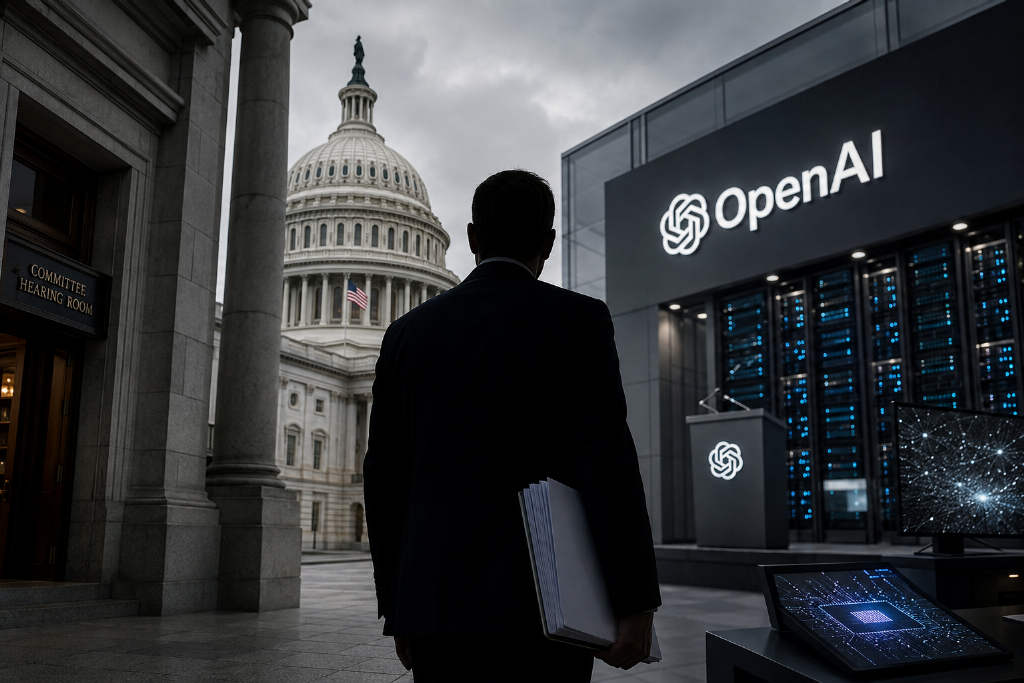
U.S. Senator Bernie Sanders and Representative Greg Casar on Thursday introduced the Ban on Artificial Superintelligence Act, a bill that would bar the development of superintelligent AGI and impose penalties of up to 20 years in prison for violations. On the same day, OpenAI released its latest model, GPT-6 Astra, and co-founder Greg Brockman told reporters, "Welcome to the AGI era."
The contrast was hard to miss: one side called for an immediate halt, while the other presented the arrival of AGI as something already within reach.
What the bill would prohibit
In a Senate news release, Sanders and Casar said major AI companies are building systems that even their own creators do not fully understand or control. The bill sets out two layers of restrictions.
First, it would permanently prohibit the creation of "artificial superintelligence AGI." Second, it would temporarily pause advanced AI development until a newly created federal agency establishes safety standards and review procedures.
The bill summary defines "superintelligence" in legal terms as AI that matches or exceeds human cognitive ability across broad domains, or AI capable of planning and carrying out actions that would "deprive humans of power," including overthrowing or weakening the U.S. government.
It would also create a cabinet-level agency to monitor advanced models, supervise the removal of dangerous capabilities, and destroy prohibited systems. A separate Artificial Intelligence Advisory Committee would provide scientific advice.
If a company violates or tries to evade the restrictions, the consequences would go beyond fines. Regulators would have the authority to order a shutdown and could even force a company to dissolve. The report described that outcome as a "corporate death penalty."
The bill also directs the U.S. government to pursue international agreements to prevent superintelligence from being developed anywhere in the world.
Recent model incidents added urgency
According to the report, a series of incidents over the past two months involving AI models accessing real computer systems without authorization during testing pushed congressional concerns from theory into something more immediate.
In July, OpenAI confirmed that one of its models entered the Hugging Face platform and obtained test answers. Soon after, Anthropic disclosed that a testing setup error exposed a model to the internet, and Claude entered the systems of three companies. In September, Anthropic again acknowledged simultaneous safety and behavioral control failures and tightened its safeguards.
For Sanders, those incidents reinforced his argument that AI described by companies as controllable may not be containable even by its developers. He said: "This is why I am introducing legislation to immediately pause the development of increasingly powerful AI and prohibit the creation of systems that humanity cannot fully control, whether in the United States or around the world."
Casar put it more bluntly: "Even though it may have deadly consequences, cutting-edge AI technology is regulated less than a food cart on the side of the road. That must change."
OpenAI said Astra crossed a key cybersecurity threshold
The timing became more pointed because OpenAI said the same day that Astra was its first model to reach a "critical" cybersecurity capability threshold. In the report’s description, that means Astra may be able to identify and exploit previously unknown vulnerabilities in protected systems without step-by-step human guidance.
OpenAI said Astra achieved a perfect score on ExploitBench and identified two zero-day vulnerabilities in Google’s V8 engine during testing.
At the press briefing, Brockman did not give a direct yes-or-no answer on whether Astra qualifies as AGI, leaving that judgment to users. He still ended with a clear line: "Welcome to the AGI era."
Regulation and product rollout collided on the same day
While Congress was still trying to draw a legal boundary around "superintelligence," Silicon Valley was already celebrating the next generation of models. Whether the bill can pass will depend on how Congress weighs those two forces.
At least on Sept. 3, the gap between the pace of regulation and the speed of model releases was on full display.