
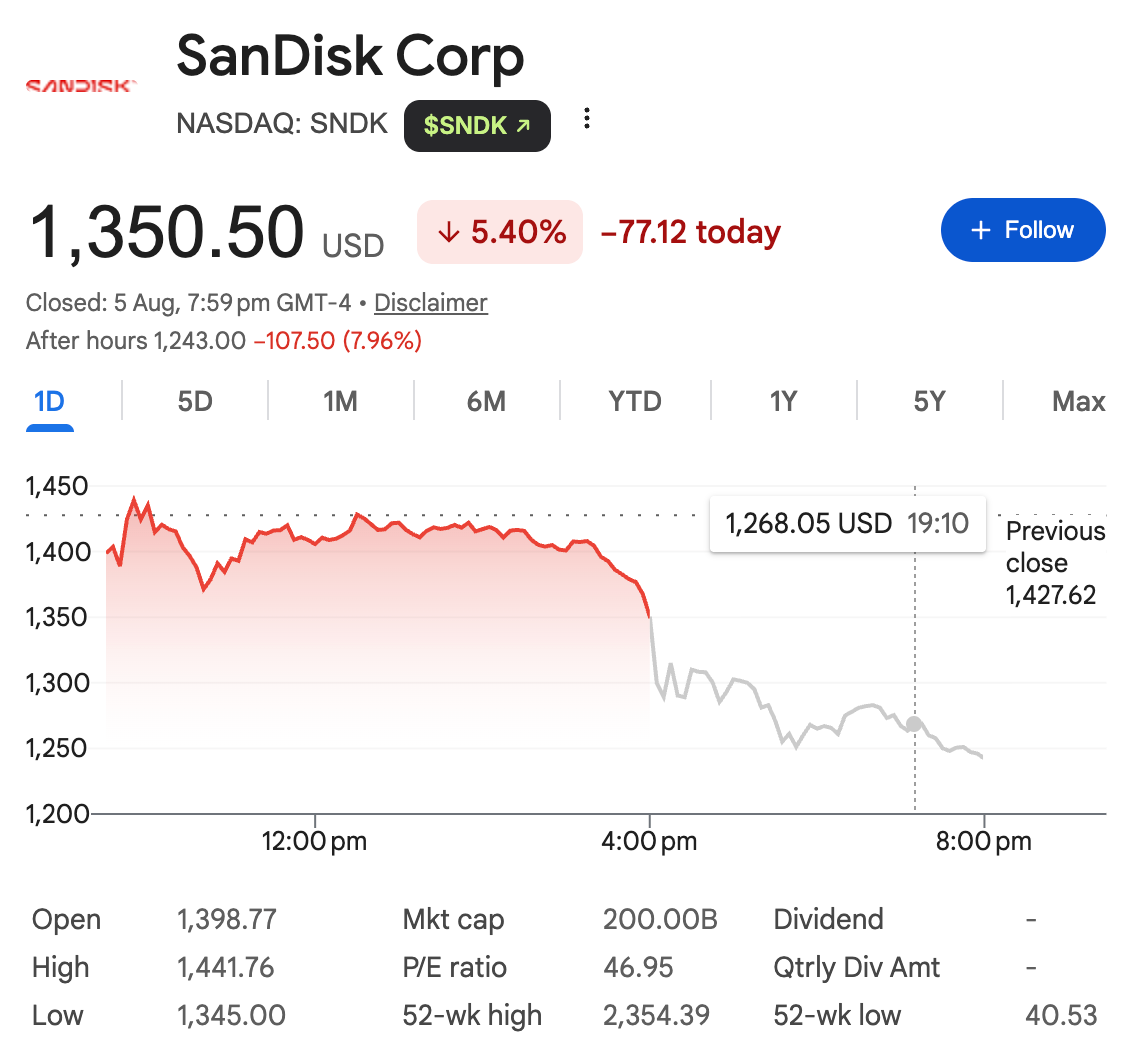
SanDisk reported record quarterly and full-year results for the period ended July 3, but the market response stayed negative. Before the earnings release, the stock had already closed down 5.4%. After the report, it fell nearly 8% in after-hours trading and was quoted at $1,243 as of 11:00.
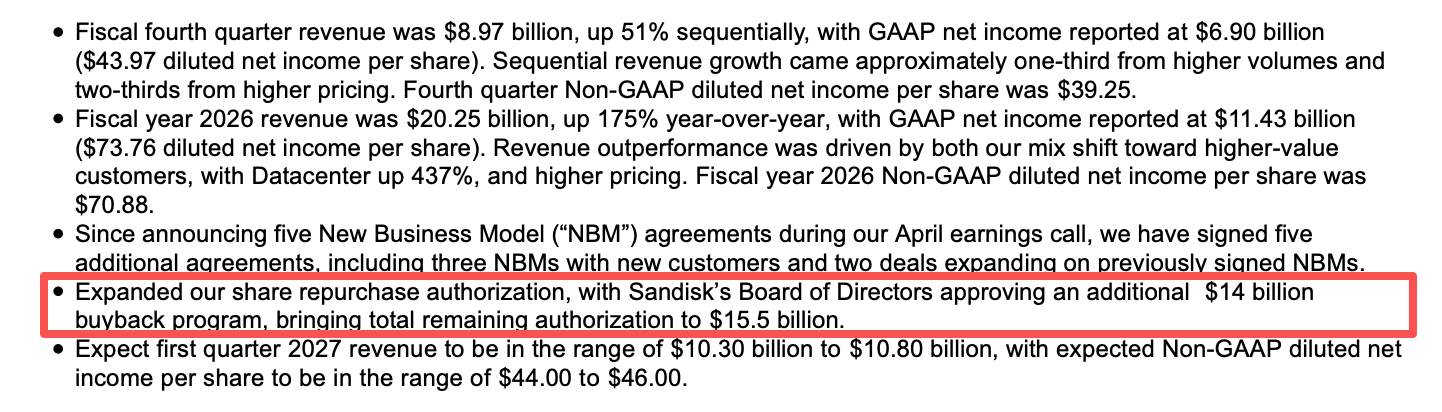
For the fourth fiscal quarter, SanDisk posted revenue of $8.97 billion, above the market expectation of $8.48 billion. Revenue rose 372% from a year earlier and 51% from the prior quarter. On a non-GAAP basis, adjusted earnings per share came in at $39.25, up 135 times from $0.29 a year ago and 68% from the previous quarter. The figure was nearly 10% above market expectations. Adjusted gross margin reached 84.6%, up 58.2 percentage points year over year.
Full-year results were equally strong. SanDisk said fiscal 2026 revenue reached $20.25 billion, up 175% from the prior year. GAAP net income was $11.43 billion, while full-year non-GAAP EPS reached $70.88. In fiscal 2025, the company had posted a loss of $1.64 billion. That reversal over one year reflected the combination of the NAND memory cycle and AI-related demand described in the source report.
Why the stock still sold off
The earnings report itself was not the main issue. The market appeared to focus on whether future growth could keep running ahead of already elevated expectations.
SanDisk guided for fiscal 2027 first-quarter revenue of $10.3 billion to $10.8 billion, with a midpoint of $10.55 billion. The market had been expecting $11.16 billion, leaving a gap of about 5.5%. That difference shaped the reaction: investors were not rejecting the results that had already been delivered, but questioning whether the next leg of growth would still satisfy a higher bar.
Business mix shifts toward data center
A breakdown of the quarter showed how much the company’s revenue mix has changed. CEO David Goeckeler said data center had become SanDisk’s main growth engine.
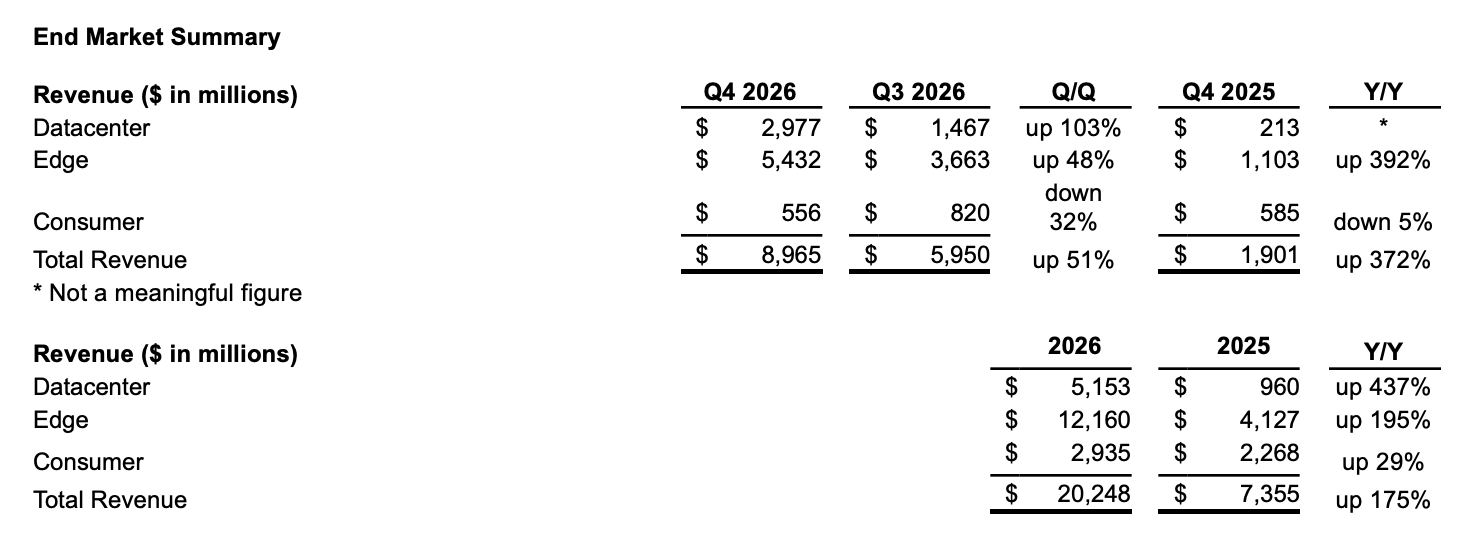
Data center revenue reached $2.98 billion in the fourth quarter, up 1298% from a year earlier and 103% from the previous quarter. The segment’s share of total revenue climbed from about 11% a year ago to 33%. For the full fiscal year 2026, data center revenue rose 437%, and management identified it as a key growth pillar.
The report tied that strength to demand from AI servers and high-performance computing storage. Edge remained the company’s largest revenue contributor, however. Fourth-quarter edge revenue was $5.43 billion, up 392% year over year and 48% quarter over quarter, supported by enterprise and end-device markets.
Consumer was the weakest part of the business. Revenue in that segment fell to $556 million, down 5% from a year earlier and down 32% from the prior quarter. It also came in well below the market expectation of $874 million. The report pointed to weak traditional consumer electronics demand and longer replacement cycles for PCs and smartphones. It also said SanDisk has been shifting customer mix toward higher-value data center and enterprise markets, making the consumer decline part of that transition.
NBM long-term agreements drew heavy attention
Management spent significant time on the earnings call discussing the strategic role of its New Business Model, or NBM, long-term agreements.
In the NAND industry, supply and pricing have historically been negotiated quarter by quarter, producing sharp swings. SanDisk said that after disclosing five NBM long-term agreements during the April earnings season, it disclosed five more this quarter. Those included three new agreements and two expanded or upgraded existing agreements.
The related orders cover supply over multiple years. SanDisk said more than half of its fiscal 2027 supply has already been locked in, while about two-thirds of fiscal 2028 supply has also been arranged.
David Goeckeler said the company wants long-term agreements to “enhance the predictability of the business and resilience against cyclicality, and break away from the industry’s past boom-and-bust cycle.” The report argued that this approach can lock in capacity, smooth price swings and deepen ties with major customers. At the same time, it noted a short-term concern from investors: if pricing is near the top of the cycle, locking in orders early can also limit upside from future price moves.
$14 billion buyback plan adds another signal
SanDisk also announced a new $14 billion share repurchase plan. Including prior authorization, the company’s remaining total buyback authorization now stands at $15.5 billion.
For a company whose share price had dropped 47% in July and whose market value had shrunk by more than $150 billion, that scale of repurchase was presented in the source report as both a sign of management confidence in cash flow and a message that the current share price looks attractive.
Still, buybacks usually matter more over a longer horizon. In the immediate earnings window, the market’s focus remained on whether guidance had been raised enough. On that front, the company did not clear the bar investors had set.
The gap was in forward guidance
SanDisk said fiscal 2027 first-quarter revenue should come in between $10.3 billion and $10.8 billion, with a midpoint of $10.55 billion. That midpoint implied year-over-year growth of about 359%. On its own, the figure was still strong: revenue would continue to rise sequentially, and the growth rate remained high.
Gross margin sent a subtler message. Fourth-quarter adjusted gross margin hit a record 84.6%, but first-quarter guidance was set at 83% to 85%, with a midpoint of about 84%. That is still an exceptionally high level, yet it no longer points to further expansion. For investors who had become used to successive margin breakouts, a flat outlook at the top end could read like a plateau.
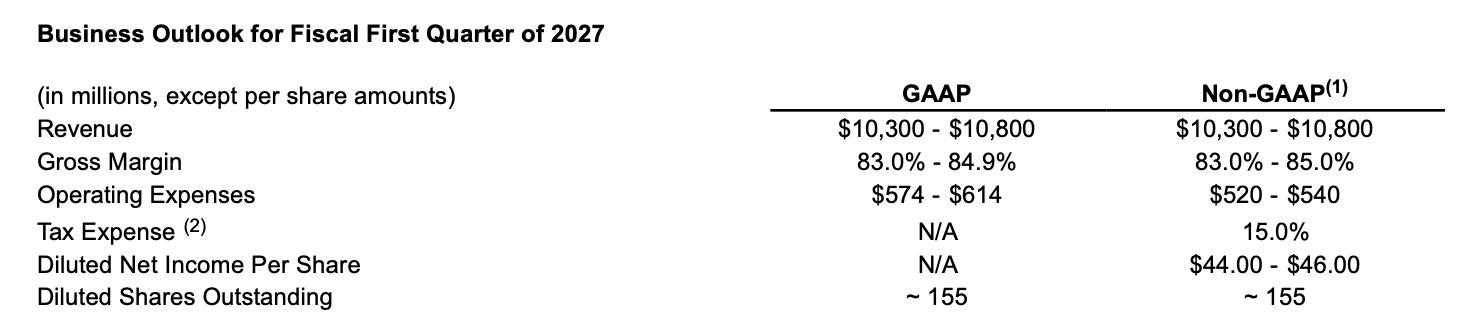
EPS guidance came in at $44 to $46, with a midpoint of $45, broadly around market expectations. After a record quarter, the market was looking for a record outlook as well. SanDisk instead delivered guidance that was solid, but not materially stronger.
The market is trading acceleration, not just growth
The source report cited a line from a new article by Arthur Hayes: “What investment really trades is not growth itself, but the acceleration of growth.”
That frame fits the reaction here. SanDisk’s fundamentals did not show obvious deterioration. Quarterly revenue set a record. Gross margin stayed near peak levels. Data center became a new growth pillar. The company is still benefiting from the NAND recovery cycle and the structural demand shift tied to AI infrastructure spending.
What changed is where investors are looking. Over the past year, the memory sector has gone through a major rerating. AI data center buildouts lifted demand for high-performance storage, while tighter NAND supply and recovering pricing pushed profitability higher. In that setting, SanDisk’s valuation was reflecting not only current earnings but also expectations that growth would keep accelerating over the next few quarters.
Once the company offered guidance that still pointed to high growth but did not move meaningfully above those expectations, the reaction turned harsher. That is the central tension in this report: the business remains strong, but expectations have moved ahead of the numbers.