

A lawsuit filed in the New York State Supreme Court threatens to shake the core of Bitcoin's greatest mystery: the untouched fortune of its creator, Satoshi Nakamoto. Under the pseudonym Noah Doe, an anonymous individual and two Wyoming shell companies are asking the court to declare them the lawful owners of 39,069 dormant Bitcoin addresses holding over 3.7 million BTC—valued at roughly $293.5 billion at current prices. Among those addresses are 21,744 believed to belong to Satoshi, containing about 1.1 million Bitcoin, or $84.7 billion. The claim, astonishing as it sounds, rests on a creative misinterpretation of New York's lost-property statutes and has already drawn a timeline that could lead to a default judgment by summer 2026.
Noah Doe's legal theory relies on CPLR 3001 (a declaratory judgment action) and Article 7-B of the New York Personal Property Law, which governs the rights of finders of lost objects. In the traditional physical world, a finder hands over an item to the police; if no owner steps forward within the statutory waiting period, the finder obtains full title. Noah Doe translated that into the digital realm by depositing a USB drive containing the public addresses—not private keys—with the NYPD's 17th Precinct. To notify the “owners,” he broadcast an OP_RETURN message on the Bitcoin blockchain and issued a press release. Then, an unnamed expert valued each address at less than $10, pushing the entire case into the fastest statutory track reserved for low-value goods.
The gap between physical lost property and publicly readable blockchain addresses is wide enough to sink the whole claim. Noah Doe never possessed any private key to the addresses, never controlled any of the coins. The law envisions a finder who can actually return the object to its true owner; here, there is no object to return. Even if a court issued a declaratory judgment, it would not magically move the coins on-chain. The real menace lies elsewhere: if any of the contested Bitcoin ever enters a regulated exchange or custodian, the plaintiff could present the New York judgment as a cloud on title, prompting the institution to freeze the funds and force the true owner to unmask themselves in a costly, multi-year legal battle to reclaim what is rightfully theirs.
What Exactly Did Noah Doe “Find”?
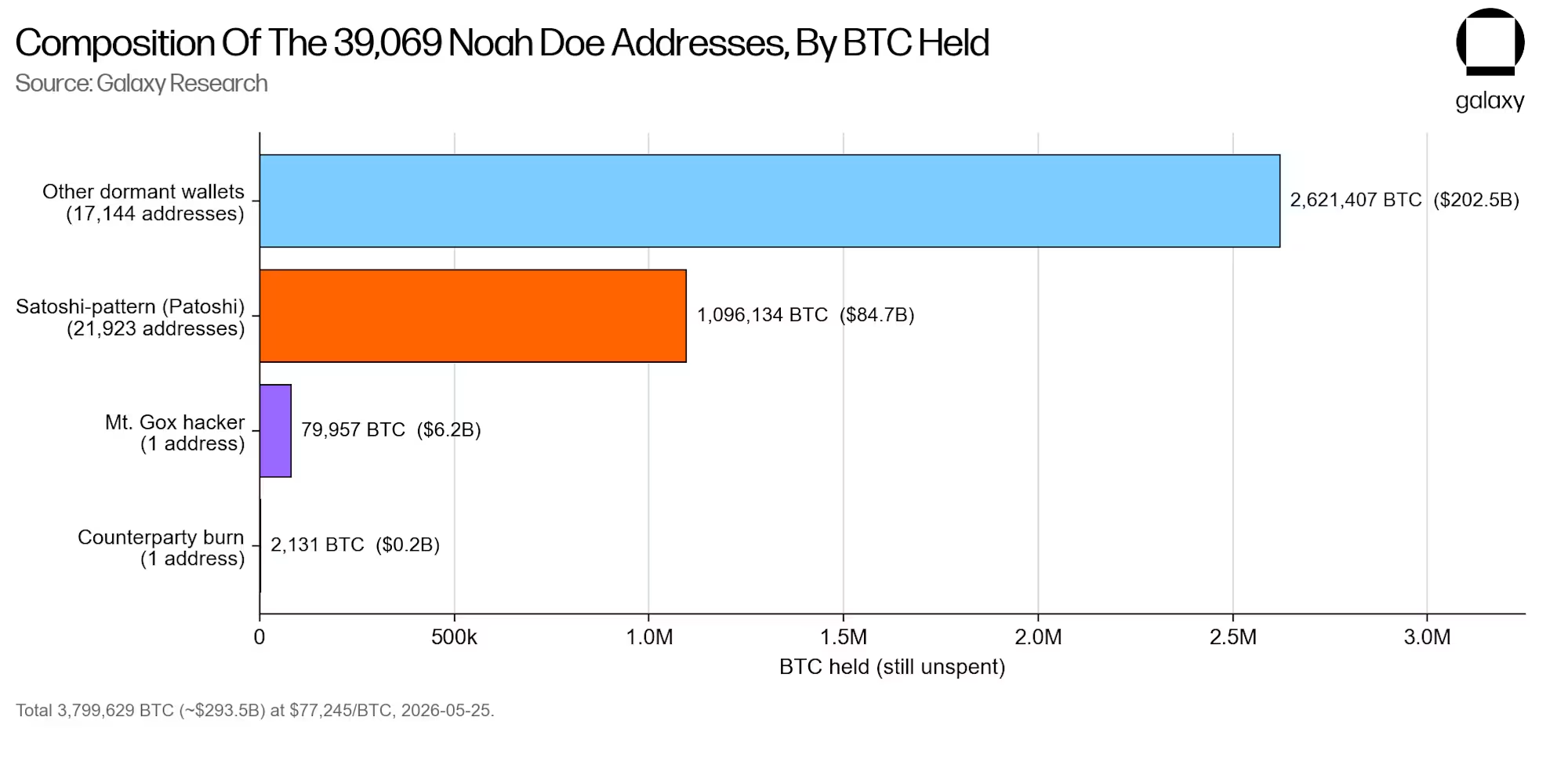
Using their full Bitcoin node and proprietary research database, Galaxy analyzed the 39,069 addresses Noah Doe presented. As of May 25, 2026, the hoard totaled 3,799,629 BTC, worth around $293.5 billion, but it was far from uniform.
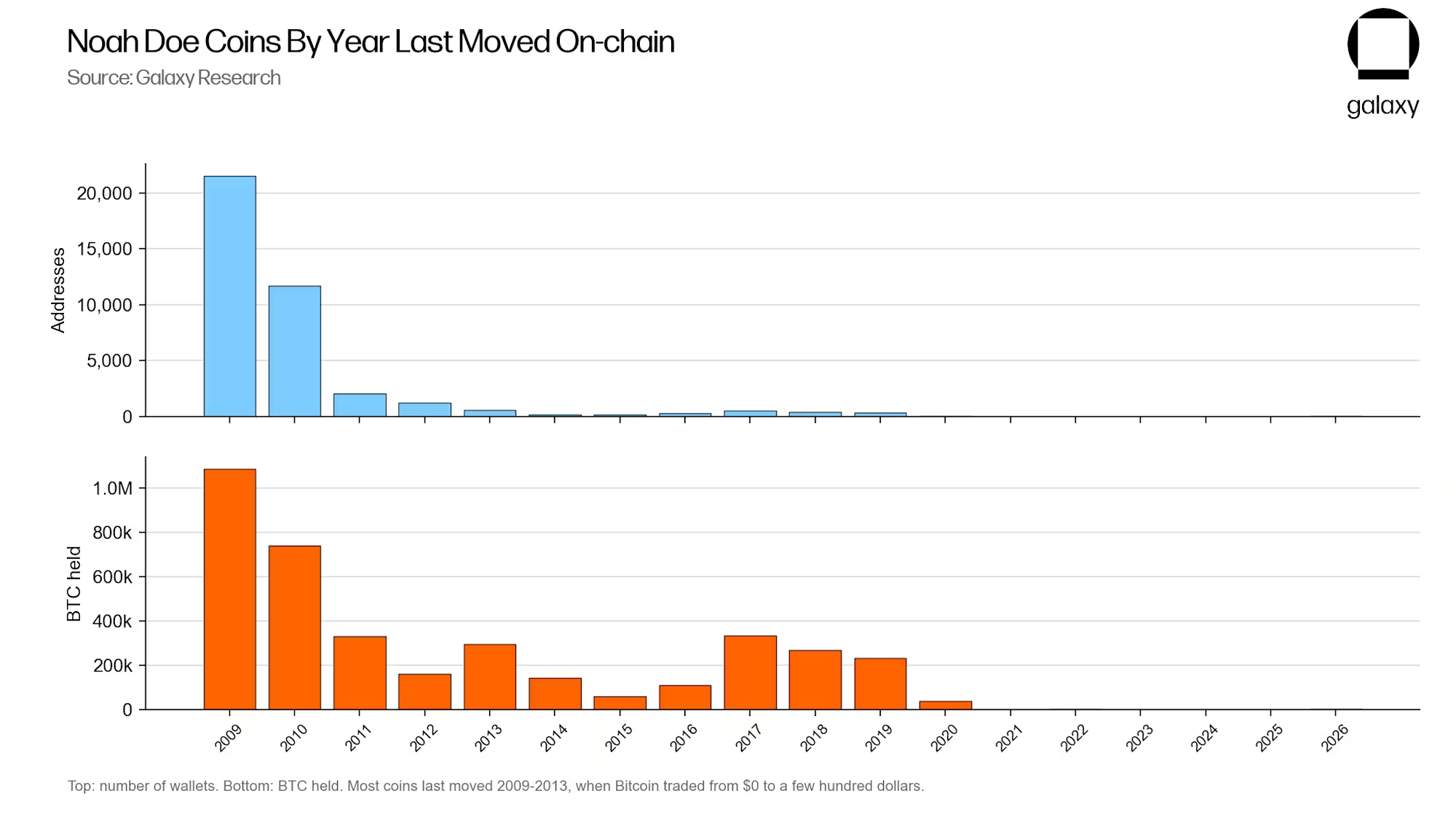
The first and largest bucket consists of 21,923 “Patoshi” addresses, holding about 1,096,134 BTC ($84.7 billion). These are the early mined coins linked through the well-known Patoshi nonce pattern to Bitcoin's pseudonymous creator; they have never moved. The second bucket is a single address containing 79,957 BTC ($6.2 billion) stolen from the Mt. Gox exchange in 2011—property that is itself the subject of ongoing investigations. A third bucket is another solitary “burn” address with 2,131 BTC ($160 million) that is fundamentally unspendable because no corresponding private key exists by design. The fourth and by far the largest bucket comprises 7,144 addresses holding 2.6 million BTC ($202.5 billion). These belong to early holders and exchange-era whales, with the vast majority of last on-chain movement occurring between 2009 and 2013, a time when Bitcoin's price rose from virtually nothing to a few hundred dollars.

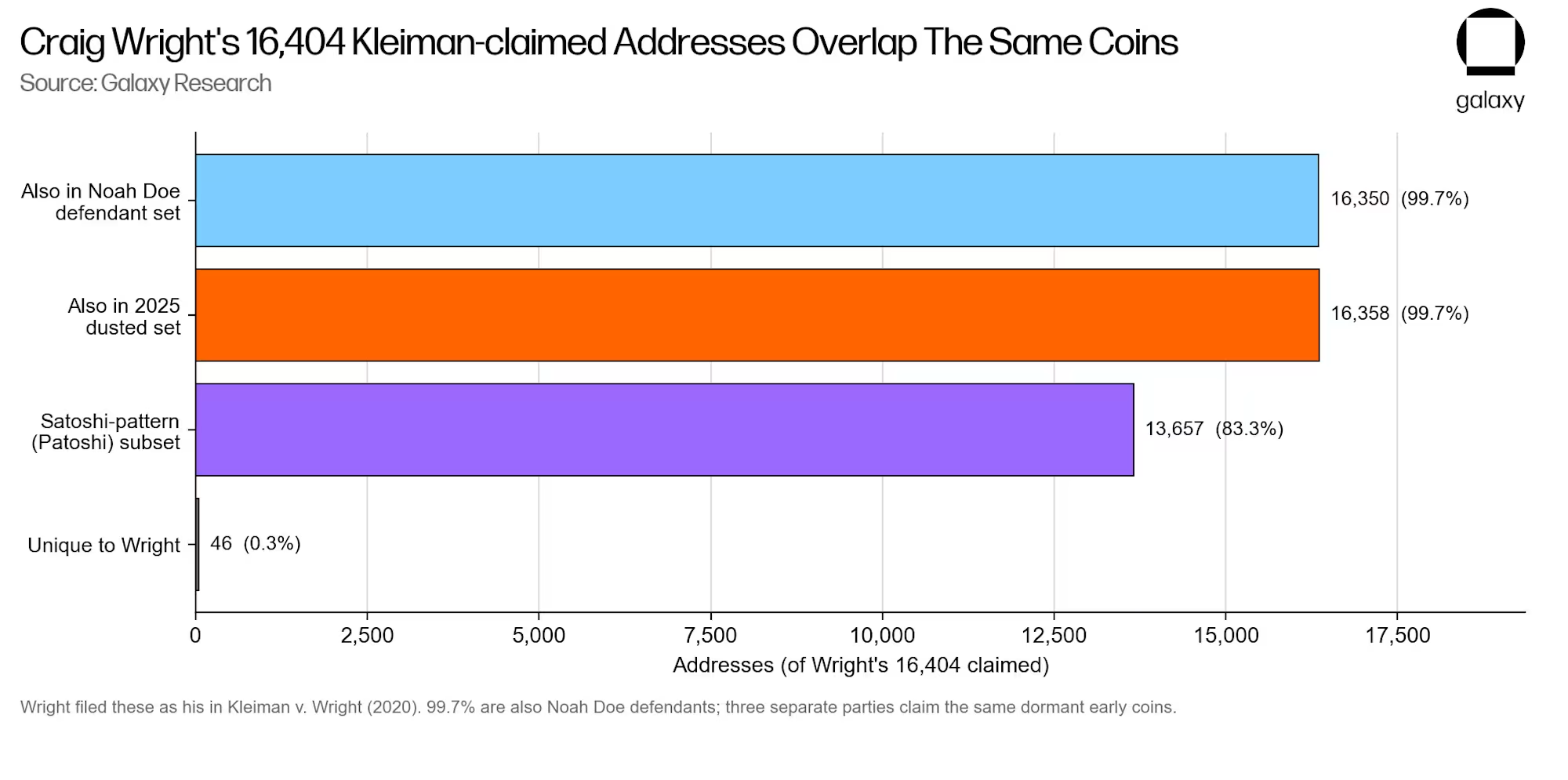
Adding to the legal tangle, many of these addresses have previously been claimed. In the 2018 Kleiman v. Wright case, Craig Wright submitted a list of 16,404 early addresses that he alleged were his as part of his ultimately rejected identity as Satoshi. Cross-referencing Galaxy's data reveals significant overlap between Wright's list and Noah Doe's list, underscoring that these addresses are far from being “unclaimed” or forgotten.

Absurd Valuation and Anonymous Double Standards
The linchpin of the expedited procedure is the expert opinion that each address, in its “as-is” condition, is worth less than $10. Yet the average holding per Noah Doe address is 97.25 BTC (over $7.5 million), and the median is 50 BTC (about $3.86 million). Calling each address worth under $10 is a transparent ploy to meet the low-value threshold that shortens police custody to three months and the vesting period to one year. If this logic were applied universally, any self-custodied Bitcoin address would be valued near zero—a stance no market participant, not even the plaintiff, genuinely holds. Compounding the problem, the expert who provided this figure is unnamed in the filing, making it impossible to scrutinize or challenge the crucial number governing the entire timeline.
The plaintiff's own anonymity is equally problematic. Noah Doe and the two LLCs asked the court to shield their identities to avoid becoming targets as large holders. Yet the very relief they seek would force every true address owner to publicly come forward and defend their cryptocurrency—stripping them of the privacy the plaintiff demands for himself. Moreover, while a natural person might articulate a personal safety theory, shell LLCs have no body to threaten and no privacy to expose. The idea that empty corporate envelopes could be allowed to claim hundreds of billions in property under a cloak of anonymity flies in the face of New York's growing push toward transparency, including the LLC Transparency Act's mandatory disclosure of beneficial ownership—even if federal rules currently limit its scope to foreign-formed LLCs.

The Real Threat: Frozen Assets and Unmasked Whales
Because all defendant addresses are pseudonymous and intentionally not publicly served, a technical default judgment is almost certain by the end of June 2026. However, courts are reluctant to grant novel, high-impact relief on the back of a dubious $10 valuation. The genuine danger is not that Satoshi's coins will be seized or that anyone will lose their on-chain rights. It is that the moment any coin from these thousands of addresses moves into a centralized exchange or custodian, the plaintiff can present the New York judgment and place a lien on the funds. Such an action would likely freeze the assets immediately, trigger years of litigation across jurisdictions, and ultimately force long-dormant whale holders to surface and prove ownership—sacrificing the very anonymity they have guarded for over a decade.

Seen in this light, the lawsuit is a sophisticated piece of legal engineering designed not to steal coins directly, but to create a “cloud on title” that can be weaponized against regulated intermediaries. That is precisely why, for the parties behind Noah Doe, a declaratory judgment that could never actually move a single satoshi on the blockchain may still be well worth the fight.