

Compiled by Odaily Planet Daily / Golem (@web3_golem)
It is almost unimaginable that Satoshi Nakamoto, the founder of Bitcoin, could one day face a lawsuit where the 'ownership' of wallet addresses might be seized. In March, the Supreme Court of the State of New York accepted a case in which the plaintiff, pseudonymously named Noah Doe along with two unnamed Wyoming LLCs, is attempting to establish ownership over more than 3.7 million Bitcoins (worth approximately $274 billion) associated with 39,069 dormant Bitcoin addresses. More critically, these 39,069 addresses include those suspected of belonging to Bitcoin's creator, Satoshi Nakamoto—comprising 21,744 addresses holding about 1.09 million BTC, valued at roughly $83.7 billion at current prices.
In simple terms, an anonymous individual and their Wyoming-registered shell companies are asking a New York court to rule that Satoshi Nakamoto's Bitcoin—and a vast trove of other crypto—is lost property, and that they, as the 'finders,' should legally obtain ownership. Galaxy Research has analyzed the plaintiff's potential motives, identity, the implications for Bitcoin, and the likelihood of their success.
Case Overview and the Plaintiff's Ploy
The plaintiff has petitioned the New York State Supreme Court to declare them the owner of 39,069 dormant Bitcoin addresses and all assets within. The legal basis is a declaratory judgment confirming ownership under New York Civil Practice Law and Rules (CPLR) § 3001, resting fundamentally on New York's Lost Property Law, Article 7-B of the Personal Property Law. That statute provides that a finder of lost property who turns it over to the police and goes unclaimed by the true owner during a prescribed waiting period can ultimately take title. The plaintiff is attempting to retrofit this archaic framework onto Bitcoin.
The exact ploy works as follows: Noah Doe, acting as the finder, delivered a USB drive containing the addresses—not private keys or proof of control, merely public addresses—to the NYPD's 17th Precinct, using this gesture to substitute for physically handing over lost property. Subsequently, they initiated OP_RETURN notifications on the Bitcoin blockchain and issued press releases as a proxy for contacting the true owners. Finally, they had an expert appraise each address's value at under $10, funneling the case into the statute's fastest procedural track. The real value of a New York judgment lies elsewhere. It would act as a 'cloud on title': if any of these Bitcoins ever appear in a regulated venue, the plaintiff could present this document to confront an exchange or custodian. This is the potential risk this case poses to Bitcoin holders, and why a lawsuit that sounds absurd on its face demands a closer look.
New York's Personal Property Law Article 7-B (Sections 251-258) lays out an expedited lost-property regime. It provides two distinct pathways for a finder to acquire title, and the plaintiff invokes both concurrently. An unnamed 'independent expert' cited in the complaint pegged the 'as-is' value of each address at less than $10, citing a low likelihood of recovery. This valuation steers the entire procedural timeline, placing each address into the uniform one-year vesting period under Section 257(2). It also enables a shorter process for items valued under $100, where police custody lasts just three months under Section 254. The complaint strings together several arguments, each a necessary predicate for the next, in a cascading chain.
Anatomy of the Noah Doe Addresses: From Satoshi to Mt. Gox
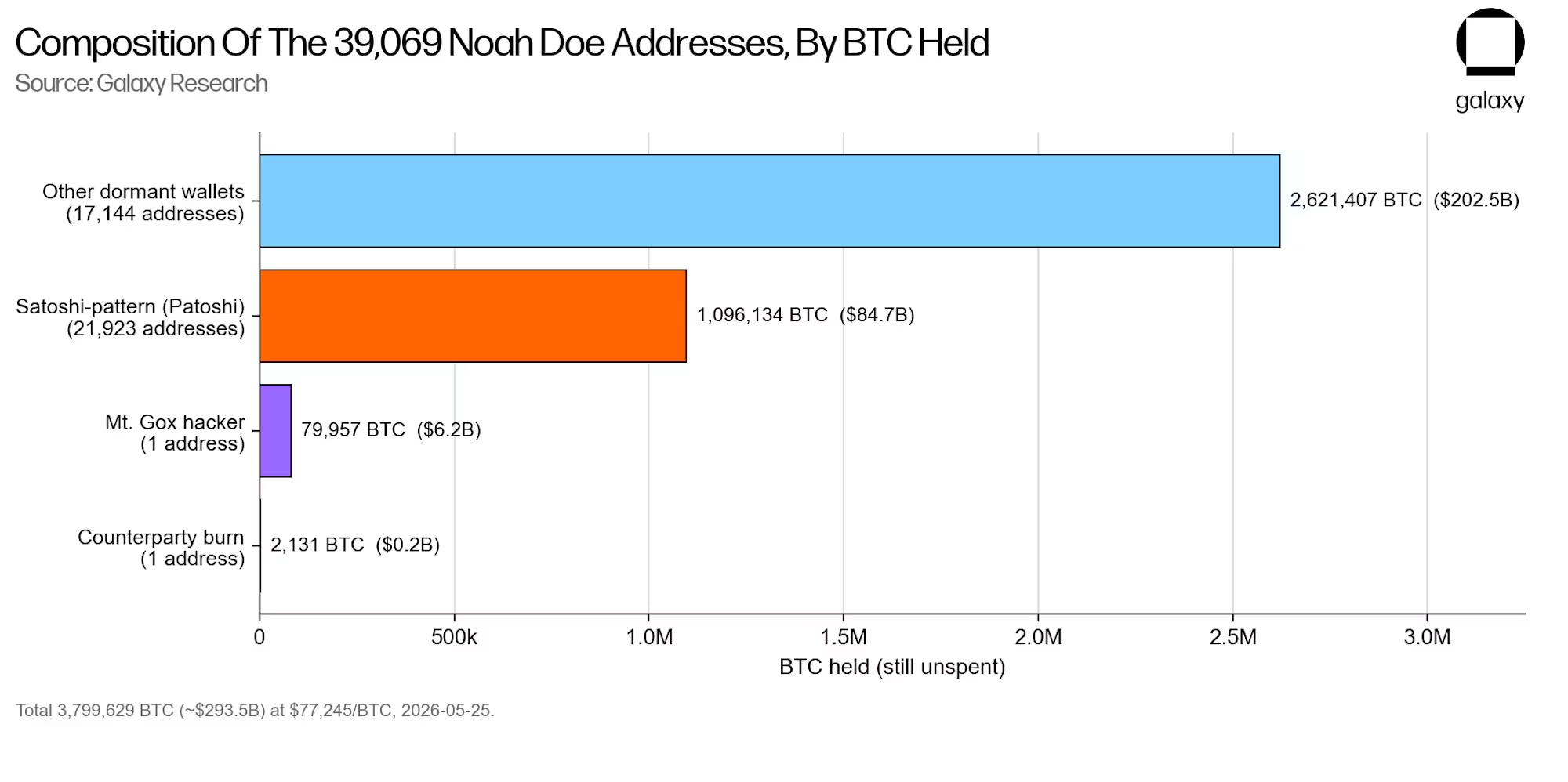
Using their Bitcoin full node and internal research database, Galaxy analyzed the addresses Noah Doe claims to have 'found.' As of May 25, 2026, the 39,069 'Noah Doe addresses' held 3,799,629 BTC, worth roughly $293.5 billion at a price of $77,245 per bitcoin. This value is not evenly distributed but concentrated in several distinct clusters, each telling a different story.

The first cluster comprises the Satoshi (Patoshi) addresses: 21,923 addresses holding approximately 1,096,134 BTC (about $84.7 billion). These are early-mined coins linked to Bitcoin's creator through the 'Patoshi' nonce pattern and have never moved. Next is a single address holding roughly 79,957 BTC (about $6.2 billion), identified as John Doe #1. These coins were stolen from the early exchange Mt. Gox and have lain dormant since 2011; they are disputed property tracked by investigators for years. Then there is another single address, John Doe #104, with about 2,131 BTC (around $160 million). This is a provably unspendable 'burn' address; no one holds its keys because, by design, no such keys exist. Finally, the 'Other Whale' cluster encompasses 7,144 addresses holding approximately 2,621,407 BTC (around $202.5 billion). These contain large sums from early holders and the exchange era, untouched for years.
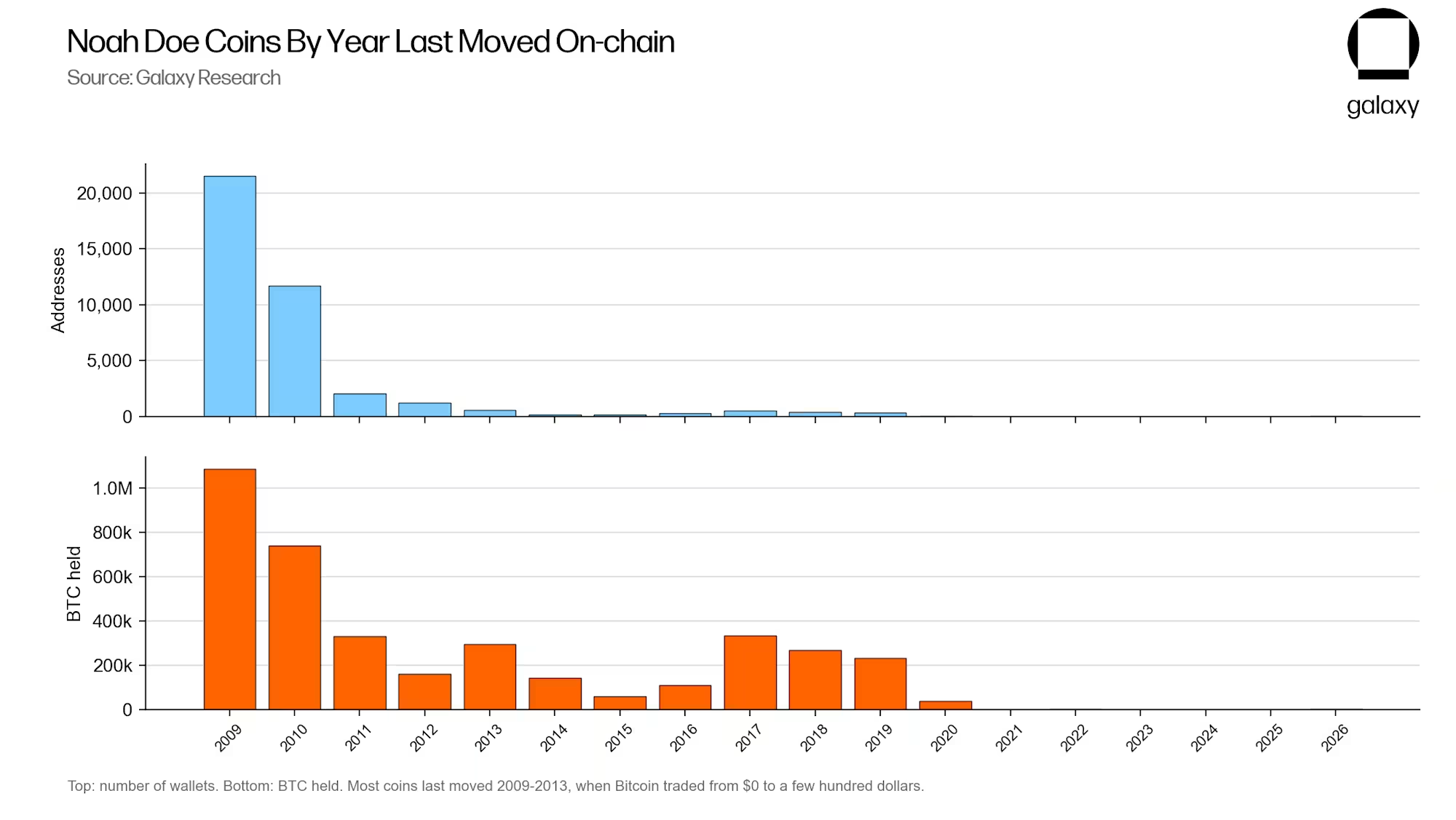
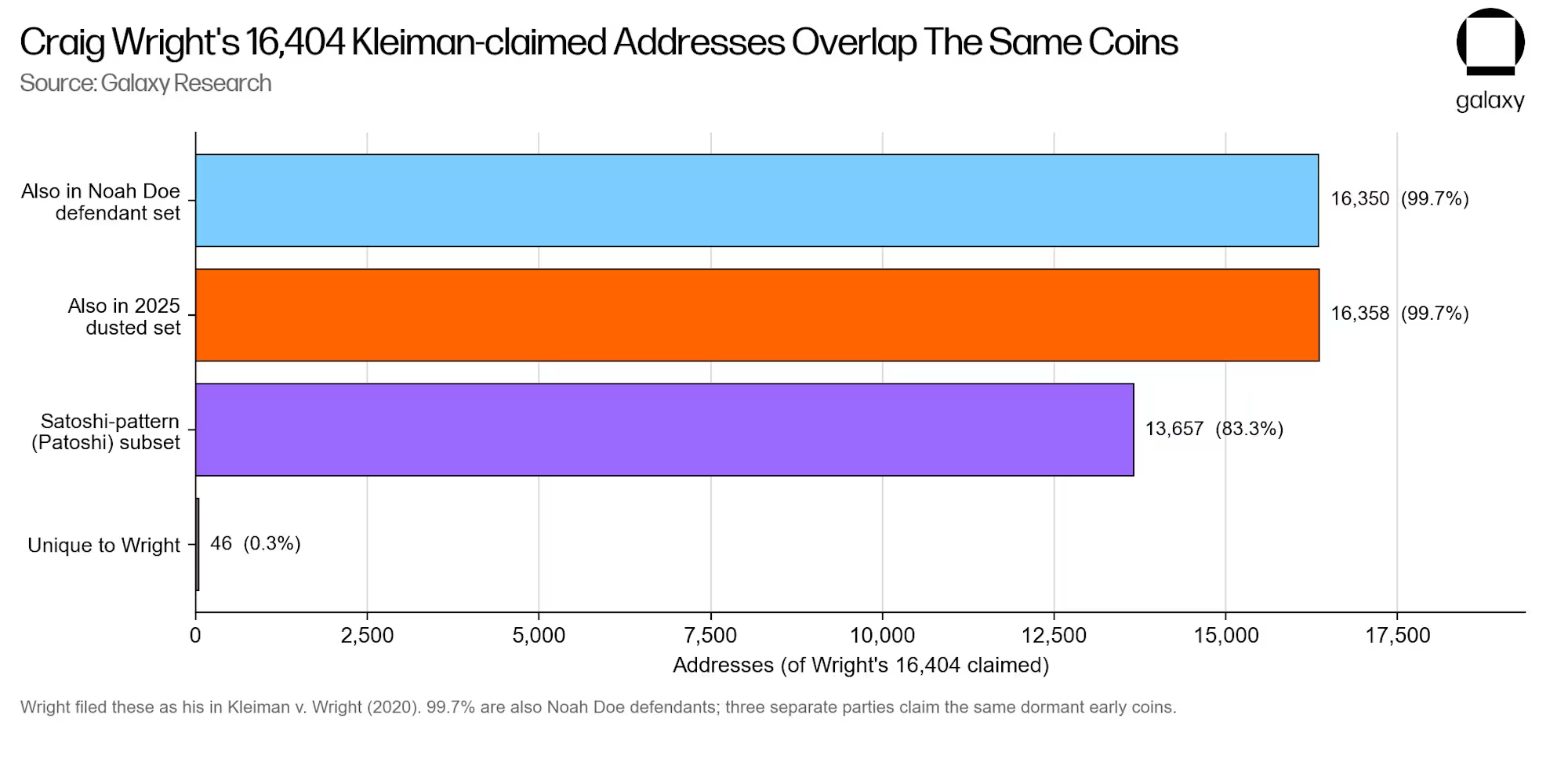
This dormancy is long-standing. Sorting each address by the year its Bitcoin last moved on-chain shows the vast majority of activity concentrated in Bitcoin's early years, with most last transactions occurring between 2009 and 2013—a period when Bitcoin's price soared from near zero to several hundred dollars. Significantly, many of these addresses have been claimed before. In the Kleiman v. Wright case (S.D. Fla., 2018), Australian businessman Craig Wright submitted a list of 16,404 early block addresses he alleged were his, as part of a later-discredited claim to be Satoshi. Overlaying Wright's claimed Bitcoin addresses against Noah Doe's list reveals a significant intersection.

Pervasive Flaws: Valuation, Anonymity, and Procedural Gaps
While Galaxy is not a law firm, the court record and relevant statutes surface an array of fatal problems. Before any valuation or service issues arise, there is a more fundamental problem: the lost-property statute is designed for physical objects a finder picks up, possesses, and hands to the police. Noah Doe never possessed these coins or their keys. He simply looked at public addresses on a ledger anyone can read. Inspecting a public address is a world apart from possessing lost property, and delivering a USB stick listing addresses to the police is not the same as actually surrendering the goods. The statute envisions a finder who could return the item if the true owner appears, but here, the finder never held the coins and could not possibly hand them to anyone—neither to the police purportedly safeguarding them nor to a rightful owner seeking their return. The issue goes well beyond title. Losing a private key does not strip the true owner of any rights. Bitcoin remains on-chain; the real key-holder can move it at any moment, and hundreds of owners who lost Bitcoin have done exactly that. Ownership cannot effectively transfer to a finder who can never touch the asset.
Consider the numbers: the average holding for a Noah Doe address is 97.25 BTC, worth around $7.5 million; the median is 50.00 BTC, worth about $3.86 million. Against these figures, the claim that each address is valued under $10 is completely untenable—a tactic deployed purely to accelerate the statutory clock. Two additional details further weaken this valuation. The expert who produced the 'sub-$10' figure is unnamed in the filings, meaning the single number driving the entire timeline cannot be scrutinized or challenged. Applying this 'as-is recoverable' logic universally would render the value of nearly all self-custodied Bitcoin close to zero, a treatment inconsistent with how any user—certainly not a plaintiff going to these litigation lengths—would regard these assets.

Noah Doe's anonymity in this proceeding is also highly suspicious. He seeks to remain anonymous to avoid being hunted as a large holder, yet the very interest he pursues would force actual address holders to unmask themselves to defend their crypto. The plaintiff wants for himself the very protection he intends to strip from every defendant. Even if an individual could articulate a genuine physical-safety theory for anonymity, that protection exists for natural persons. ABC Company and XYZ Company are LLC shells; a corporation has no physical person to threaten and no personal privacy to expose, making the fear-of-extortion logic inapplicable. Allowing two empty LLCs to claim hundreds of billions of dollars in property under pseudonyms is extraordinary. Furthermore, New York State disfavors anonymous litigants. New York courts rarely permit pseudonyms, and while the state historically allowed anonymous LLC ownership, the LLC Transparency Act now mandates disclosure of beneficial ownership, though a federal rule has currently narrowed its scope to foreign-formed LLCs.
The Real Danger: A Judgment as Leverage Against Exchanges
Even setting these details aside, the audacity of this lawsuit is staggering. That a New York court would award legal ownership of approximately $293 billion in Bitcoin—including some belonging to Satoshi—to an anonymous entity, based on a dubious 'lost-and-found' theory with a sub-$10 valuation, defies belief. Courts are generally reluctant to entertain novel and sweeping claims of this magnitude, especially where property is contested and a ruling could cast far-reaching effects over a vast population of affected parties.

Because this is a declaratory action concerning property ownership, the true owners of the addresses have a right to intervene directly under CPLR § 1012(a)(3), while interested non-owners may seek permissive intervention under § 1013. Yet a cavernous practical obstacle swallows this doctrinal allowance. To intervene, an owner must come forward and prove control over a listed address—precisely the de-anonymization that cautious Bitcoin whales spend their lives avoiding. The defendant addresses are all pseudonymous and deliberately non-public, making a technical default judgment nearly certain by late June 2026, roughly 30 days after service. A default motion will likely be filed over the summer; however, for many reasons, the court is unlikely to rush to grant a default judgment that fully encapsulates all the relief the plaintiffs demand.
The danger, therefore, is not that the plaintiff can seize Satoshi Nakamoto's Bitcoin, or any other Bitcoin named in the Noah Doe defendant addresses. The danger is that if any of these Bitcoins ever move to a centralized exchange or custodian, the plaintiff can present their New York judgment to that institution and attempt to attach a claim against those coins. Such an action could freeze assets, trigger years of litigation, and force a holder moving coins decades after the fact to step forward, prove ownership, and jeopardize their anonymity. Paper title is leverage against regulated intermediaries and those who rely on them, which almost certainly explains why, even if a judgment could never directly touch the Bitcoin itself, it remains worth obtaining for the individuals behind this case.