

In a stunning legal move that could reverberate across the crypto world, the New York State Supreme Court has taken up a lawsuit in which an anonymous plaintiff, going by the pseudonym Noah Doe, together with two unnamed Wyoming LLCs (“ABC Company” and “XYZ Company”), is seeking to establish ownership over 3.79 million bitcoins held in 39,069 dormant addresses. The total value of these holdings, at roughly $77,245 per BTC at the time of analysis, exceeds $293 billion. Most remarkably, the suit lists 21,923 addresses that exhibit the Patoshi mining pattern, containing approximately 1.09 million BTC—worth about $83.7 billion—and widely believed to belong to Bitcoin’s mysterious creator, Satoshi Nakamoto.
The plaintiff’s argument hinges on a novel application of New York’s long-standing lost property law, codified in Article 7-B of the Personal Property Law (§§ 251–258). Under this statute, a person who finds lost tangible property, turns it over to the police, and waits a specified period can acquire full ownership if the original owner does not come forward. Noah Doe claims to have “found” the 39,069 addresses by compiling them into a USB drive and delivering that drive to the NYPD’s 17th Precinct. He then sent an OP_RETURN transaction on the Bitcoin blockchain and issued a press release—steps he argues satisfy the notice requirement. Crucially, the plaintiff hired an unnamed “independent expert” who appraised each address as being worth less than $10 in its “as-is” condition, triggering the shortest possible statutory timeline: items valued under $100 require the police to hold them for only three months, while higher-valued items entail a one-year holding period. By shoehorning all addresses into the sub-$10 category, the plaintiff aims to fast-track the entire case.
The Anatomy of the “Found” Addresses
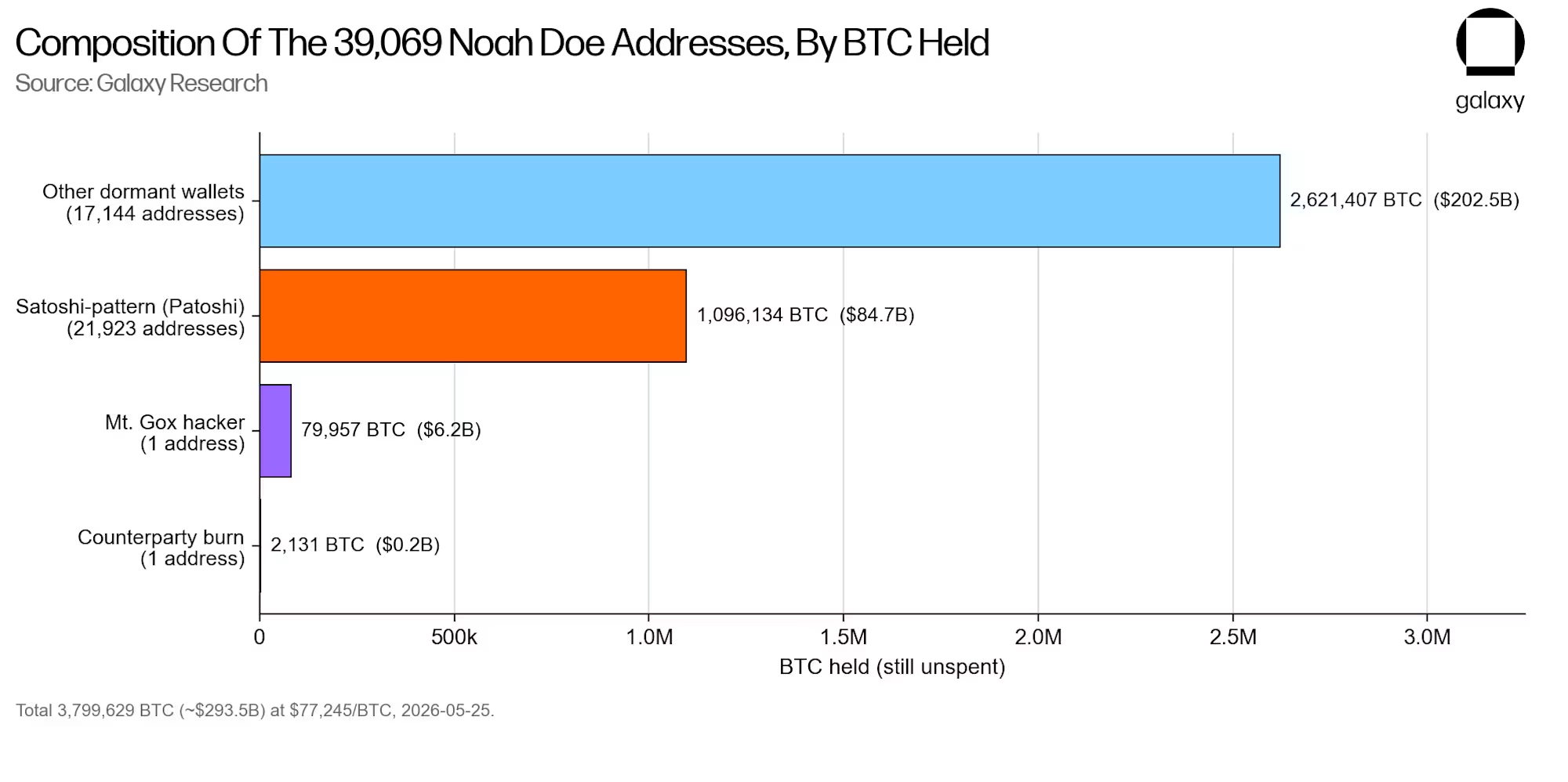
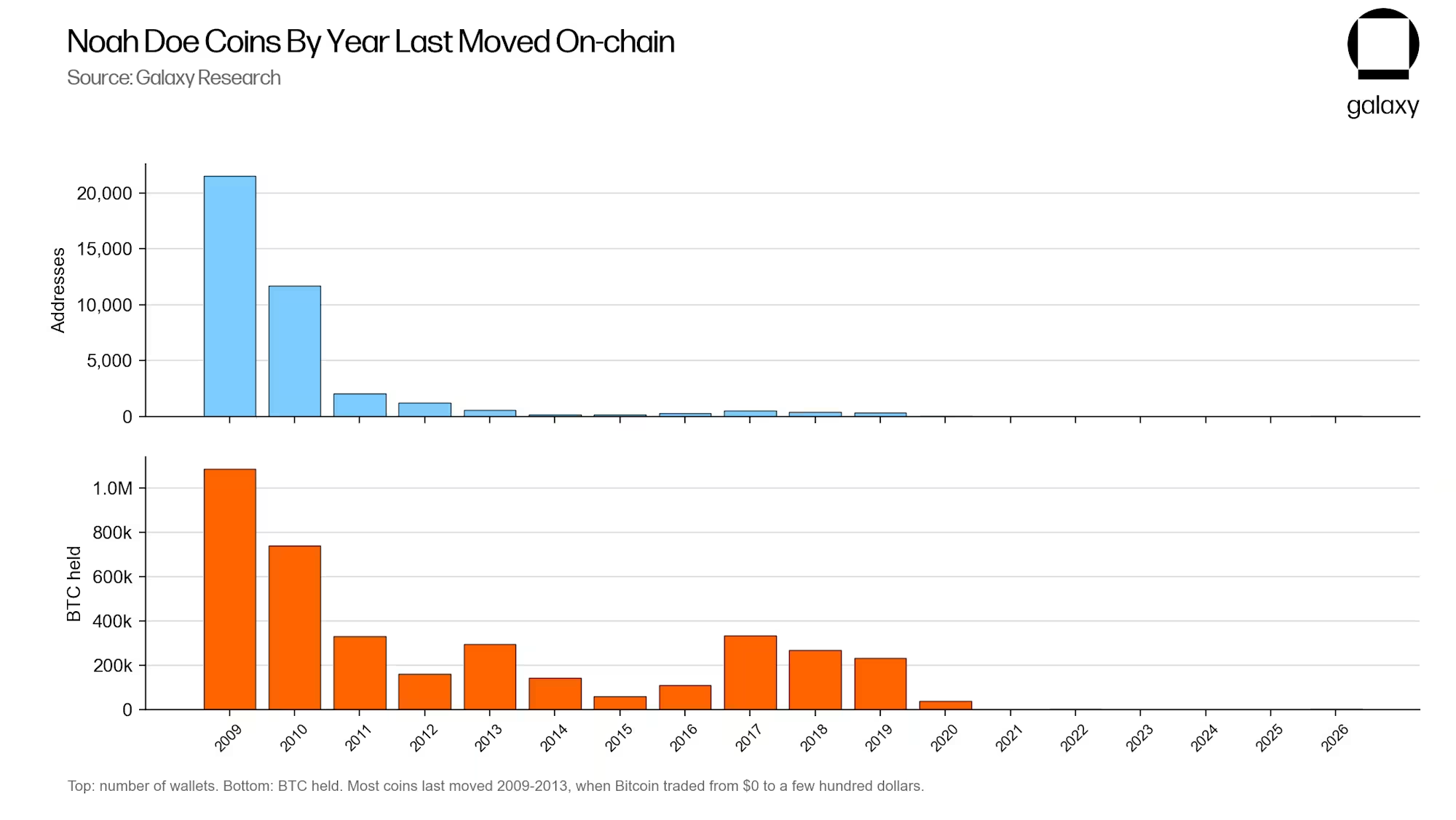
Galaxy, using its Bitcoin full node and proprietary research database, analyzed the 39,069 addresses at issue. As of May 25, 2026, these addresses held a staggering 3,799,629 BTC. The distribution is heavily skewed and can be broken down into several interesting groupings: (i) Satoshi (Patoshi) addresses: 21,923 addresses holding ~1,096,134 BTC, all mined in Bitcoin’s earliest days and displaying the telltale Patoshi nonce pattern, none of which have ever moved; (ii) Mt. Gox thief: a single address containing 79,957 BTC traced back to the 2011 Mt. Gox hack, left untouched ever since; (iii) Burned address: a provably unspendable address with 2,131 BTC, for which no private key exists by design; and (iv) Dormant whale addresses: 7,144 addresses holding a combined 2,621,407 BTC, representing early holders and exchange-era accumulations that have remained idle for over a decade. The vast majority of these bitcoins last moved between 2009 and 2013, a period when Bitcoin’s price rose from nearly zero to a few hundred dollars.
The Craig Wright Connection
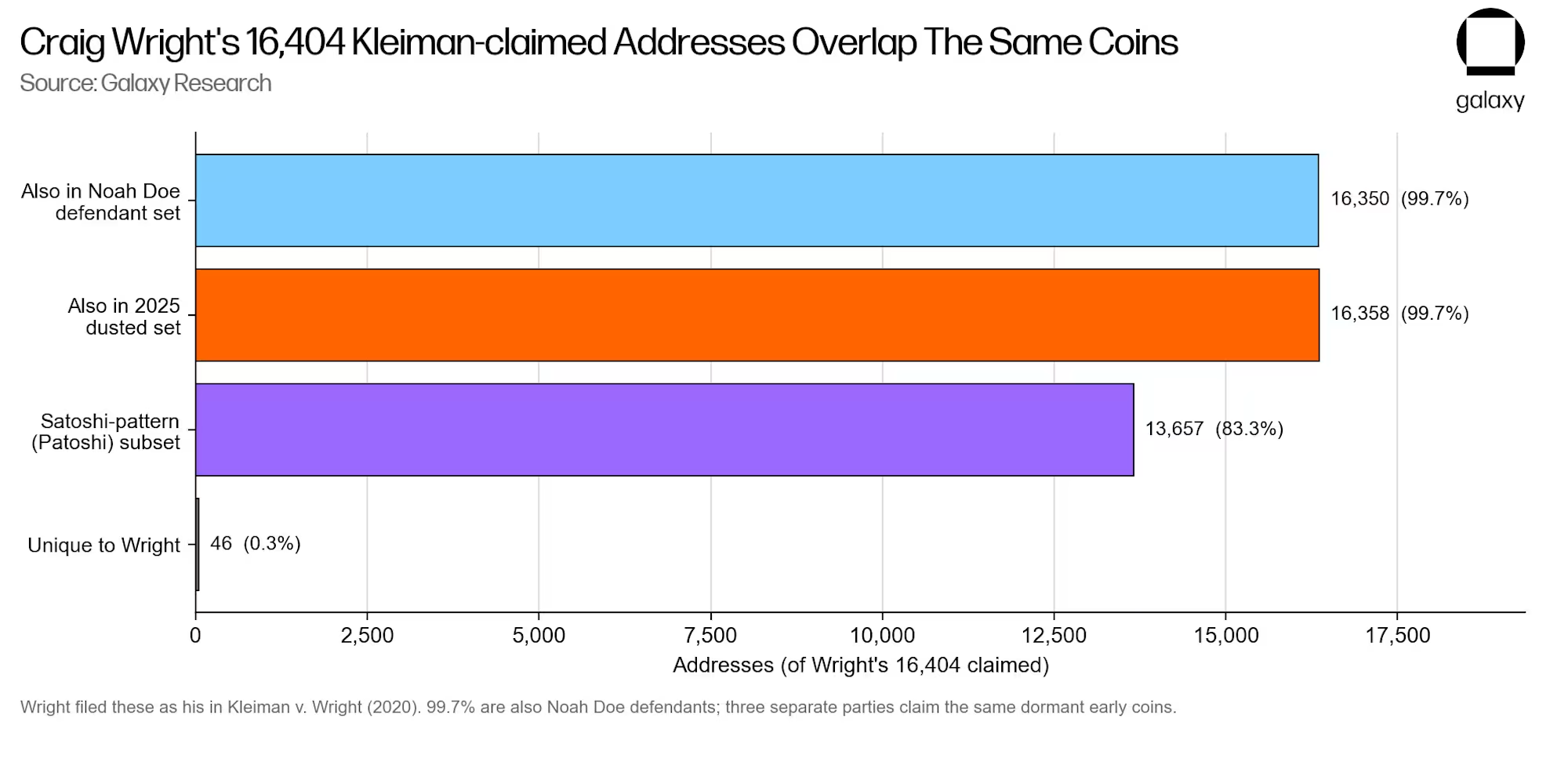
Notably, Galaxy’s comparison revealed significant overlap between Noah Doe’s address list and the 16,404 early block addresses that Craig Wright, the Australian computer scientist who once claimed to be Satoshi, asserted were his own during the Kleiman v. Wright litigation (S.D. Fla., 2018). Wright’s claim was ultimately rejected by the court, but his address list now resurfaces in this new case, raising questions about the origins of the data and the plaintiff’s true motivations. The overlap suggests that the lawsuit may be a renewed attempt—perhaps by Wright or his affiliates—to secure a legal declaration that could be used as a bargaining chip, even if direct control over the Bitcoin remains elusive.

Legal Flaws and Anonymity Puzzles
The suit is riddled with legal vulnerabilities. First, the lost property statute was designed for tangible items that a finder physically possesses and surrenders. Noah Doe never held the private keys or the Bitcoin itself; he merely observed public addresses on an open ledger and put them onto a USB stick. This is fundamentally different from “finding” and “holding” lost property. The plaintiff can never turn over the actual Bitcoin to the police or return it to the true owner, making a transfer of ownership impossible under the law. Second, the sub-$10 valuation is patently absurd. With an average holding of 97.25 BTC per address (median 50 BTC), the market value of even a single address is in the millions of dollars. The unnamed expert’s figure is not subject to scrutiny, and the whole maneuver appears engineered solely to speed the case through the courts.
The use of anonymity also strains credibility. While Noah Doe claims that revealing his identity would invite targeted attacks from high-net-worth holders, his corporate plaintiffs—ABC and XYZ—are shell LLCs with no physical presence or endangered individuals. Allowing faceless entities to claim hundreds of billions of dollars in property is legally unprecedented and conflicts with New York’s growing push for transparency, including the LLC Transparency Law which mandates disclosure of beneficial ownership for certain companies. Even if a person could argue a genuine need for anonymity, extending that privilege to corporate shells that are suing to assert ownership over dormant Bitcoin wealth is a stretch that most courts would find difficult to accept.

The Real Danger: Default Judgment and Cloud on Title
Because the defendant addresses are pseudonymous and no holders have publicly stepped forward, service of process is effectively impossible. With a deadline of late June 2026 for service, a default judgment is practically guaranteed. Courts are typically reluctant to grant sweeping relief in novel cases, but a default judgment, even if limited in scope, would give the plaintiff a piece of paper that could be used as a “cloud on title.” If any of these long-dormant bitcoins were to ever move to a centralized exchange or custodian, the plaintiff could present the New York judgment to the platform and demand that the assets be frozen or turned over. This would force the original owner to come out of hiding and engage in a lengthy legal battle just to reclaim their own property, effectively destroying the anonymity that Bitcoin holders value most.

Galaxy’s analysis underscores that the true objective is not to physically seize the Bitcoin—which is impossible without private keys—but to create a jurisdictional lever against regulated intermediaries. A default judgment would act like a paper title deed, weaponizable against any centralized service that touches these coins. For the broader Bitcoin community, this case sets a dangerous precedent: if anyone can file a lost-property claim against dormant addresses and obtain a default order, every Bitcoin holder who has ever lost access to keys or chosen to keep coins offline for years could one day find their assets contested. The fight over Satoshi’s billions may be the first battle in a new form of legal harassment targeting Bitcoin’s very ownership model.

While the lawsuit may ultimately fail on the merits or be dismissed, the process itself—and the possibility of a default—remains a wake-up call for holders of dormant Bitcoin. The core tenet of “not your keys, not your coins” takes on a new dimension: a default judgment could become a legal weapon to strip you of control even if you hold the keys, should those coins ever touch a regulated venue.