

Almost two decades after Bitcoin’s launch, the anonymous creator Satoshi Nakamoto has been dragged into a bizarre legal battle. The New York State Supreme Court has accepted a declaratory judgment action in which an anonymous plaintiff, “Noah Doe,” and two unnamed Wyoming LLCs seek to claim ownership of 39,069 dormant Bitcoin addresses holding over 3.7 million BTC. Among them are 21,744 addresses widely recognized as Satoshi’s—containing about 1.09 million bitcoins worth roughly $83.7 billion at current prices. The plaintiff argues that these coins are “lost property” under New York’s Personal Property Law, and that as the finder who turned the addresses over to police, he is entitled to legal ownership.
The plaintiff’s method is unorthodox. Noah Doe put a USB drive containing a spreadsheet of the public addresses—but no private keys or proof of control—into the custody of the NYPD’s 17th Precinct, equating this to delivering lost goods to the police. He then issued an OP_RETURN notification on the Bitcoin blockchain and a press release, treating this as “notifying the owner.” To speed up the process, an unnamed expert valued each address at less than $10, triggering the accelerated timeframe under New York’s lost property statute.
New York’s Personal Property Law §7-B (sections 251‑258) provides two routes for a finder to gain ownership of lost property, depending on its value. For goods valued under $100, police hold them for three months; for those under $20, the finder can take title after one year. By capping every address below $10, the plaintiff tries to channel all 39,069 addresses into the faster one‑year track. The complaint is built as a chain of arguments, each needing the previous one to succeed.
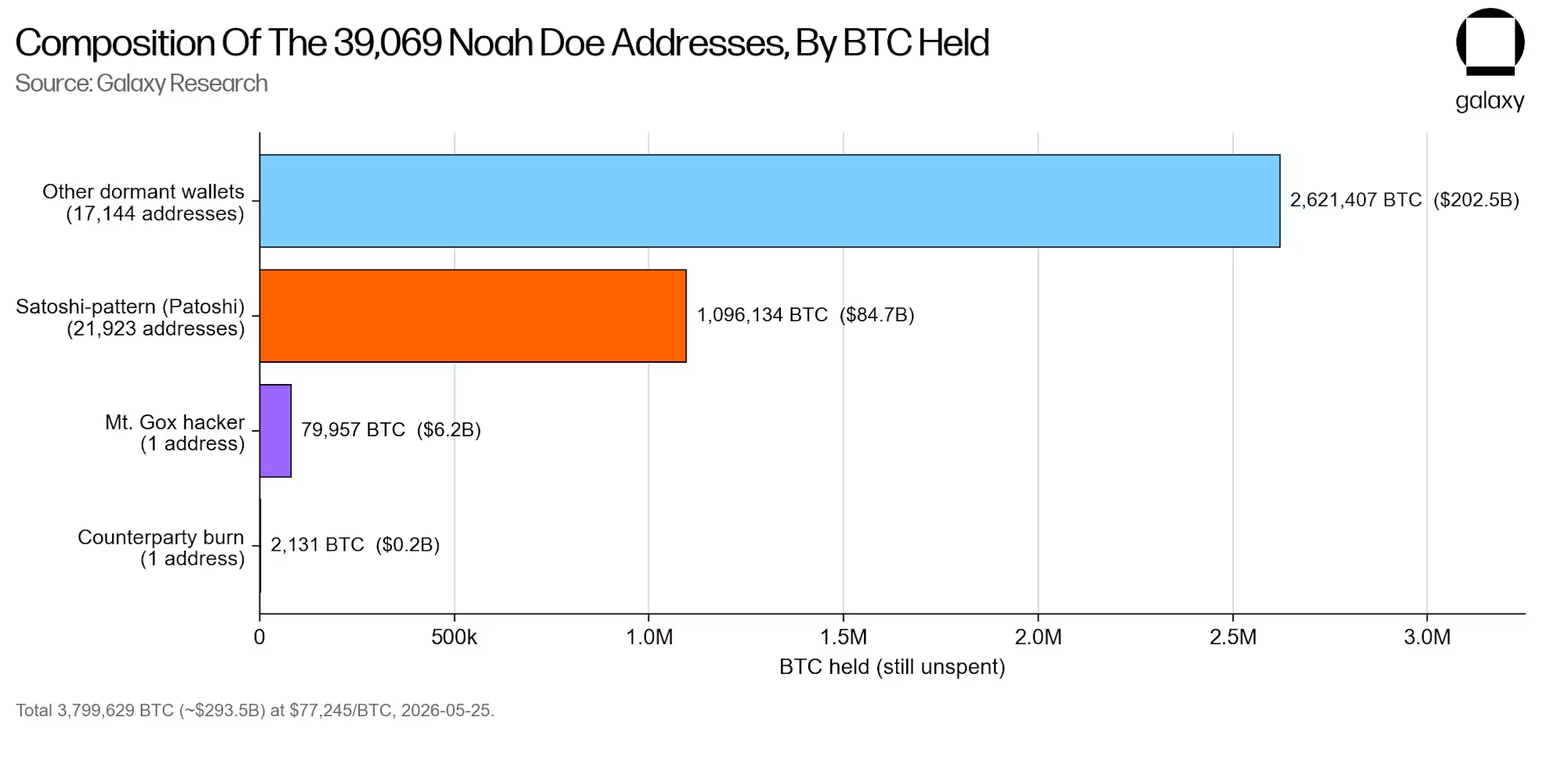
Galaxy Digital analyzed the addresses using its full node and proprietary database. As of May 25, 2026, these addresses held 3,799,629 BTC, worth approximately $293.5 billion. The wealth is concentrated in a few distinct clusters:
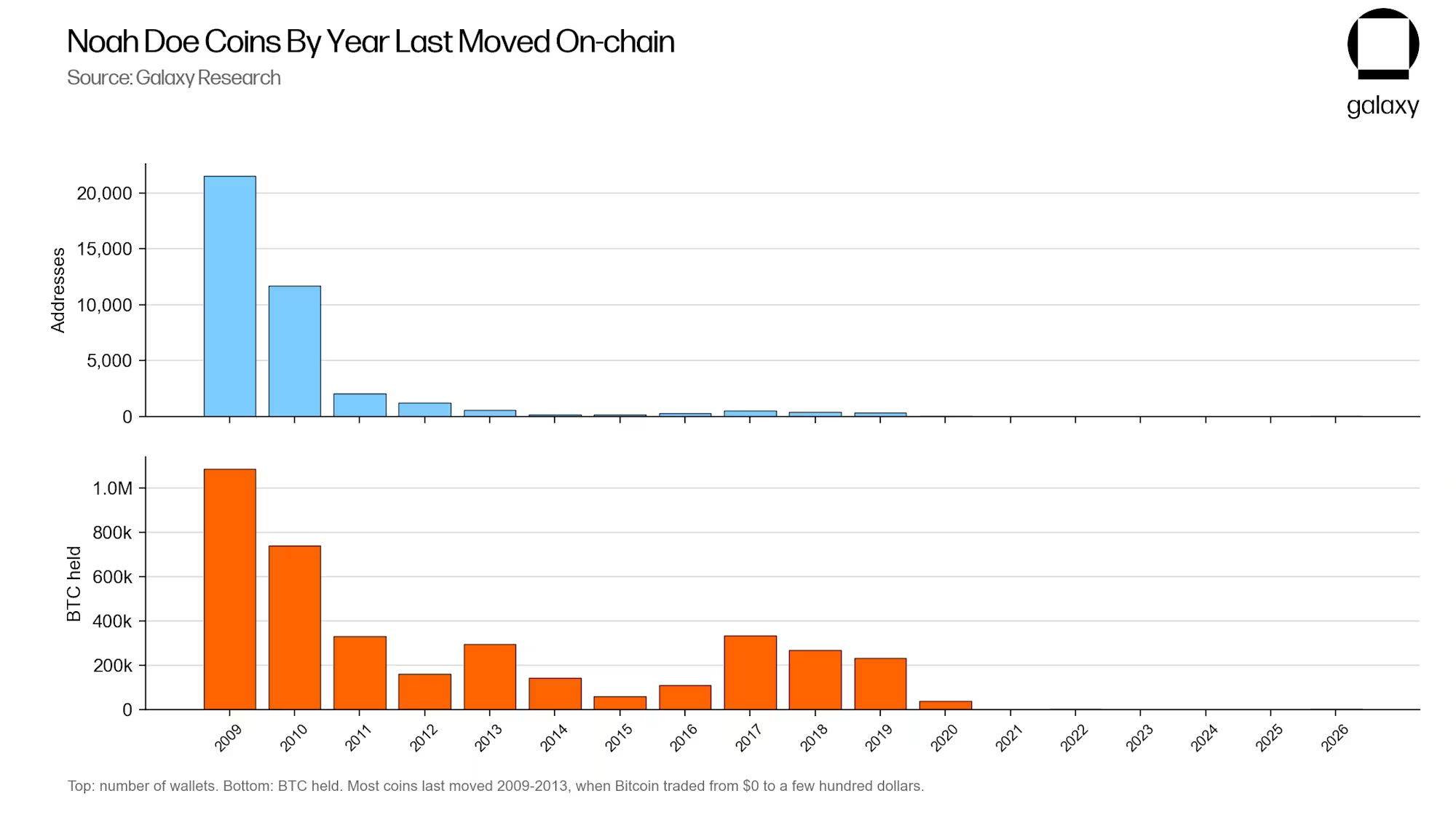
Patoshi addresses: 21,923 addresses, ~1.096 million BTC ($84.7 billion) – early mined coins that have never moved and are linked to Satoshi through the “Patoshi” nonce pattern. John Doe #1: a single address with 79,957 BTC ($6.2 billion) stolen from Mt. Gox in 2011 and untouched since – a known disputed property actively tracked by investigators. John Doe #104: a provably unspendable “burn” address holding 2,131 BTC ($160 million), where no private key can possibly exist. Dormant holder addresses: 7,144 addresses containing 2.62 million BTC ($202.5 billion) – mostly early adopters or exchange-era coins that last moved between 2009 and 2013.

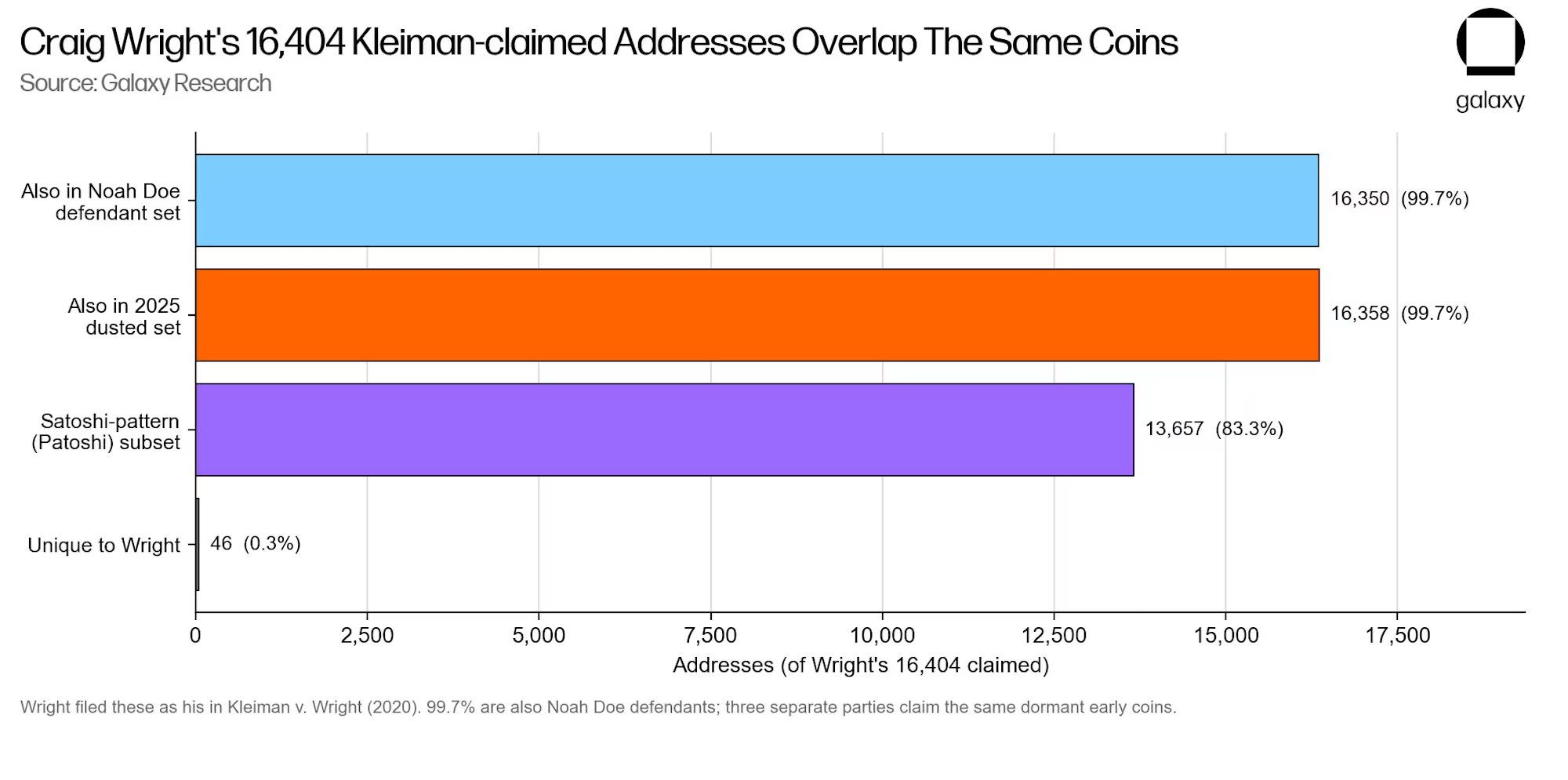
Intriguingly, many of Noah Doe’s addresses overlap with a list submitted by Craig Wright in the 2018 Kleiman v. Wright lawsuit, where Wright claimed 16,404 early block addresses as evidence of being Satoshi. Galaxy’s comparison shows significant overlap, adding yet another layer of suspicion to an already dubious claim.
Legal experts and Galaxy’s analysis underscore several fatal flaws. The lost property law governs tangible items physically delivered to the police; Noah Doe never held any coins or private keys. He merely browsed a public ledger, copied addresses, and handed a USB drive to the NYPD – a far cry from “finding” and “delivering” the actual assets. Losing a private key does not strip a rightful owner of their interest; bitcoins remain on-chain, and real key-holders can move them at any time, as many have done after recovering supposedly lost wallets. It is conceptually incoherent for ownership to pass to a finder who can never touch the asset.

The below‑$10 valuation—the linchpin of the accelerated schedule—is equally suspect. The average holding per Noah Doe address is 97.25 BTC (~$7.5 million), the median 50 BTC (~$3.86 million). Arguing each is worth less than a lunch bill is transparently a procedural maneuver. If extrapolated, the logic would assign near‑zero value to virtually all self‑custodied bitcoin, contradicting market reality. Moreover, the unnamed expert cannot be examined or challenged, leaving the cornerstone of the entire timeline opaque.

Noah Doe’s anonymity is also problematic. He requests to proceed under a pseudonym to avoid being targeted as a large holder, yet the lawsuit’s purpose is to force the actual address owners to reveal themselves to defend their crypto. The two Wyoming shell companies—ABC Corp. and XYZ Corp.—further compound the issue; corporations cannot easily claim privacy or fear for personal safety. New York’s LLC Transparency Act now mandates disclosure of beneficial ownership, making such anonymous shells harder to maintain.
Despite the case’s obvious weaknesses, it poses a genuine threat—not through a direct seizure of Satoshi’s coins, but through the creation of a “cloud on title.” If any of these bitcoins ever move to a centralized exchange or custodian, the plaintiff could present a New York judgment and attempt to have the assets frozen. The true owner, perhaps dormant for decades, would then have to step forward and prove control, potentially sacrificing the very anonymity they had carefully preserved. The paper title acts as leverage against regulated intermediaries, explaining why, even if a judgment can never touch the on-chain coins, the backers of this suit still consider it worth pursuing.

With the service deadline approaching at the end of June 2026, a technical default judgment is almost certain, as all defendant addresses are pseudonymous and intentionally undisclosed. However, courts are generally reluctant to grant sweeping relief in novel cases with wide‑ranging consequences, especially when property is contested and absent owners may be affected. Whether the default hearing will grant the full ownership declaration remains to be seen. One thing is clear: this unprecedented lawsuit has already sounded a legal alarm for every Bitcoin holder whose coins have long lain dormant.