
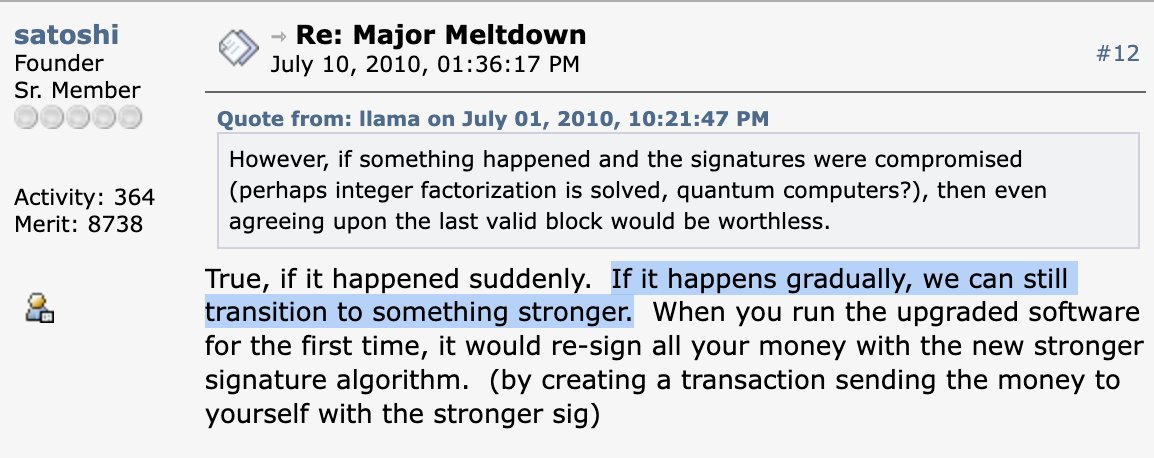
Bitcoin Magazine has resurfaced a July 10, 2010 forum reply from Satoshi Nakamoto on BitcoinTalk, where he addressed the risk of quantum computing to Bitcoin. His answer was concise: if the threat arrived gradually, Bitcoin could transition to a stronger cryptographic algorithm. That comment is drawing fresh attention after recent publicity around Google’s Willow chip and Microsoft’s progress on topological qubits.
Satoshi framed the problem around time and migration
The exchange appeared in a thread titled “Re: Major Meltdown.” A user named “llama” had raised the concern that if integer factorization were solved, or if quantum computers could break digital signatures, rolling the chain back to the last valid block would not solve much. Satoshi replied that such a scenario would indeed be severe if it happened suddenly. If it unfolded step by step, the network could upgrade.
He described a migration path in which upgraded software would let users re-sign their funds with a new and stronger signature algorithm by creating a transaction that sends coins back to themselves. That idea closely mirrors the path discussed in current post-quantum Bitcoin Improvement Proposal debates: a soft fork to change the signature scheme, combined with user-led movement of UTXOs into new address formats.
Why ECDSA remains the focal point
Bitcoin currently relies on ECDSA, the Elliptic Curve Digital Signature Algorithm, to authorize transactions. As outlined in the report, a sufficiently powerful quantum computer running Shor’s algorithm could in theory derive a private key from a public key in polynomial time, breaking the security assumptions behind that system.
The most exposed outputs are old P2PK addresses, which place the public key directly on-chain rather than revealing it only when funds are spent. The article says that roughly 1 million BTC mined by Satoshi are mostly tied to that format. If quantum hardware ever reaches the required level, those long-dormant coins could theoretically become vulnerable. P2PKH and P2WPKH are less exposed before spending because they reveal only a hash of the public key, but once a transaction is broadcast, the public key becomes visible and a window opens.
Quantum progress is putting pressure on the old assumption
Satoshi’s 2010 view rested on one condition: the threat would emerge slowly enough for the community to respond. That assumption now looks less comfortable. The report points to Google’s Willow chip showing benchmark results beyond classical supercomputers in specific tests, while Microsoft has announced progress on topological qubits, a step many consider important for fault-tolerant quantum computing.
At the same time, the article notes that most estimates in cryptography still place a practical break of ECDSA far away, likely requiring millions of logical qubits. That could mean years, or longer. The harder issue is that Bitcoin itself upgrades slowly. A soft fork needs coordination across miners, node operators, and wallet providers, and users would still need to move funds from older address types on their own. If quantum capability advances faster than Bitcoin can coordinate a migration, the transition window Satoshi described could narrow sharply.
Post-quantum proposals are already on the table
Bitcoin developers are not ignoring the issue. Blockstream CEO Adam Back has advocated using SLH-DSA, also known as SPHINCS+, with integration into Taproot. According to the report, SLH-DSA is one of the post-quantum signature standards adopted by the U.S. National Institute of Standards and Technology, relying on hash-based security rather than the mathematical assumptions behind current public-key systems.
Another candidate mentioned is CRYSTALS-Dilithium, which has smaller signatures but still needs compatibility work in Bitcoin’s scripting environment. The report also notes that quantum technology firm BTQ has launched a Bitcoin Quantum testnet aimed at building protective infrastructure before any real attack materializes.
The debate does not stop at cryptography. If a migration deadline were ever set and a large amount of bitcoin remained in legacy formats, the community would face a harder governance question: whether those inaccessible or unmoved coins should be frozen or destroyed. That issue cuts straight into ownership and consensus, and it sits near the center of the post-quantum discussion now taking shape around Bitcoin.