
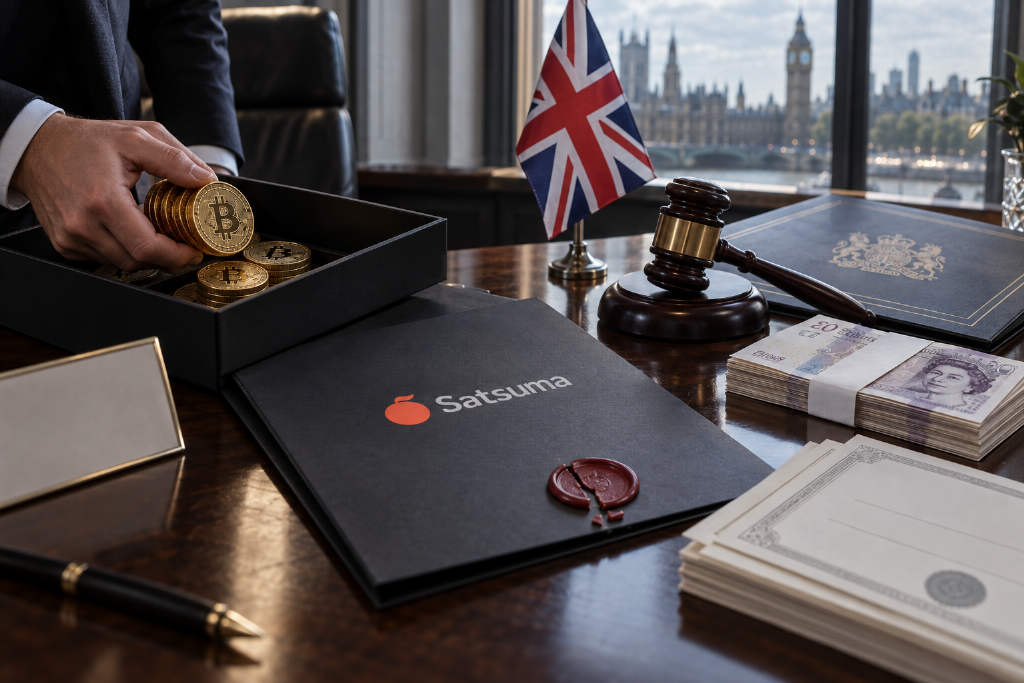
Satsuma, a UK-listed company, is scheduled to delist on Sept. 14, marking one of the clearest examples from the past two years of how a crypto treasury company can shut down: sell its Bitcoin, return most of the capital to shareholders, and then leave the stock market.
Over the last two years, the market has seen a wave of digital asset treasury companies, or DATs. Some kept raising money to accumulate large BTC positions. Others leaned into ETH and other crypto assets. A number of previously low-profile listed firms also used the model to turn themselves into public-market proxies for crypto exposure. The structure worked as long as a company’s stock traded at a premium to net asset value, allowing it to raise capital, buy more coins, and feed the cycle.
Satsuma shows what happens after that cycle breaks.
How Satsuma ended up here
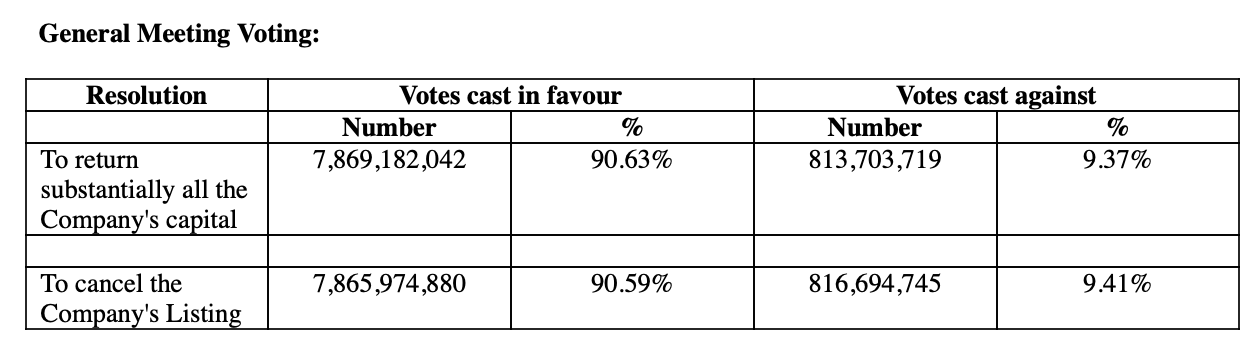
On July 20, 2026, Satsuma held a shareholder meeting to vote on two special resolutions. One called for returning most of the company’s capital to shareholders. The other sought to cancel its listing on the FCA Official List.
The outcome was decisive. The first resolution passed with 90.63% support, and the second with 90.59%. After the vote, the board moved to wind down trading activity and started preparing to sell the remaining 669 BTC on the balance sheet.
The decision did not come out of nowhere. Since shifting to a BTC treasury strategy, Satsuma had accumulated as many as 1,199 BTC. Its average purchase price, however, was above $113,000. As BTC pulled back, the marked value of those holdings dropped quickly, and the market valuation attached to the company kept sliding.
In December 2025, Satsuma sold 579 BTC in a single transaction, roughly half of its holdings at the time, for about £40 million. The implied price was about £69,084 per coin, or about $93,057 at the exchange rate cited in the source. The sale was not framed as a deliberate step to reduce BTC exposure. It was a response to liquidity strain, as the company needed to repay a convertible bond of roughly £78 million due that month.
That sale did not stabilize the situation. BTC kept falling, and Satsuma’s cash-flow pressure intensified. Once a treasury company has to sell BTC to service debt, the original cycle of financing, buying coins, and financing again becomes much harder to sustain.
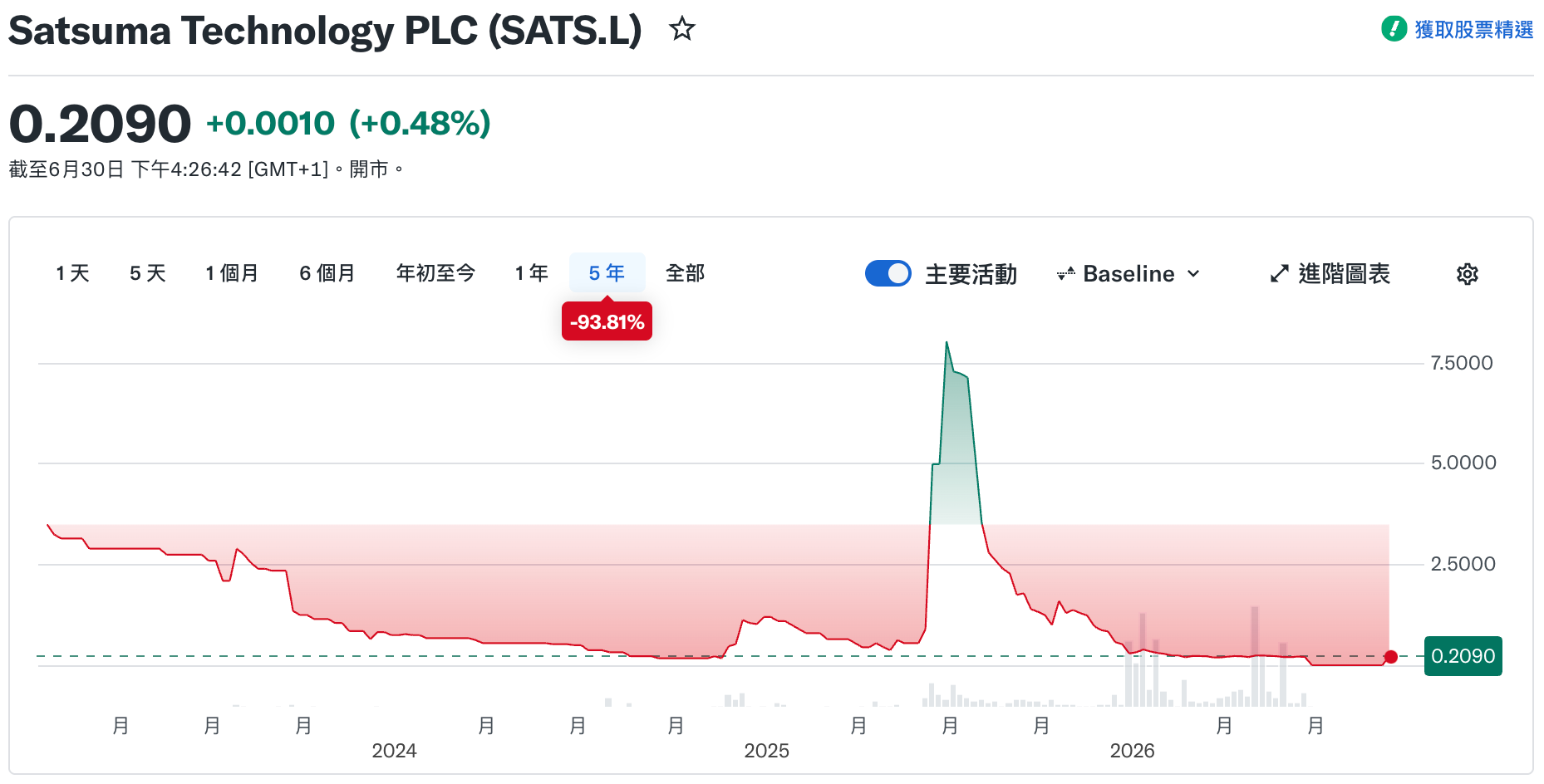
The stock told the same story in more dramatic fashion. From its peak in June 2025 to the delisting vote in July this year, Satsuma’s share price had fallen by about 99%. At one point, its market capitalization even slipped below the value of the BTC it still held. In practical terms, the market was no longer willing to assign a premium to the listed vehicle itself.
In April 2026, Pantera Capital, identified as one of Satsuma’s largest institutional shareholders, publicly called on the company to abandon the treasury model, sell the remaining BTC, and return cash to shareholders. Shareholders holding more than 20% of the company then jointly requested a shareholder meeting, which ultimately pushed the capital return and delisting proposals forward. More than 90% of shareholders backed both measures, bringing Satsuma’s chapter as a BTC treasury company to an end.
What a voluntary DAT delisting looks like
Satsuma’s case also lays out, step by step, how a digital asset treasury company can exit the market.
Step one: shareholders approve special resolutions
A board cannot simply shut down a listed entity on its own. Satsuma first needed shareholder approval for both the capital return and the cancellation of its listing.
Step two: determine who is entitled to the capital return and how many shares qualify
Satsuma chose to implement the capital return through B Shares. After the record process closed, the final number was set at 11,235,874,700 shares. That figure matters because the amount returned per share depends largely on two variables: how many assets remain after the wind-down and how many shares are eligible for the distribution.
Step three: sell BTC, close operations, and clean up the balance sheet
This is the core of the exit process. It turns the company from a listed BTC-holding vehicle into a liquidation entity that is waiting to distribute cash. Between July 24 and July 31, Satsuma sold all of its remaining 669 BTC for a total of about £31.91 million. The implied price was about £47,667 per coin, or about $64,226 at the exchange rate cited in the source.
Step four: court approval of the capital return
This part reflects a feature of UK company law. On Sept. 8, the High Court of England and Wales approved the cancellation of 11,235,874,700 B Shares and a capital return of about £30.72 million to shareholders. That fixed the repayment amount at £0.002734 per B Share.
Step five: delisting and final distribution
Under the timetable previously published by the company, Satsuma will complete its delisting on Sept. 14. Eligible shareholders are expected to receive the payment on Sept. 28. Only at that point is the exit effectively complete.
A second test for treasury companies
Satsuma’s story does not, by itself, prove that the crypto treasury model has failed. Larger names such as Strategy and Bitmine are still expanding their holdings. But for smaller DATs with limited financing capacity, the equation changes quickly when BTC drops, the stock falls below net asset value, and fresh funding becomes harder to secure.
In that sense, buying BTC is only the first half of the treasury-company playbook. Exiting is the second half. Satsuma’s process — shareholder approval, BTC liquidation, capital return, court approval, and final delisting — offers a detailed template for what that exit can look like.
As more companies enter the DAT trade, another measure may draw more attention: not just whether a treasury company can acquire BTC, but whether it can return assets safely to shareholders when the rules of the game change.