
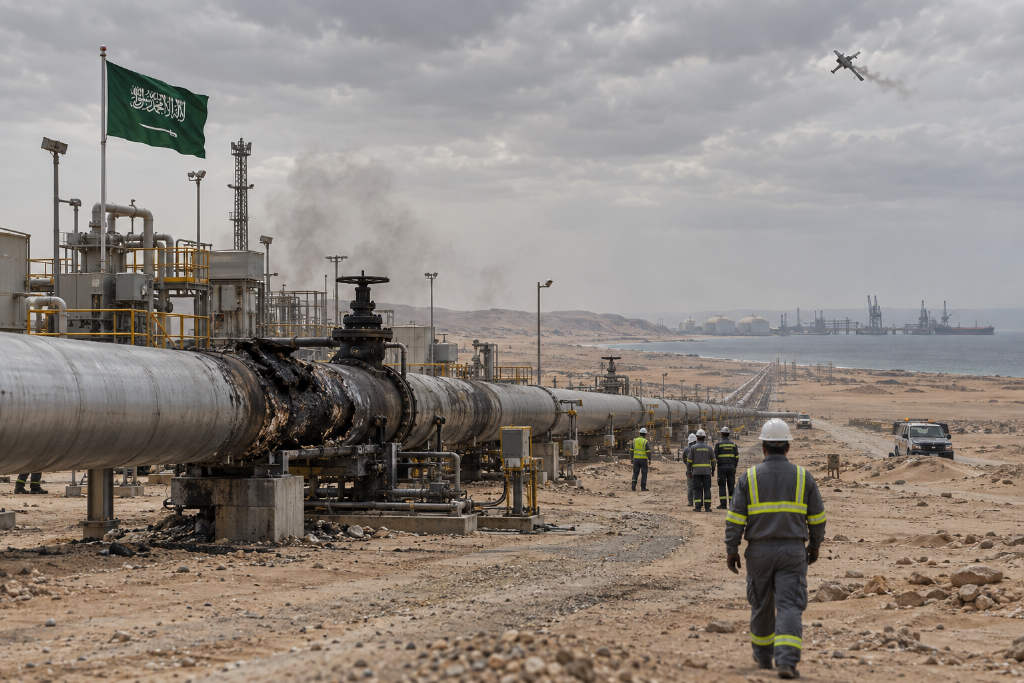
Saudi Arabia’s East-West pipeline has been shut after a drone attack, cutting off a critical land route the kingdom uses to move crude exports outside the Strait of Hormuz. Oil prices jumped in Asian and European trading on Sept. 14, with Brent crude briefly reaching $109.44.
The pipeline, about 1,200 kilometers long and capable of carrying as much as 7 million barrels per day, was forced offline after the strike. It links major oil-producing areas on Saudi Arabia’s Gulf coast to the Red Sea export terminal at Yanbu, giving the kingdom a way to reroute crude away from the Persian Gulf.
On Monday, Sept. 14, Brent crude rose as much as 4.83% intraday to $109.44 before easing to around $107. U.S. crude, or West Texas Intermediate, climbed 4.74% to $104.79.
A key route outside Hormuz is now offline
The attack took place between Sept. 10 and Sept. 11. According to the report, the drones were launched from Iraq. Saudi authorities then shut the pipeline but did not disclose the extent of the damage or give a timeline for a restart.
The East-West pipeline runs across Saudi Arabia and connects the country’s main producing region on the Persian Gulf coast with the Yanbu export terminal on the Red Sea. During periods of tension between Iran and the United States over control of the Strait of Hormuz, it has served as one of Saudi Arabia’s main alternatives for moving crude exports away from Gulf waters. The National estimated that a disruption to the line is equivalent to removing 30% to 40% of Gulf crude supply.
Saudi Aramco chief executive Amin Nasser said on the company’s August earnings call that the pipeline’s role in stabilizing the oil market exceeded even large U.S.-led releases from strategic petroleum reserves. In practical terms, the route had been seen as a buffer against supply losses tied to regional conflict. It is now itself a target.
Analysts focus on inventories and the length of the outage
Matt Smith, head of commodities research at Kpler, estimated that if the pipeline remains closed for a month and inventories at Yanbu are drained, the market would lose 120 million barrels of crude. That estimate assumes exports of 4.5 million barrels per day through the line and about 15 million barrels of storage at Yanbu.
Smith said, 「A loss of 120 million barrels of exports over the next month would provide strong support for prices, especially when the global market is already short of barrels.」
Even so, the price move has not been more extreme. Janiv Shah, an analyst at Rystad Energy, wrote in a Monday report, 「The relatively controlled price reaction suggests the market still expects Saudi inventories to support exports in the short term, but if the disruption lasts beyond the 5- to 7-day inventory buffer, the situation could change quickly.」
Andy Lipow, president of Lipow Oil Associates, said photos circulating online appear to show one pumping station suffering heavy damage. He added that Saudi Arabia may still be able to bypass the damaged station and restart the pipeline at reduced capacity, which helps explain why prices did not rise even more sharply.
Lipow also warned, 「The longer it stays shut, the higher prices will go; based on the photos, repairs could take months.」
Regional tensions are adding pressure
The report said diplomatic talks between Iran and Gulf Arab states, scheduled for Monday in Salalah, Oman, to discuss the Strait of Hormuz situation, were postponed after the pipeline attack.
Omani Foreign Minister Badr Albusaidi wrote on X on Sunday, 「In pursuit of consensus, the regional meeting scheduled for tomorrow in Salalah has been postponed... We remain committed to dialogue that supports regional stability and long-term cooperation.」
Pressure is also building along Saudi Arabia’s southern Red Sea route. According to the Saudi Press Agency, Yemen’s Houthi forces attacked Saudi energy facilities and other civilian targets early last week, leaving more than 70 people injured.
The report also said the Houthis, after taking Yemen’s west coast port of Mokha, had gone on to seize Perim Island, a strategic position in the Bab el-Mandeb strait. That development would strengthen their ability to disrupt crude shipments moving through Bab el-Mandeb to global markets.