

Tokyo’s WebX conference has wrapped up, and SBI Holdings emerged as one of the clearest examples of how Japan’s large financial groups are trying to turn digital-asset experiments into a broader on-chain business system.
In a video message, Japanese Prime Minister Sanae Takaichi said she hoped coordination between Web3 events and government policy would help drive the country’s innovation ecosystem. Inside the venue, the crowd and energy stood in sharp contrast with the quieter tone of the broader crypto market, with some attendees joking that the event felt like a return to the atmosphere of a bull cycle.
SBI was hard to miss. The group served as title sponsor of WebX, and chairman Yoshitaka Kitao delivered a keynote speech. In October last year, SBI acquired a 51% stake in CoinPost, the Japanese crypto media company that organizes WebX, and folded it into the group.
That visibility lines up with a busy run of moves in digital assets. Over the past month and a half, SBI Holdings participated in the $175 million financing round for decentralized lending protocol Morpho, launched the yen stablecoin JPYSC, and introduced Ripple-issued dollar stablecoin RLUSD in Japan.
In July, it added another large bet by investing $125 million in DeFi risk management and yield strategy platform Gauntlet. During WebX, SBI also entered a strategic partnership with the Solana Foundation, with plans to expand around stablecoins, real-world assets, cross-border settlement and institutional on-chain services.
The shift is notable because SBI’s earlier crypto footprint was broad but scattered, spanning Ripple, exchanges, market making and digital securities. More recently, the focus has tightened. The 27-year-old financial group is trying to rebuild settlement, asset issuance, trading, credit and asset management on-chain as parts of one system.
From a broad digital-asset footprint to an on-chain finance framework
SBI has been in crypto for about a decade. Its early investments in Ripple and enterprise blockchain company R3, along with the buildout of crypto trading, institutional liquidity and digital securities businesses, made it one of the earlier Japanese financial groups to establish a wide digital-asset presence.
Those businesses were not tightly connected at first. SBI VC Trade handled crypto trading and custody. B2C2 provided liquidity to institutions worldwide. Its digital securities arm explored tokenization for bonds, funds and other real-world assets. Over the past two years, “on-chain finance” has started to become the framework linking those lines together.
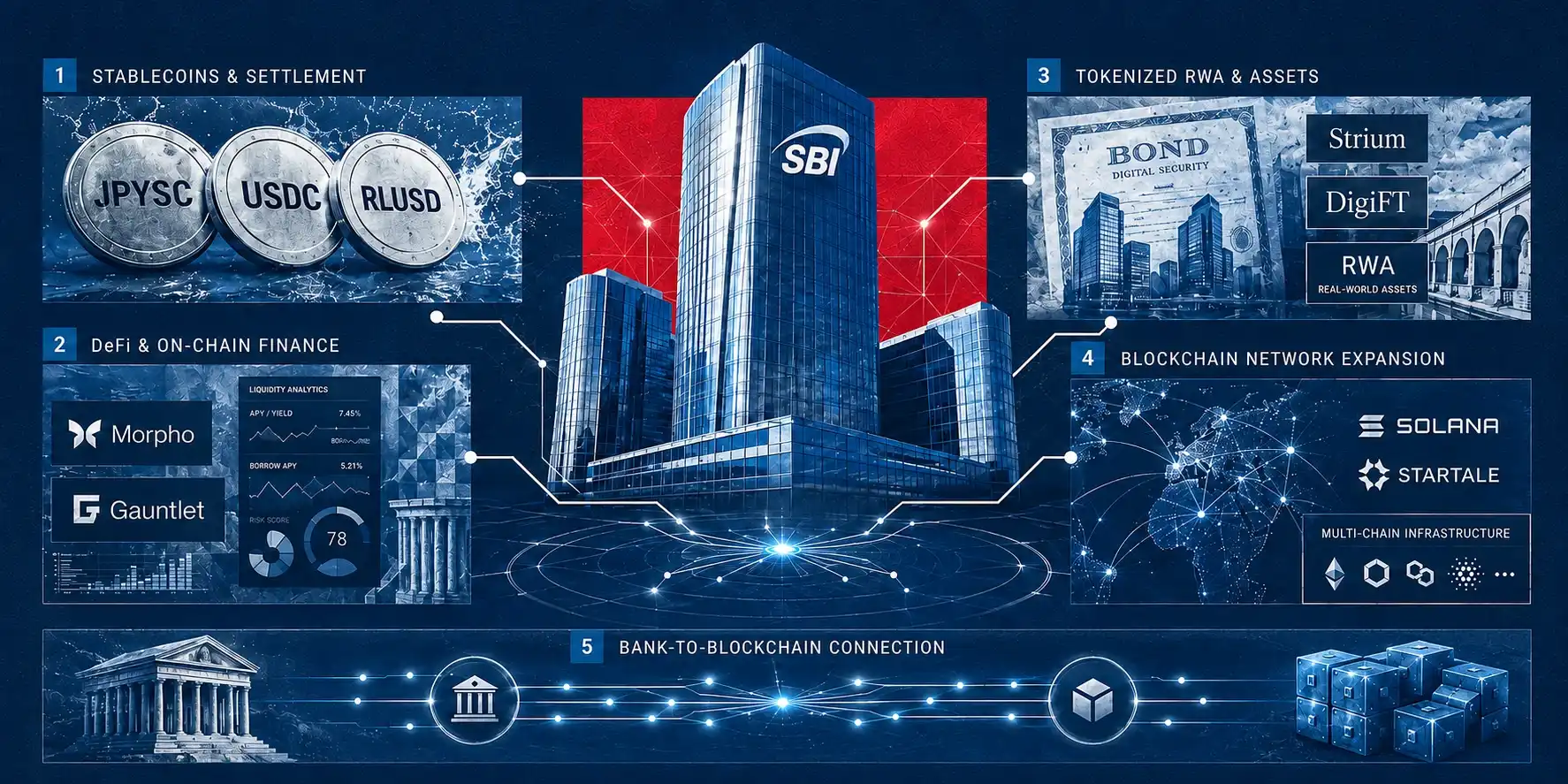
In strategic materials released in May 2026, SBI divided on-chain finance into six layers: settlement, assets, markets, yield treasury, distribution and investors. It also proposed building an “SBI On-Chain Asset Management Platform.”

Under that plan, JPYSC, USDC and RLUSD sit in the settlement and fund-transfer layer. Blockchain and RWA platforms are meant to handle asset issuance and trading. DeFi tools are used to improve capital efficiency. Asset management, securities and digital-asset units inside the group are expected to handle product design and client reach.
Recent investments have followed that structure closely. In its own strategy material, SBI places Circle’s financial blockchain Arc in the settlement layer, Morpho in the market layer, and Gauntlet in the yield treasury layer.
The classification shows how SBI is thinking about expansion: identify missing core capabilities in the stack and plug those gaps one by one.
Stablecoins first: building a yen and dollar settlement network
Within SBI’s on-chain finance framework, stablecoins are the first part to move into live operation.
On June 24, JPYSC, developed jointly by SBI and Startale, officially launched. The token is issued by SBI Shinsei Trust Bank, distributed by SBI VC Trade, and built primarily by Startale on the technology side. SBI describes it as Japan’s first yen stablecoin issued under a trust-based structure. It was designed under Japan’s Payment Services Act as a “Type 3 electronic payment instrument,” with reserves managed by a trust bank and a one-to-one peg of 1 JPYSC to 1 yen.
That trust structure creates an important difference. JPYSC is not subject to the 1 million yen remittance and holding cap that applies to “partial funds transfer” and “overseas-issued” stablecoins. In theory, that makes it more suitable for corporate treasury movements, large-value settlement, RWA transactions and cross-border payments.
Still, JPYSC is not yet in open on-chain circulation. For now, the product is available only within SBI VC Trade accounts, and users cannot transfer JPYSC to or withdraw it into external wallets. SBI has said it plans to move toward public blockchain circulation after legal interpretations, tax practices and operational arrangements become clearer.
Even before opening external transfers, SBI has started expanding internal use cases. SBI VC Trade said applications for JPYSC lending would open on July 16 and the service would begin on July 23. Users will be able to lend JPYSC to the platform and receive returns paid in JPYSC at maturity. The initial annualized yield is set at 3%, while the regular annualized rate is expected to remain around 1% to 3%.
Alongside the yen product, dollar stablecoins provide the other side of the connection.
In March 2025, SBI VC Trade became the first platform in Japan to offer USDC trading services to retail users. Cooperation between SBI and Circle then expanded beyond the stablecoin itself into capital and business ties.
Also in March 2025, the two companies signed an agreement to form Circle SBI Japan, a 50-50 joint venture focused on promoting USDC circulation in Japan and expanding payment and other financial applications. In June that year, when Circle listed on the New York Stock Exchange, SBI Group bought $50 million worth of Circle shares as a strategic investor.
In March 2026, SBI VC Trade added a USDC lending service, extending the stablecoin’s role from trading and payments into yield products.
USDC is not the only dollar token in the lineup. In June this year, SBI VC Trade also listed RLUSD. The stablecoin is issued by a regulated trust company under Ripple, and SBI has treated it as Japan’s first “Type 4 electronic payment instrument.”
That leaves SBI’s licensed digital-asset platform supporting JPYSC, USDC and RLUSD at the same time, creating a parallel structure of yen and dollar stablecoins.
Each token has a different role. JPYSC is meant to connect domestic Japanese bank money and yen-based assets. USDC brings access to broader global on-chain liquidity. RLUSD extends SBI’s decade-long relationship with Ripple and is aimed at institutional payment and cross-border finance use cases.
SBI also wants to push further into cross-currency settlement between JPYSC and dollar stablecoins, while exploring stablecoin use in card clearing, cross-border payments and settlement of tokenized assets. The group has already worked with Visa on digital finance initiatives and tested offline USDC payments.

Bringing traditional assets on-chain and linking them to global capital
Stablecoins address how money gets on-chain. The next step is bringing investable financial assets there as well.
Startale is becoming one of SBI’s key technology partners in that effort. In March this year, SBI said it would invest about $50 million in Startale and planned to account for the company as an equity-method affiliate. The two sides are currently working on two main products together: the yen stablecoin JPYSC and Strium, a Layer 1 network aimed at tokenized securities and RWA trading.
Strium was formally announced in February this year. The network is intended to support round-the-clock spot and derivatives trading in tokenized stocks, bonds and RWA-related products, with the goal of creating an on-chain market that is not limited by traditional trading hours. At present, Strium remains in the proof-of-concept stage, and no formal timeline has been announced for a testnet or commercial deployment.
SBI has also formed SBI Onchain, a joint venture with Singapore-licensed RWA platform DigiFT, with SBI holding 60%. The platform is intended to build tokenization, legal and risk-management frameworks around Japanese assets and connect them with overseas on-chain capital.
The longer-term goal is to convert securities, funds and other financial products inside the group into on-chain assets and then use stablecoins for trading and settlement.
Another piece was added on July 13 through SBI’s cooperation with Solana. Under the plan, the Solana Foundation will participate in the next phase of SBI R3 Japan, which is set to be renamed “SBI Solana Global.” The business scope will cover stablecoins including JPYSC, RWAs such as corporate bonds and commercial paper, cross-border settlement, institutional on-chain financial services and AI agent payments.
The move also reflects a clearer multi-chain approach. SBI continues to work with Startale on Strium for tokenized financial assets while maintaining positions around XRPL, Canton and Ethereum. Solana, in this structure, provides a high-performance public chain and access to global liquidity.
How those networks will divide responsibilities over time has not been fully disclosed. What SBI has made clear is that it does not want to bind financial products and clients to a single chain.
From Morpho to Gauntlet: filling in credit and on-chain asset management
If stablecoins and RWAs answer the question of how money and assets move on-chain, Morpho and Gauntlet address what happens once that capital is there: lending, allocation and yield.
In June, SBI took part in Morpho’s new $175 million financing round, which was co-led by Paradigm, a16z crypto and Ribbit Capital. Unlike earlier DeFi lending models where a protocol sets asset and risk parameters centrally, Morpho uses a modular architecture that lets institutions and developers build isolated lending markets and choose their own collateral, risk conditions and yield strategies.
In SBI’s official strategy material, that places Morpho in the market layer. The attraction is credit infrastructure that can be embedded in banks, fintech platforms and asset-management products.
In July, SBI, through its U.S. subsidiary, also led Gauntlet’s $125 million Series C round. Gauntlet first became known for DeFi risk modeling, providing market parameters, liquidation risk analysis and stress testing for multiple lending protocols. In recent years, it has moved more deeply into yield vault management, designing on-chain allocation strategies based on assets, return targets and risk preferences.
Morpho and Gauntlet are strongly complementary. Morpho provides the underlying credit network on which lending markets can be built. Gauntlet sits on top of those markets to assess risk, design vaults and allocate capital. One is closer to market infrastructure; the other handles asset management and risk optimization.
After this recent burst of deals and product launches, SBI’s on-chain finance map is much easier to read. Rather than build every technical module from scratch, the group is importing capabilities from crypto-native companies through investments and partnerships, then using its own licenses, client base and distribution network to bring those pieces into operation.
The system is still under construction, though, and many of the components are some distance from large-scale deployment. SBI now has a fairly complete strategic outline. Whether those business lines can work together and turn into a durable operating on-chain finance system will depend on how the products perform in actual use.