
SBI Holdings said on July 16 that it has formed a strategic partnership with U.S.-based RWA tokenization platform Ondo Finance to tokenize Japanese stocks and other assets. The plan includes integrating Ondo’s on-chain platform and distributing Ondo’s tokenized products through the SBI ecosystem.
Ondo Finance said the partnership is meant to connect one of the world’s most mature capital markets with the tokenized economy. Newly appointed CEO Ian De Bode said Japan has a large and mature capital market and that SBI Group sits at its center, making the tie-up a route for Japanese assets to move on-chain. SBI Holdings President and CEO Yoshitaka Kitao said Ondo Finance has already established a leading global position in tokenized assets and tokenized equities, adding that Ondo will serve as a key strategic partner as SBI builds what he described as a global digital asset corridor.
Japanese equities and other assets are part of the plan
According to the announcement, the cooperation will focus on tokenizing Japanese stocks and other assets. Ondo’s blockchain-based platform is set to be part of that framework, while Ondo’s tokenized products are expected to be distributed within SBI’s broader ecosystem.
The companies have not yet released details on product structure, target clients, geographic rollout or timing. Those items, the report said, will be announced later in line with applicable legal and regulatory procedures.
JPYSC is set to be used for settlement and collateral
As part of the proposed structure, SBI and Ondo plan to use JPYSC, a trust-based Japanese yen stablecoin developed by SBI Group, as the on-chain settlement and collateral tool for tokenized asset transactions.
JPYSC was jointly developed by SBI Group and blockchain startup Startale Group, which the report described as being backed by Sony and SBI. It was first issued on June 24 this year and is presented as the first yen stablecoin in Japan issued through a trust-based mechanism.
The report said Japan’s Payment Services Act provides clear legal classifications for stablecoins. JPYC, a commonly used yen stablecoin, is issued by a funds transfer operator and classified as a Type 1 electronic payment instrument, making it suitable for real-time transactions on public blockchains for individuals and Web3 developers. JPYSC, by contrast, is issued by a trust bank and classified as a Type 3 electronic payment instrument. Because of its trust-based design, JPYSC has no upper limit on issuance and redemption amounts, which the report said makes it better suited for large-value settlement and collateral use by corporates and institutional investors.
SBI continues to expand its on-chain finance push
The partnership with Ondo is the latest step in SBI Group’s broader expansion into on-chain finance.
Over the past month, according to the article, SBI was the sole investor in Gauntlet’s $125 million Series C financing and in EDX Markets’ $75 million Series C round. The report also said SBI acquired Japanese exchange Bitbank in June for nearly $289 million and has been working with the Solana Foundation to help build an on-chain finance market in Japan.
Tokenized stocks approach a $13 billion market cap
The report framed the deal as part of the wider growth in global asset tokenization. Data cited from Ondo’s website shows that Ondo Finance currently supports 12 blockchains and has around $3.6 billion in total value locked, putting it in a leading position in the real-world asset sector.
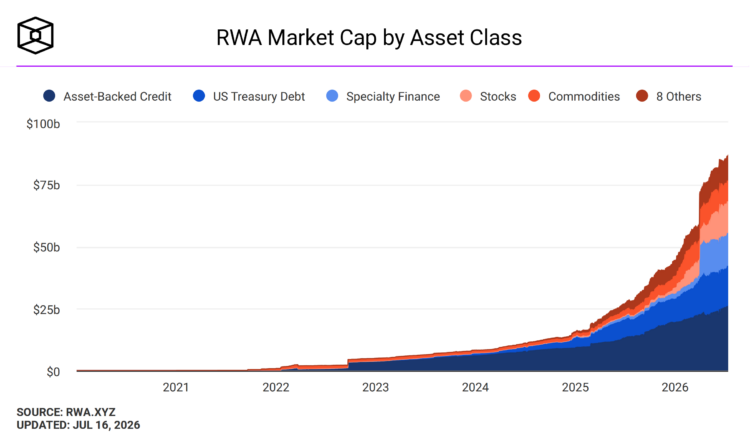
Data from The Block, as cited in the article, shows the global market capitalization of tokenized stocks is now close to $13 billion, representing roughly 15% of the broader tokenized asset market. Asset-backed credit and U.S. Treasurys remain the largest asset categories in that segment.
SBI and Ondo Finance said they aim to build a bridge for global investors between Japan’s capital markets and the global tokenized economy.