
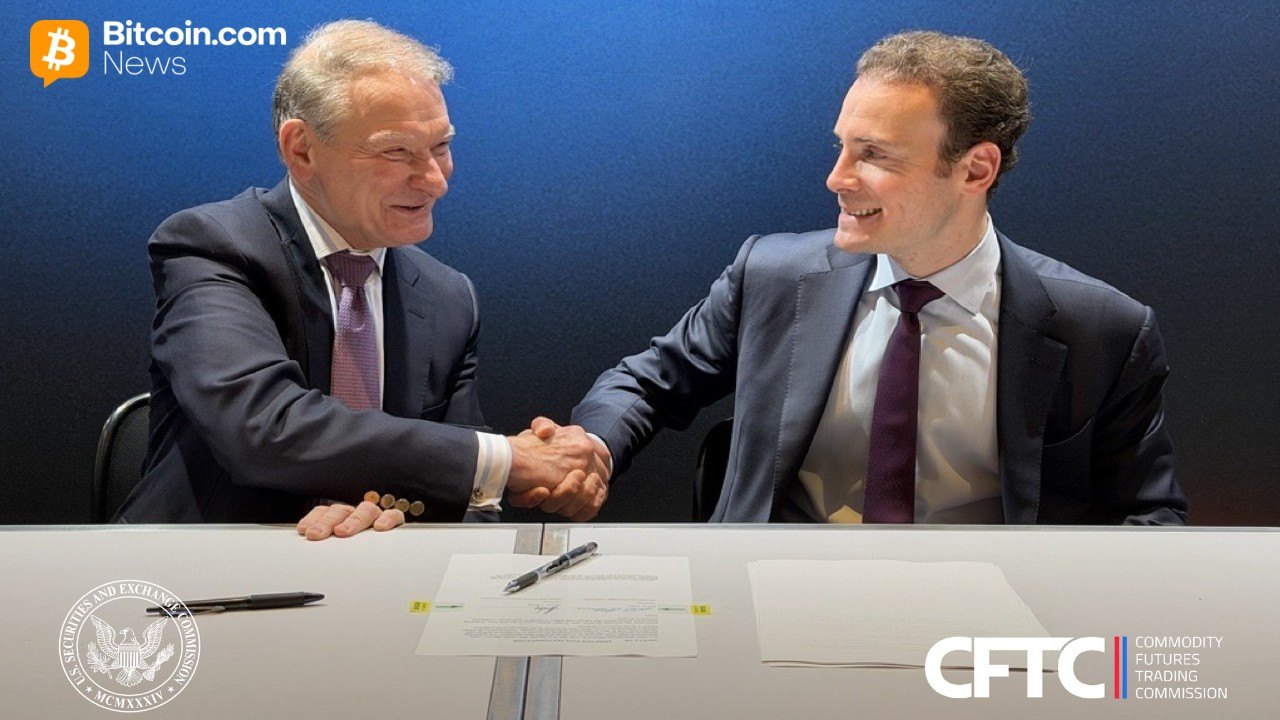
The U.S. Securities and Exchange Commission and the Commodity Futures Trading Commission have signed a memorandum of understanding designed to coordinate oversight across securities, derivatives, and crypto-related markets. Announced on March 11, the agreement is meant to cut long-running regulatory conflict, duplicative registration requirements, and overlapping rules while supporting market integrity and protecting investors and customers.
A formal structure for joint oversight
The memorandum creates a framework for collaboration between the two agencies. It covers aligned regulatory definitions, coordinated oversight, and secure data sharing. Regulators described the arrangement as a roadmap for clearer expectations across the market and lower compliance friction for firms operating where the agencies’ jurisdictions meet. The statement also said the effort would aim for the “minimum effective dose” of regulation while preserving U.S. competitiveness in financial markets.
SEC Chairman Paul S. Atkins said that for decades, turf battles between the SEC and CFTC, duplicate agency registrations, and separate rulebooks had stifled innovation and pushed market participants to other jurisdictions. That remark captures the core issue behind the agreement: the agencies are trying to reduce overlap in areas where market structure has moved faster than regulatory boundaries.
Crypto assets are explicitly part of the plan
Under the memorandum, the agencies also launched a Joint Harmonization Initiative to coordinate policymaking, examinations, and enforcement in areas of shared jurisdiction. The priorities include clarifying product definitions through joint rulemakings, modernizing clearing, margin, and collateral frameworks, and reducing friction for exchanges, trading venues, and intermediaries registered with both regulators.
The agreement specifically lists a goal of creating a fit-for-purpose regulatory framework for crypto assets and other emerging technologies. Based on the published details, that means the SEC and CFTC intend to work toward clearer lines on product classification, oversight responsibilities, and compliance expectations for digital assets. For the crypto market, where the boundary between securities and commodities has been a recurring point of dispute, that language stands out.
Shared reporting, surveillance, and risk monitoring
Other priorities include streamlining regulatory reporting for trade data and funds, along with coordinating cross-market surveillance and risk monitoring. Robert Teply of the SEC and Meghan Tente of the CFTC will co-lead the initiative. The announcement does not set out all implementation details, but it does show that reporting, examinations, and enforcement are being placed into a single coordination track rather than handled in isolation.
CFTC Chairman Michael S. Selig said U.S. financial markets are admired globally because they scale and adapt to investor demand, and he argued that the regulatory frameworks of both agencies must also evolve and modernize to meet the needs of market participants. He added that coordinated oversight would reduce duplicative rules and close regulatory gaps while delivering broader market supervision tied to modern financial activity.
The memorandum does not settle every open question in U.S. crypto regulation. What it does is establish a working structure first, then place product definitions, enforcement coordination, reporting simplification, and cross-market monitoring inside that framework. For crypto firms and investors, the main shift is that the SEC and CFTC are now attempting to handle overlapping jurisdiction through a shared mechanism instead of parallel approaches.