
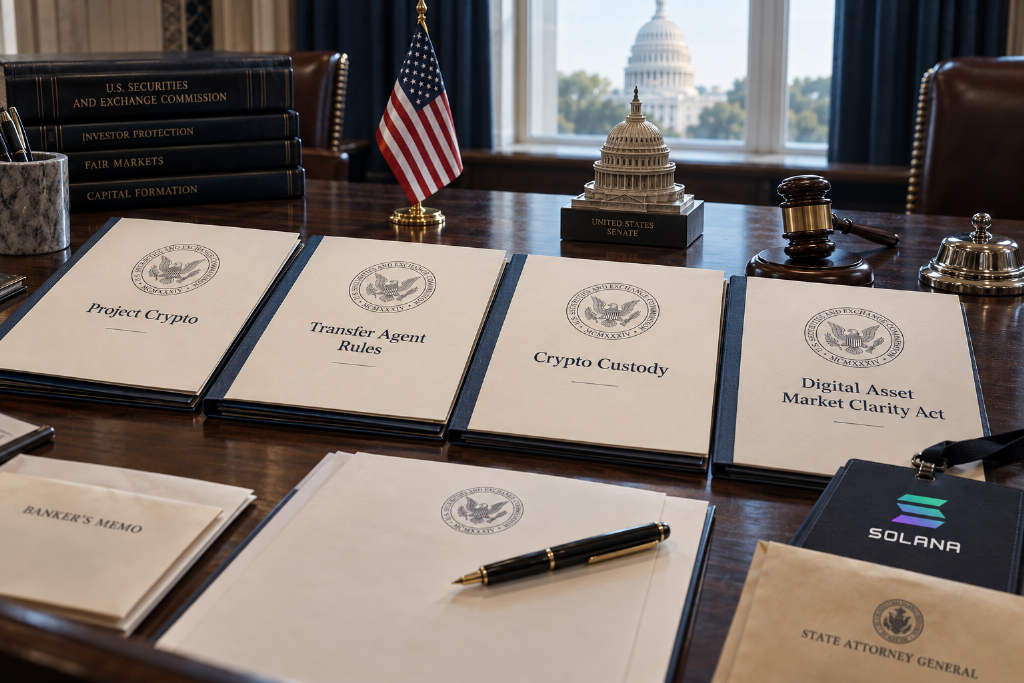
U.S. Securities and Exchange Commission Chair Paul Atkins said Monday that Congress should advance the Digital Asset Market Clarity Act, while stressing that the SEC will keep moving on crypto rulemaking whether or not the legislation passes.
Speaking at an event in Washington hosted by the Solana Policy Institute, Atkins said, 「Congress should vote to move the Clarity Act forward and get it to the president’s desk as soon as possible.」 He then added, 「But I also want to be clear: with or without that legislation, this administration will deliver results for American investors and technology innovators.」
According to CoinDesk, the Senate was set to hold a procedural vote Tuesday afternoon Eastern Time on whether to begin consideration of the Digital Asset Market Clarity Act. The Tuesday vote was a cloture vote on the motion to proceed, designed to test whether the market structure bill had enough support to move ahead. It was not a substantive vote on final passage. Lian News had previously reported on Sept. 11 about a new Republican version of the bill and the 60-vote threshold.
Project Crypto centers on three areas
Atkins used much of his speech to describe a parallel SEC effort outside the legislative process, which he called Project Crypto. He identified three parts of that agenda.
Regulation Crypto Assets
The first is Regulation Crypto Assets, a proposal the SEC has already put forward. Atkins described it as one of the commission’s most important efforts to modernize securities rules for crypto assets. If adopted, he said, founders raising capital with digital assets in the U.S. would have clearer guidance instead of having to guess what the law is as they build.
Transfer agent rule overhaul
The second is a rewrite of transfer agent rules so that blockchain can be included within the scope of digital ownership records. Atkins said those rules have not been seriously updated in about 40 years and were originally designed for paper stock certificates, even as transfer agents themselves have been adapting to a market that increasingly includes tokenized assets.
Crypto custody proposal
The third piece involves custody. Atkins said he has asked staff to develop a proposal clarifying how investment advisers and regulated funds may custody crypto assets. The proposal would seek to let investment advisers self-custody crypto under certain conditions and allow state-chartered trust companies to serve as custodians.
Atkins said the reason is practical: for some assets, no qualified third-party custodian currently exists, while state-chartered trust companies already offer what he called a workable path. He grouped the three initiatives together as the three pillars of a single, rational and comprehensive regulatory framework, and said, 「The SEC should not be the last institution to notice that the world has actually changed.」
Pushback grew ahead of the Senate vote
Atkins’ speech landed at a moment when the bill was facing pressure on several fronts. On Monday, eight banking trade groups sent a letter to Senate leaders asking for tighter restrictions on stablecoin interest and rewards, arguing that the current language could still drive deposit outflows and reduce lending.
The named organizations included the American Bankers Association, the Bank Policy Institute and the Independent Community Bankers of America.
A bipartisan coalition also sent a letter in opposition. The group consisted of attorneys general from 17 states plus the District of Columbia, for a total of 18. They warned that the current version of the bill could weaken their authority to prosecute crypto fraud and urged senators to vote no unless those powers are protected.
Polymarket pricing fell back to about 17%
CoinDesk also noted that Polymarket on Monday afternoon was pricing the chance that the market structure bill becomes law in 2026 at roughly 17%. That erased most of an earlier move that had pushed the figure to about 30% during the day.
Going into the procedural Senate vote, signals from the SEC, banking groups, state attorneys general and prediction markets all pointed to an active fight over the future of the Digital Asset Market Clarity Act.