
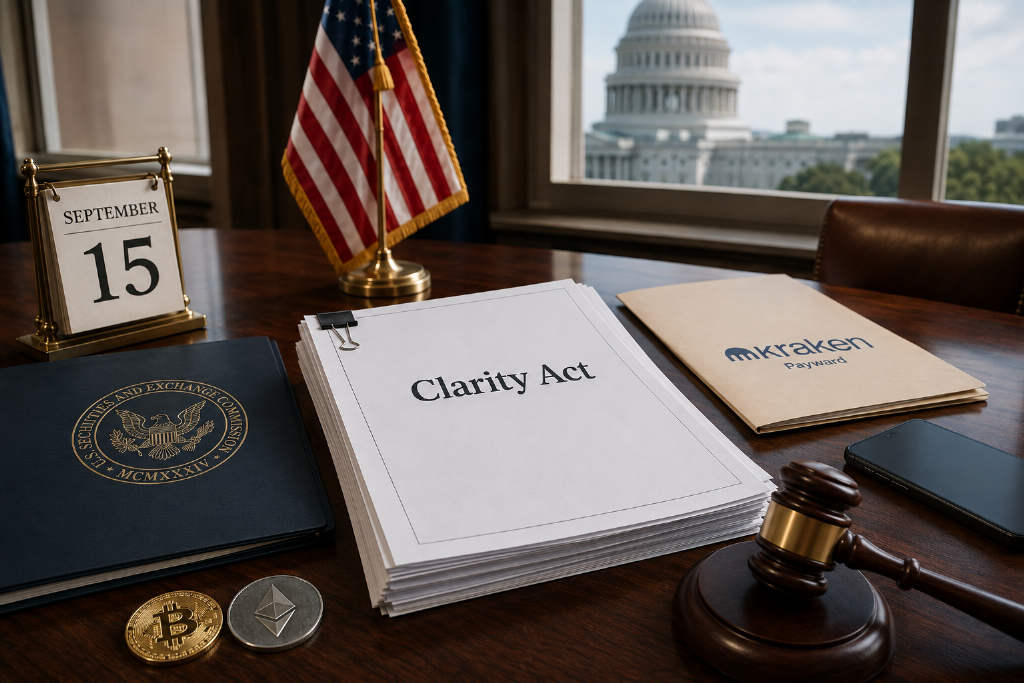
Atkins says Clarity Act is expected to clear the Senate this month
U.S. Securities and Exchange Commission Chair Paul Atkins said he expects the Clarity Act to pass the Senate this month and said the United States could become the "crypto capital." In an interview with Fox Business, Atkins said the bill is set for a Sept. 15 Senate vote and that he expects it to pass before going to the president for signature.
Atkins said regulators are working on rules meant to help the crypto industry grow. "We are changing the way things were done in the past to update the rules for the blockchain and crypto asset era." He also said the SEC submitted a proposal to the White House last week that is meant to clarify the custody framework for crypto assets for investment advisers and companies.
The Clarity Act is designed to create a framework that distinguishes whether a digital asset should be regulated as a security, a commodity, or a stablecoin. The bill passed the House last year, but it was stalled through much of this year as banking lobby groups and crypto companies argued over issues such as whether platforms including Coinbase should be allowed to pay yield to customers. Some lawmakers tried to revise ethics language in the bill. A separate draft bill circulating since July would bar government officials from promoting crypto assets and profiting from them, though some Democratic lawmakers say the language still falls short, while several pro-crypto Republicans accuse Democrats of slowing the process for political reasons.
Kraken parent Payward delays IPO to at least the second quarter of 2027
According to two people familiar with the matter, Payward, the parent company of crypto exchange Kraken, has pushed back its long-awaited initial public offering to as early as the second quarter of 2027.
CoinDesk reported in March that the company had shelved its multibillion-dollar IPO plan because of difficult market conditions. The latest delay extends that timeline again.
Payward confidentially filed a draft S-1 registration statement with the SEC in November 2025. Before that, the company had completed an $800 million raise at a $20 billion valuation, including a $200 million investment from Citadel Securities.
After Circle and Bullish completed successful listings last year, many in crypto expected a wave of IPOs in 2026. Weak token prices, lower trading volumes, and poor public-market performance from some newly listed digital-asset companies have cooled that enthusiasm. Grayscale, Consensys, and Ledger have also delayed listing plans.
While the IPO is on hold, Payward has kept expanding beyond its core exchange business through acquisitions and product launches in traditional and crypto derivatives, tokenized stocks, and payments infrastructure. The company posted second-quarter adjusted revenue of $508 million, up 17% from a year earlier. Funded accounts rose to 6.6 million, and assets on the platform reached $40 billion.
Social Graph VC says data center capex will top $1 trillion in 2026
Venture firm Social Graph VC said in a recent primer on the compute market that data center capital expenditure will exceed $1 trillion in 2026, roughly double what the four hyperscale cloud providers are projected to spend in 2025.
Jensen Huang expects annual spending to reach $3 trillion to $4 trillion by the end of the decade and as much as $10 trillion by 2031. The article said AI investment accounts for about 0.9% of global GDP now and could rise to about 1.4% by 2028.
It also said Fable 5 and GPT-5.6 each require less than 2GW of training power and cost about $120 billion to train. It argued that each generation of model can pay for itself, while losses at labs come from continuing to train the next generation at 10 times the scale.
The piece said compute cannot be bought at a single market-clearing price. H100 rental rates are about $1.95 per hour in the market and $8 to $9 per hour through hyperscalers, with hourly pricing swinging 137% over one year. Of the roughly $3 trillion expected to be spent on global data centers by 2028, it said there is a $1.5 trillion financing gap.
It also said CME plans to list cash-settled monthly H100 and B200 rental futures on NYMEX on Oct. 5, 2026, pending regulatory review, with settlement tied to the Silicon Data index. ICE has also announced GPU futures based on the Ornn index.
Garrett Jin says bitcoin held key support at $76,600
BTC OG whale broker Garrett Jin said macro conditions tightened sharply this week. Brent crude approached $95, the U.S. 10-year Treasury yield moved above 4.8%, and the market raised the probability of a September Fed rate hike to about 70%.
Against that backdrop, he said bitcoin pulled back modestly but held the key $76,600 support level before bouncing back toward the upper end of the $77,000 range. On-chain cost basis data shows a large amount of new supply between $75,000 and $80,000, which he said forms a strong support base. The current heaviest resistance sits between $80,000 and $82,500. A daily close above $82,500 followed by a successful retest would, in his view, be the key signal that supply has been cleared.
On ETF flows, U.S. spot ETFs saw about $3.5 billion in net inflows in August, but September opened with two-way flows. He said Tuesday alone saw about $237 million in net outflows, while retail activity also cooled.
He added that a daily close below $76,600, combined with weaker ETF flows, a weaker Coinbase premium, and weaker 7-day net realized profit and loss, would be a clear warning signal. Friday’s nonfarm payrolls report is the next macro test. If the data comes in hot, it could reinforce rate-hike expectations and put that support level back under pressure.
Dubai VARA signs tokenization MoU with Securitize
According to Cointelegraph, Dubai’s Virtual Assets Regulatory Authority, or VARA, has signed a memorandum of understanding with BlackRock-backed tokenization platform Securitize to advance tokenization and digital-asset infrastructure in Dubai and the United Arab Emirates.
The two sides said the agreement creates a framework for cooperation to support regulated tokenization initiatives, encourage institutional participation, and strengthen Dubai’s digital-asset ecosystem. A VARA spokesperson said the MoU is meant to combine VARA’s regulatory perspective with Securitize’s experience in institutional tokenization to determine how cooperation can help Dubai develop a trusted and regulated tokenized market. No specific project has been disclosed at this stage.
Securitize co-founder and CEO Carlos Domingo said Dubai is one of the world’s most forward-looking jurisdictions for digital-asset innovation and that working with regulators is critical if tokenization is to move from concept to mainstream financial infrastructure.
The announcement comes as demand for tokenized assets keeps rising. RWA.xyz data shows the number of tokenized-asset holders rose 103% over the past 30 days to 3.2 million, while total tokenized-asset value increased 2% to $38.5 billion. Securitize is currently the world’s largest tokenization platform with $4.9 billion in tokenized assets under management. Ondo Finance is second with $3.5 billion.
Ondo asks SEC and CFTC to regulate stock perpetuals under existing rules
Ondo Finance is urging U.S. regulators to bring stock-linked perpetual contracts under supervision and argues that the products can operate lawfully under the existing securities futures framework without requiring new rules.
In three comment letters sent to the SEC and the Commodity Futures Trading Commission on Aug. 24, Ondo said current rules can accommodate equity perpetual futures while also reflecting modern margin practices and on-chain market data. The company said its Panama-based affiliate has already been offering stablecoin-settled perpetuals linked to individual U.S. stocks offshore. Since the June launch, cumulative trading volume reached $8 billion as of Aug. 14.
Ondo said periodic funding-rate payments keep perpetuals aligned with the price of the underlying stock and function in a way comparable to expiry settlement in traditional futures. In its letters, the company said the statutory definition of a security future product does not require a fixed expiration date.
It also said many offshore perpetuals reference stocks that trade mainly on U.S. exchanges, and bringing that business back to the United States should be an active priority for both agencies. RWA.xyz data shows Ondo is one of the largest managers in tokenized real-world assets, ranking fourth with about $2.6 billion in allocated value as of Wednesday.
The proposal arrives as U.S. regulators revisit market rules for on-chain products, including perpetuals and tokenized securities. In March, the SEC and CFTC signed a memorandum of understanding to coordinate supervision where their jurisdictions overlap.
Bybit appoints Sean Ballard to lead derivatives and institutional business
Crypto exchange Bybit said it has appointed Sean Ballard as head of derivatives and institutional business. The role covers trading infrastructure, risk frameworks, and institutional capabilities, with Ballard expected to play a central part across trading risk and exchange technology.
Ballard has more than 25 years of experience in global financial markets, including derivatives, high-frequency trading, trading risk, market structure, and exchange technology. Before joining Bybit, he worked at Jump Trading, where he led high-frequency futures trading across the United States, EMEA, and Latin America, managed portfolios, and worked with global exchanges and regulators on market structure, trading performance, and infrastructure.
During his time at Jump Trading, he also served as a senior trader on the Jump Crypto team, managing centralized exchange trading and driving strategic partnerships tied to ecosystem growth.
Bybit said Ballard will help improve the institutional trading experience through market infrastructure, risk management, and product development. Over the past year, Bybit Institutional added services including bank triparty arrangements, allowing institutions to manage counterparty risk through regulated custody while keeping full trading access. Its market-maker gateway has reduced round-trip latency for high-frequency and quantitative clients from 4 milliseconds to 1.5 milliseconds. Since July 2026, Finloop’s AAA-rated U.S. dollar money market fund FUIDL has been accepted as trading collateral on Bybit.
Bank of America says payrolls are not the key driver for a September hike call
Bond markets have been volatile, and investors are waiting for two major U.S. data points that could influence the Federal Reserve: the August nonfarm payrolls report due Friday and the August CPI report due on Sept. 11.
Bank of America said the two releases do not carry the same weight ahead of the Sept. 15-16 FOMC meeting. In its view, payrolls are more of an appetizer, while CPI remains the main course.
Bank of America analysts said Wednesday: "Nonfarm payrolls are unlikely to be the decisive factor for a September hike. A meaningfully weak report could lower the odds, but CPI remains the key data point in determining whether the Fed follows through with a hike. We maintain our call for a September rate increase." The bank said inflation remains the issue the Fed is watching most closely.
Thailand finalizes crypto travel rule effective Feb. 27, 2027
According to Cryptopolitan, Thailand’s Securities and Exchange Commission has finalized a crypto travel rule that will require digital-asset operators to identify the sender and recipient in every crypto transfer. The rule takes effect on Feb. 27, 2027, and non-compliant transfers will be prohibited from that date.
Operators will need to create transfer-risk policies, collect customer and counterparty identity data, transmit sender and recipient information with each transfer, and keep records for at least five years. For the first two years, those records must be made available immediately when regulators request them. One of the most difficult requirements is verifying that a user controls the funds in a self-hosted wallet.
The rule is intended to combat money laundering and terrorist financing and align Thailand’s standards with the Financial Action Task Force.
Circle president Heath Tarbert calls for passage of the CLARITY Act
At a hearing before the U.S. House Financial Services Committee, Circle president and former CFTC chair Heath Tarbert said the GENIUS Act has already created a federal framework for payment stablecoins, which he described as a "dollar layer" for the internet financial system.
He urged Congress to next pass the CLARITY Act to complete the long-term "market layer" regulatory framework for digital assets. Tarbert also said final implementation rules for the GENIUS Act should close offshore stablecoin regulatory arbitrage, impose appropriate limits on intermediaries that actually serve U.S. customers, and ensure foreign stablecoin issuers meet truly comparable regulatory standards.
HiddenLayer raises $100 million in Series B
According to Securityweek, AI security company HiddenLayer has raised $100 million in a Series B round led by Delta-v Capital, with participation from Booz Allen Ventures, Microsoft’s M12, Morgan Stanley, and Ten Eleven Ventures. The company has now raised more than $155 million in total.
HiddenLayer focuses on securing the full lifecycle of generative AI, predictive AI, and AI agents. Its enterprise platform includes AI asset discovery, AI supply chain security, attack simulation, and runtime protection. The new funding will primarily be used to expand runtime security capabilities for AI agents, especially AI coding agents.
Fed Governor Waller says strong August inflation could support a September hike
Federal Reserve Governor Christopher Waller said that if August inflation data comes in strong, he would consider supporting a September rate increase. He said communicating the reaction function helps the public plan ahead and that policy may not need a sharp acceleration in inflation to justify a tighter stance.
Plenti raises $3 million seed round led by Tether
According to Crypto Briefing, Colombian fintech company Plenti has raised a $3 million seed round led by Tether, with Verda Ventures also participating. The company said the money will support its existing business in Colombia and expansion into Peru and Bolivia.
Founded in 2022, Plenti offers multi-currency accounts for freelancers and remote workers. Users can hold U.S. dollars, euros, and Colombian pesos, earn yield on balances, and invest in U.S. stocks, ETFs, digital gold, and crypto assets. The company said it serves more than 150,000 active users, processes more than $3.1 billion in annual transaction volume, and has handled more than 680 million USDT since 2023.
Apple faces a $2.7 billion class action in London over app tracking rules
According to Reuters, Apple is facing a class action lawsuit in London seeking 2 billion pounds, about $2.7 billion. The claim was filed with the Competition Appeal Tribunal by former UK Competition and Markets Authority senior official Ann Pope on behalf of app developers.
The core allegation is that Apple’s App Tracking Transparency feature, introduced in 2021, imposed stricter limits on third-party developers than on Apple’s own services, giving Apple’s advertising ecosystem an unfair competitive advantage. Ann Pope said Apple’s policy caused "very significant harm" to businesses that depend on Apple as a gatekeeper.
Apple says the feature is designed to let users decide whether apps can track their activity across other companies’ apps and websites. The claimants argue that the rule is enforced with a double standard because third-party apps face strict pop-up consent requirements while Apple’s own personalized advertising and services can avoid equivalent limits. The case is described as the first large-scale private antitrust suit in the UK focused on Apple’s app ecosystem rules.
Hyperscale Data exits bitcoin mining in Michigan and pivots to AI infrastructure
Publicly listed Hyperscale Data said it has ended all bitcoin mining operations at its Michigan facility and is converting the site into infrastructure for AI data center customers. The company said Wednesday that all bitcoin mining machines at the site have been shut down after an inspection by an unnamed California neocloud provider, and that it plans to sell the mining equipment.
Hyperscale Data said the customer signed a 10-year master services agreement for 20 megawatts of AI compute, with two optional five-year extensions. The company estimates that the agreement could generate more than $1.2 billion in revenue over a maximum 20-year term. If the customer exercises an additional 32 MW option, potential revenue could exceed $3 billion. The site is ultimately expected to support 340 MW. The company added that the expansion plan remains preliminary and depends on financing, approvals, and other risks.
At the same time, Hyperscale Data sharply reduced its bitcoin holdings to fund AI buildout. Its shares closed at $0.1984 on Wednesday, down about 17%, a post-split record low after a one-for-four reverse split and other factors. BitcoinTreasuries.NET data shows the company now holds about 215 BTC worth about $16.7 million, down about 79% from roughly 1,006 BTC at the end of July. It ranks 84th among public companies tracked by the platform.
U.S. spot ether ETFs record a daily net outflow of $48.08 million
SoSoValue data shows that U.S. spot ether ETFs posted a total net outflow of $48.0764 million on Sept. 2, Eastern Time. That was the first net outflow after 12 straight days of net inflows.
The biggest daily net inflow came from BlackRock’s staked ETH ETF ETHB, which added $52.9147 million and now stands at $758 million in historical cumulative net inflows. The second-largest daily inflow came from 21Shares ETF TETH, which brought in $2.0267 million and now has $22.8026 million in cumulative net inflows.
The largest daily net outflow came from BlackRock ETF ETHA, which lost $53.3529 million. ETHA’s historical cumulative net inflow stands at $12.744 billion. As of publication, total net assets across spot ether ETFs were $14.995 billion. The ETF net asset ratio reached 5.13%, and cumulative historical net inflows stood at $13.025 billion.
U.S. spot bitcoin ETFs post a daily net inflow of $101 million
SoSoValue data shows U.S. spot bitcoin ETFs recorded a total daily net inflow of $101 million.
The largest daily inflow came from BlackRock’s IBIT, which added $115 million and now has cumulative historical net inflows of $63.485 billion. The second-largest daily inflow came from Grayscale’s Bitcoin Mini Trust ETF BTC, which added $30.4166 million and now has $2.897 billion in cumulative historical net inflows.
The biggest daily outflow came from Grayscale’s GBTC, which saw $56.2127 million leave the fund. GBTC’s historical cumulative net outflow has reached $27.662 billion. As of publication, total net assets across spot bitcoin ETFs stood at $97.221 billion. The ETF net asset ratio was 6.26%, and cumulative historical net inflows had reached $54.712 billion.
Berkshire CEO Greg Abel says the firm plans to hold Japan’s five trading houses for decades
Berkshire Hathaway CEO Greg Abel said in an interview with CNBC that the company plans to keep its stakes in Japan’s five major trading houses as long-term investments and expects to hold them for decades. Berkshire currently owns more than 10% of each of the five companies and is continuing to explore other cooperation opportunities with them in Japan and overseas.
Abel said that although Japan’s 10-year government bond yield has risen to about 3%, the trading houses do not see higher rates as a fundamental challenge, and Berkshire still plans to issue yen bonds when conditions warrant.
On AI, Abel said the fast pace of artificial intelligence development and the practical use of AI across Berkshire businesses are among the reasons the company is constructive on Alphabet. On AI data centers, he said energy supply and related infrastructure remain the main constraint, which creates opportunities for Berkshire and Berkshire Energy.
He said Berkshire is willing to provide energy services for large technology companies’ data centers, provided that doing so does not harm other customers and brings a net benefit to local communities. On U.S. housing, Abel said Berkshire keeps a long-term view and believes the "American dream" remains intact, though he does not expect a rapid rebound in the near term and said the sector could remain choppy for some time. On the broader economy, he said most of Berkshire’s large businesses were strong through the second quarter and demand remained healthy, though U.S. consumers are still under pressure and must be more careful with spending. Overall, he said the company still sees "very strong" economic fundamentals.
Anthony Armstrong joins Coinbase board
According to The Block, Coinbase has appointed Anthony Armstrong to its board of directors and added him to the audit and compliance committee.
Anthony Armstrong previously served as chief financial officer at xAI, X.AI Corp, and X Corp. He spent nearly a decade at Morgan Stanley and was vice chairman of investment banking before later joining the Department of Government Efficiency, or DOGE, as a senior adviser. Coinbase said he has "an outstanding record of operational execution and building systems that scale." The appointment expands Coinbase’s board from nine members to 10. An SEC filing said Anthony Armstrong is not related to Coinbase CEO Brian Armstrong.
Glassnode says bitcoin is still stuck in a range, with resistance at $83,000 to $86,000
Glassnode said in a report that a short squeeze in mid-August pushed bitcoin higher and lifted it above $80,000 on Aug. 27, but the rally ran into long-term overhead supply. Price later fell back toward $76,000 and triggered a sequence of long liquidations.
The report said large pockets of potential short liquidations remain between $83,000 and $86,000, while an unresolved cluster of long liquidations sits lower down between $60,000 and $63,000. BTC is trading between those zones.
On-chain data shows that when bitcoin traded near $78,000 in May, about 65% of supply was in profit. By the end of August, when price returned to the same area, that figure had climbed to 68%. Summer coin redistribution pushed short-term holder cost basis to roughly $71,000, which means the same price level now activates more profitable supply and increases possible sell pressure.
Glassnode said that, combining cost basis and supply distribution, the $62,000 to $65,000 zone is an accumulation support area, while $83,000 to $86,000 marks a concentrated supply zone for long-term holders. During the rebound, the 7-day average net inflow into U.S. spot bitcoin ETFs peaked at $290 million per day, but daily secondary-market volume stayed around $3 billion, well below earlier expansion phases.
At the same time, the U.S. 10-year Treasury yield briefly fell to 4.6% after the Treasury buyback news on Aug. 19, then returned to 4.8% in just eight trading days and set a new high for the cycle, indicating sovereign debt pressure is still affecting valuations. In options, near-term optimism has cooled while longer-dated demand remains. Open interest in Deribit and IBIT options expiring on Sept. 25 stands at about $14 billion, with a large amount of positioning above $80,000. Glassnode said that could become a major volatility and positioning anchor in the weeks ahead. Until supply above $83,000 to $86,000 is absorbed, BTC is likely to remain range-bound, with $62,000 to $65,000 as the main downside reference area.
Nanya Technology reports August sales up 560.85% year over year
Taiwan DRAM maker Nanya Technology said on Sept. 2 that unaudited consolidated net sales for August 2026 reached TWD 44.690268 billion, up 1.88% from TWD 43.867609 billion in July and up 560.85% from TWD 6.762501 billion in August 2025.
The company also said consolidated sales for the year to date reached TWD 220.194 billion, up 638.19% from a year earlier. More detailed figures are available through the company’s investor relations page and the Taiwan Stock Exchange website.
Ukrainian police dismantle a Kyiv-based crypto wallet theft ring
Ukraine’s National Police and Security Service said Tuesday that they had dismantled a fake investment platform network operating out of Kyiv that used embedded wallet-draining tools to steal crypto from users in more than 20 countries.
Investigators have identified 62 victims so far, including citizens of Germany, Poland, Lithuania, Latvia, Spain, France, the United Kingdom, Canada, and Israel. Organizers recruited more than 46 Ukrainians and operated several offices in and around Kyiv. Developers built the fake platforms and worked to keep them from being blocked, while other members handled phone support and security. Ukraine’s Security Service said the organizer was a 25-year-old IT specialist and that the group’s monthly turnover peaked at as much as $1 million.
The scam started with Telegram ads promoting crypto investment projects. After users registered, connected a wallet, and deposited funds, members manually faked transactions so balances appeared to rise inside the user dashboard. When a user tried to withdraw, the platform asked them to connect their main wallet and approve a small "test" transaction for verification. That approval triggered the site’s built-in draining tool, which transferred assets to wallets controlled by the group and locked the victim’s account.
Investigators tracked the group’s database servers to the Netherlands. The servers contained victim information, wallet addresses, stolen amounts, internal communications, and platform operating data, as well as passport details, phone numbers, email addresses, login passwords, and photos. Police carried out 34 searches in and around Kyiv and seized more than 100 computers, more than 100 phones, 79 SIM cards, a GSM gateway, cash, and 15 vehicles.
Michigan judge bars Kalshi from offering sports event contracts in the state
According to Decrypt, Ingham County Circuit Court Judge Rosemarie Aquilina has issued a preliminary injunction against prediction market platform Kalshi, ordering it to stop offering sports-related contracts to Michigan residents. The court said the business amounted to sports betting "disguised as an investment opportunity."
Under the order, Kalshi must use a third-party geolocation service licensed by Michigan’s betting regulator to block in-state users or face a $500,000 daily fine. The injunction also bars the company from allowing Michigan residents to open accounts, deposit funds, view advertising, or access product features similar to sports betting until a final judgment is reached.
Catastrophe bonds are being prepared for on-chain issuance tests in early 2027
Law firm Harneys and tokenization platform droppRWA plan to issue the first catastrophe bond with ownership recorded directly on a blockchain, with the first transaction targeted for early 2027.
The structure would make the blockchain a legally enforceable ownership record. Investor registration, eligibility checks, and payment processing would all sit in one system, cutting reconciliation time from days to seconds, subject to the necessary regulatory approvals.
Catastrophe bonds make up a $65.6 billion market used by insurers, reinsurers, and government entities to transfer natural disaster exposure to capital market investors. The tokenized asset market has nearly tripled over the past year to more than $33 billion. Citi has estimated the sector could reach $5.5 trillion by 2030.
The second quarter of 2026 was the biggest quarter on record for catastrophe bond issuance, with 48 transactions raising $11.3 billion. The Bermuda Stock Exchange hosted 93% of global catastrophe bond issuance in 2025. To lower the investment threshold, investors may be able to buy beneficial interests in vehicles that hold the bonds and pass through returns instead of buying the bond notes directly, which often carry a minimum denomination of $250,000. The minimum investment could fall to $5,000. The project remains subject to applicable regulation and approvals, and any platform administrator role would need licensing under Bermuda’s Digital Asset Business Act 2018.
Term Labs says fixed-rate loan positions in affected vaults have been restored
Term Labs published a technical report on its security incident and said all fixed-rate loan positions in the affected vaults were restored on Aug. 25. The incident was limited to liquid balances inside Term vaults. Term V1 and V2 contracts were not breached, and direct lending markets remain open.
The report said the attacker funded operational wallets through Tornado Cash on Aug. 17 and 18 and submitted a malicious proposal disguised as governance action. That proposal set the governance delay parameter to zero and removed the LP window that could have blocked the change. On Aug. 23, the attacker carried out two batches of attacks, extracting assets from ETH and USDC strategies and moving them to attacker-controlled wallets.
Term Labs said it has worked with law enforcement, closed the affected meta-vaults and strategies, and upgraded and migrated the contracts before maturity.
ASIC warns unlicensed crypto firms could face fines of up to 10% of annual revenue
According to Cointelegraph, the Australian Securities and Investments Commission said crypto firms relying on temporary regulatory relief must apply for an Australian Financial Services Licence by Sept. 30 or seek changes to an existing licence.
From Oct. 1, firms that still require authorization but do not meet the conditions of ASIC’s no-action position may be in breach of financial services law and could face civil or criminal penalties, including fines of up to 10% of annual revenue. ASIC said it has received more than 45 digital-asset-related licence applications since updating its guidance in October 2025.
Ramp says 80% of OpenAI and Anthropic enterprise revenue comes from 1% of customers
Ramp head of data Ara Kharazian said in a post that the company’s latest figures show AI revenue is highly concentrated among a small group of buyers. According to the data, 80% of enterprise revenue at OpenAI and Anthropic comes from 1% of customers, and that concentration has not improved.
Kharazian said he has not seen this level of concentration risk in any other software category he tracks. The top 1% of customer companies are heavily skewed toward technology firms and AI products and services, a point he highlighted as OpenAI and Anthropic move closer to IPOs.
Meme token rankings
According to data from meme token tracking and analytics platform GMGN, as of 08:45 on Sept. 4, the top five trending tokens on Ethereum over the past 24 hours were UNI, V4, LINK, PAXG, and ASTEROID.
On Solana, the top five were fone, FOMO, BEN, CATE, and CTO.
On Base, the top five were Basecat, plumber, Basepepe, SOL, and Memestock.
Articles highlighted in the roundup
"Betting the frontier: why the best crypto investments are born in a bear market" argued that the best opportunities often appear when sentiment is at its worst. It cited a view from "比特神力" saying bitcoin could reach a low point by the end of October this year and said investors who shifted toward AI or U.S. equities may want to look again at fresh opportunities in crypto. The piece pointed to projects with real revenue, businesses mispriced by the current winter, and IOSG’s contrarian, research-driven investment approach.
"BIS general manager: stablecoins and tokenized deposits" said tokenization brings real benefits, including programmability, atomic settlement, and around-the-clock operation, but that the path to the future monetary system lies in improving the old framework while enabling the new one. If done correctly, the next frontier of money would be faster, more efficient, more inclusive, and still built on trust.
"Wintermute: after ETFs and DAT, RWA may be next in the bull cycle" said traditional channels, including ETF inflows and new stablecoin issuance, have seen money return over the past two weeks. That could help the market recover, but a full cycle may still require a new source of incremental liquidity. The article said RWA looks like the only candidate currently moving along that path and that the market will watch whether institutional assets already on-chain can move beyond closed vehicles, be used more broadly as collateral in DeFi, and draw in capital flows beyond cash management demand.
"PONS surges nearly 20x: how is it generating so much of Robinhood Chain revenue?" said trader Timo compared Pons revenue performance with Virtual’s historical peak and doubted whether such growth can last. He questioned whether the buyback ratio can really be executed, how long revenue can hold up, and whether liquidity is deep enough. KOL 蓝狐 said Pons has effectively moved the Pump.fun model onto Robinhood Chain and that the playbook is not new, even if traffic and attention are strong. The article said Pons may prove Robinhood Chain has traction, but the market still has no answer on whether Pons itself can become a durable wealth-effect platform.
"Solana Foundation chair: internet capital markets will become the biggest capital market" said 5.5 billion people are already connected to the internet, and a financial infrastructure that works at any time, for anyone, across any asset, would make the world’s largest market around capital truly reachable. The article said internet capital markets are gradually loosening historical entry barriers and that the system that ultimately absorbs that shift will not simply be an upgraded version of the old one, but a new system built token by token.
"Conversation with Ria Cecilia Tamez: when traditional banks meet a new global payments economy" included closing remarks from the host thanking Cecilia for joining the program and inviting listeners to keep following the show on LinkedIn, Spotify, and YouTube, with a promise to keep exploring innovations in digital finance.
"Jensen Huang at the G20: Nvidia will invest nearly $1 trillion in the U.S. this year, and AI is infrastructure like water and power" also cited Anthropic co-founder Tom Brown, who said countries can capture AI gains if they remove obstacles to technology infrastructure buildout. He said power and labor shortages are a clear bottleneck limiting AI demand.
"From zero TradFi experience to $10 million in profit: two crypto nerds on Wall Street arbitrage" said deployed capital was generating annualized returns of roughly 35% to 45%, depending on the stage, and described the effort as a first real entry into traditional finance. Ten months earlier, the authors said, they had almost no experience trading stocks or futures. Now they had traded $32 billion worth of stocks and related contracts.
"Ahead of Arc mainnet: who is positioning early?" said Circle plans to release a supporting product suite on Sept. 16, including a composable framework for on-chain workflows, AI-driven app and smart contract building tools, tokenized real-world asset issuance management, and interfaces for developers, users, and AI agents. Once the public mainnet opens on Sept. 16, the article said, official cross-chain inflows, DEX liquidity, lending deposits, and active addresses will start to generate verifiable mainnet data, while first-day products promised by Fomo and edgeX will be tested in live trading on the same day.