


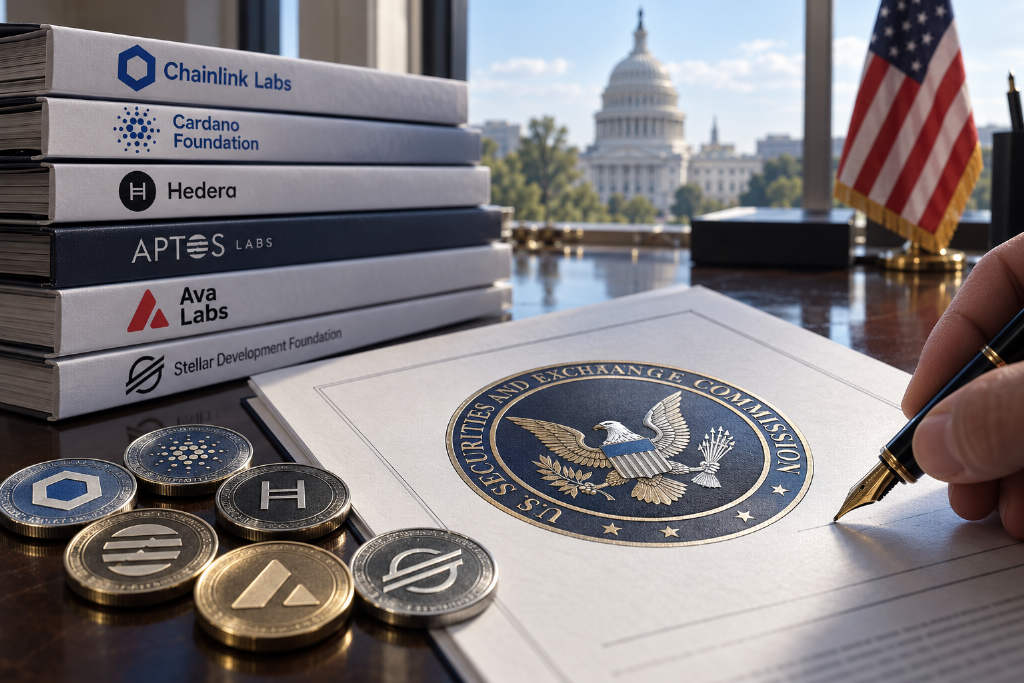
Six crypto organizations submitted a joint comment letter to the U.S. Securities and Exchange Commission on Oct. 20, asking the agency to place the definition of “digital commodities” and their non-security status into the operative text of its proposed Crypto Asset Regulation Rule.
The signatories were Chainlink Labs, Cardano Foundation, Hedera, Aptos Labs, Ava Labs, and Stellar Development Foundation. Their associated tokens — LINK, ADA, HBAR, APT, AVAX, and XLM — were already listed by the SEC as digital commodities in an interpretive release issued in March. The latest filing is aimed at turning that classification into binding rule text rather than leaving it in explanatory material.
Why the groups want more than an interpretive statement
On March 17, the SEC released guidance that placed digital commodities among five categories of crypto assets and named BTC, ETH, and the six tokens tied to the organizations behind the new letter. Under that document, the value of a digital commodity comes mainly from network operation and market supply and demand, not from an expectation of profit based on the essential managerial efforts of a project team.
Then on Aug. 18, the SEC proposed its Crypto Asset Regulation Rule. The proposal would create a dedicated issuance framework for certain investment contracts involving crypto assets, including registration exemptions. Its purpose is to spell out what rules apply when crypto projects raise funds through transaction structures that fall under securities law.
But the definition of digital commodities and their non-security status appears only in the proposal’s preamble and other explanatory sections, not in the rule text itself. That distinction is central to the six groups’ argument.
A preamble explains why an agency is adopting a rule and how it views the issue. The operative text is what directly sets scope and legal requirements. The organizations want the SEC to move the digital commodity classification from explanation into enforceable language.
They tie that request to regulatory stability. As the article notes, substantive rules under the U.S. Administrative Procedure Act generally go through notice-and-comment procedures, while interpretive rules usually do not face the same process. Putting the classification into a formal rule would raise the procedural bar for future changes and, in the groups’ view, reduce concern over shifts in the SEC’s position.
For developers, trading platforms, and ecosystem service providers, a more stable classification would lower long-term compliance uncertainty. It would not block future amendments or court challenges, but it would give the current classification a clearer legal basis.
Token status and investment contracts are not the same thing
The letter also asks the SEC to draw a sharper line between a token and an investment contract formed around that token. The six organizations argue that even if a digital commodity was once sold as the subject of an investment contract, that should not automatically make the token itself a security.
The article gives an example: a project may sell tokens early to fund development and promise that the team’s work will create returns for buyers. That sales arrangement may qualify as an investment contract. But once those promises have been fulfilled or are no longer effective, whether later token trades between third parties still amount to investment contracts should be assessed separately.
On that point, the groups propose a general presumption that secondary-market transactions between third parties do not constitute investment contracts once the issuer’s promises tied to essential managerial efforts are no longer in effect. The issue goes to whether legal relationships formed during early fundraising continue to shape later market trading.
They also say a project should not be treated as engaging in investment-contract transactions simply because it did not use the compliance safe harbors offered in the proposal. In their view, the analysis should still turn on the specific transaction structure.
Staking remains another unresolved area
Staking is another area where the six groups want more clarity. They argue that even if the underlying token is a digital commodity, whether a staking arrangement offered by a service provider falls under securities law still depends on the provider’s role and any promises made about returns.
The SEC addressed issues including liquid staking receipt tokens in a staff FAQ released in September, but those answers do not carry the force of law. For the market, the unresolved question after asset classification is which transactions and services remain subject to securities law, and under what conditions those constraints end.
Rulemaking matters more as legislation stalls
The push for a more durable rule also reflects the state of U.S. crypto market-structure legislation. With Congress yet to pass a comprehensive framework, the SEC’s own rulemaking will have a direct effect on how much legal certainty the industry can get in the near term.
On Sept. 15, the Senate voted on a procedural motion to advance the Digital Asset Market Clarity Act, or CLARITY Act. The motion failed 49-50, short of the 60 votes required.
International law firm DLA Piper said the chances of the bill becoming law this year had dropped sharply, given the time left in the current Congress and other legislative priorities. If it does not pass before the current Congress ends, it would typically need to be reintroduced in a new Congress in 2027.
That leaves the final text of the SEC proposal carrying more weight. For the six organizations and participants in their ecosystems, pressing the SEC to codify an existing classification is a practical way to reduce current regulatory uncertainty while waiting for legislation to move.
How much of the request the SEC accepts is still unclear
The groups’ position is not fully at odds with the SEC’s current direction. SEC Chair Paul Atkins said in March, when the classification guidance was released, that most crypto assets are not securities in themselves and that investment-contract relationships can end. He also described the guidance as a transitional measure while Congress works on market-structure legislation.
The latest comment letter is an effort to give that position firmer footing. Still, agreement with the general direction does not mean the SEC has agreed to place it in the rule text. So far, the requested revisions remain unanswered.
Views on the proposal remain divided. Bitwise and Hyperliquid Policy Center want clearer token classifications, broader compliance protections, and more precise rules for airdrops and token buybacks. Those comments overlap with the six groups’ position in seeking standards that are more concrete and more reliable.
Former SEC enforcement official John Reed Stark and Duke University scholar Lee Reiners, by contrast, have called for the proposal to be withdrawn, arguing that it exceeds the SEC’s authority and weakens investor protection.
Writing the definition into the rule text could make the classification more stable, but the rule would still need to rest on the SEC’s statutory authority. The objections raised by critics target the proposal as a whole rather than the six groups’ request alone. Even so, they show that any final rule could still face legal challenges. The long-term certainty sought by the six organizations will depend not only on what the SEC writes, but also on whether those provisions survive judicial review later on.