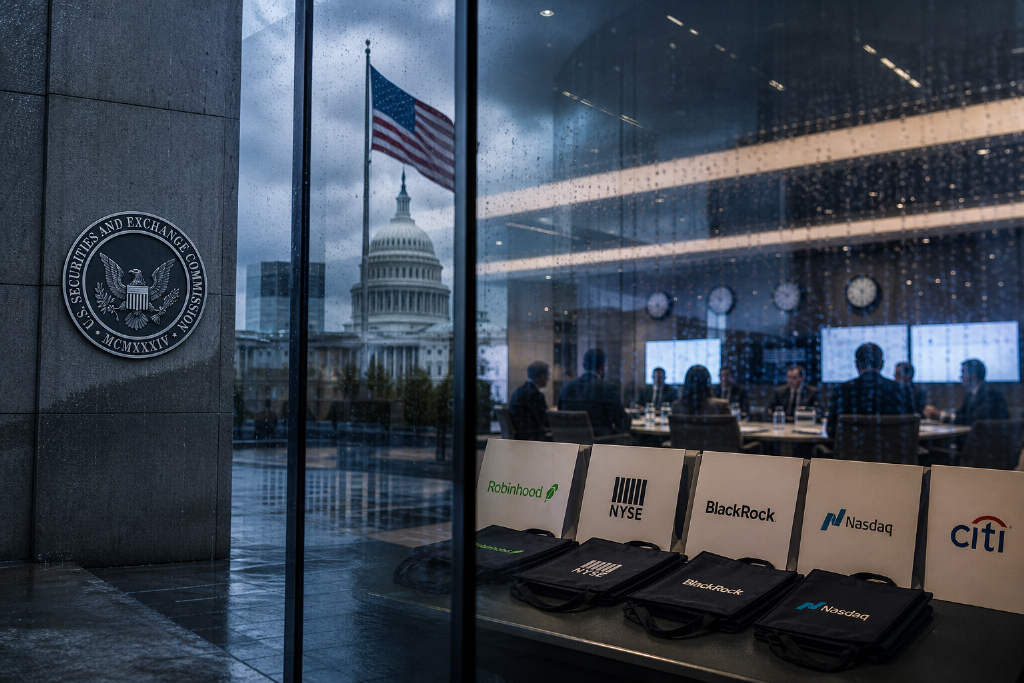
SEC sets agenda for Sept. 17 roundtable on 24-hour U.S. stock trading

SEC sets agenda for Sept. 17 roundtable on 24-hour U.S. stock trading

N
News Editor
2026-09-02 01:42:09
The U.S. Securities and Exchange Commission has released the full agenda and speaker list for its Sept. 17 roundtable on “24-hour trading,” a public event that will run from 10 a.m. to 4 p.m. at SEC headquarters and be livestreamed on the agency’s website. The program is split into three panels. The first will examine market readiness for extended trading hours, including platform and broker preparedness, overnight surveillance, closing-price processes, clearing and settlement changes, and investor protection. Speakers on that panel come from Robinhood, the New York Stock Exchange, BlackRock, Virtu Financial, Cboe, BNY Pershing, UBS, FINRA, and Bruce Markets. A second panel will focus on operational resilience, covering system readiness, Reg SCI compliance, failover and capacity planning, market data continuity, cybersecurity, and overnight staffing, with participants from Jane Street, State Street, Samsung, Charles Schwab, Nasdaq, Interactive Brokers, DTCC, Exegy, and MEMX. The third will address the expected effects of expanded trading on liquidity and capital formation, as well as infrastructure needs for a future 7×24 market, with speakers from OTC Markets, BNP Paribas, 24X, Invesco, Citadel Securities, DriveWealth, Blue Ocean, Citi, and ModernIR. SEC Chair and commissioners are scheduled to deliver opening remarks, and Trading and Markets Director Jamie Selway will also attend.

The U.S. Securities and Exchange Commission has released the full agenda and speaker list for its Sept. 17 roundtable on “24-hour trading.” The meeting will be held at SEC headquarters from 10 a.m. to 4 p.m., open to the public, and livestreamed on the SEC website.

Three panels will cover readiness, resilience, and market impact

The agenda is divided into three panel discussions. The first panel will look at readiness for a 24-hour market. Topics include the preparedness of trading platforms and brokerages, overnight surveillance, closing-price processes, changes to clearing and settlement, and investor protection.

Speakers on that panel come from Robinhood, the New York Stock Exchange, BlackRock, Virtu Financial, Cboe, BNY Pershing, UBS, FINRA, and Bruce Markets.

The second panel will focus on operational resilience in a 24-hour market. It will cover system readiness, Reg SCI compliance, failover and capacity planning, continuity of market data, cybersecurity, and overnight staffing.

Participants in the second session include Jane Street, State Street, Samsung, Charles Schwab, Nasdaq, Interactive Brokers, DTCC, Exegy, and MEMX.

The third panel will examine the expected effects of extended trading on liquidity and capital formation, along with the infrastructure required for a future move toward 7×24 trading.

That session will include speakers from OTC Markets, BNP Paribas, 24X, Invesco, Citadel Securities, DriveWealth, Blue Ocean, Citi, and ModernIR.

SEC leadership and trading officials will also appear

According to the published schedule, the SEC Chair and commissioners will deliver opening remarks. Jamie Selway, director of the Division of Trading and Markets, will also attend.

Roundtable marks a key step in SEC planning under Atkins

The roundtable is described as a key step in the SEC’s push under Atkins to move U.S. equities toward around-the-clock trading, shifting the issue from policy discussion into concrete operational preparation.

This article was originally published by Bit.Fan. For more cryptocurrency news and market insights, visit www.bit.fan.
500

Disclaimer:

The market information, project data, and third-party content displayed on this platform are for industry information sharing only and do not constitute any form of investment advice or return commitment.

Cryptocurrency trading carries high risks. Users should fully assess their risk tolerance and make independent decisions. All profits, losses, and legal responsibilities are borne by the users themselves.