
The crypto market has spent much of this cycle embracing a simple idea: if a protocol makes money, it should use part of that revenue to buy its own token in the secondary market.
That theme has spread across high-profile projects including Hyperliquid, pump.fun, Uniswap, and Ethena. In practice, token buybacks have become one of the market’s clearest shorthand signals for “fundamentals.” The more a protocol buys, the more it can look like a profitable company, and the easier it becomes for traders to frame the token around earnings support.
That is also where the compliance risk starts.
A reported SEC revision draws a stricter line around buybacks
In an article by Jamie Ni of TechFlow, the core issue is laid out plainly: in the United States, the Securities and Exchange Commission holds the decisive interpretive power over whether a token is treated as a security. If the agency believes a project is telling the public that the team will keep working and use buybacks to raise the value of the token, that token can be characterized as an investment contract.
The consequences, as the article describes them, would be severe. Compliant exchanges such as Coinbase could be forced to delist the token, access to U.S. capital channels could be cut off, and the project’s business model could be pushed into a standstill.
The report says the SEC has long maintained an FAQ used as practical guidance on whether a crypto asset may be treated as a security. Law firms and token issuers have relied on it as a key reference when trying to stay away from regulatory danger zones.
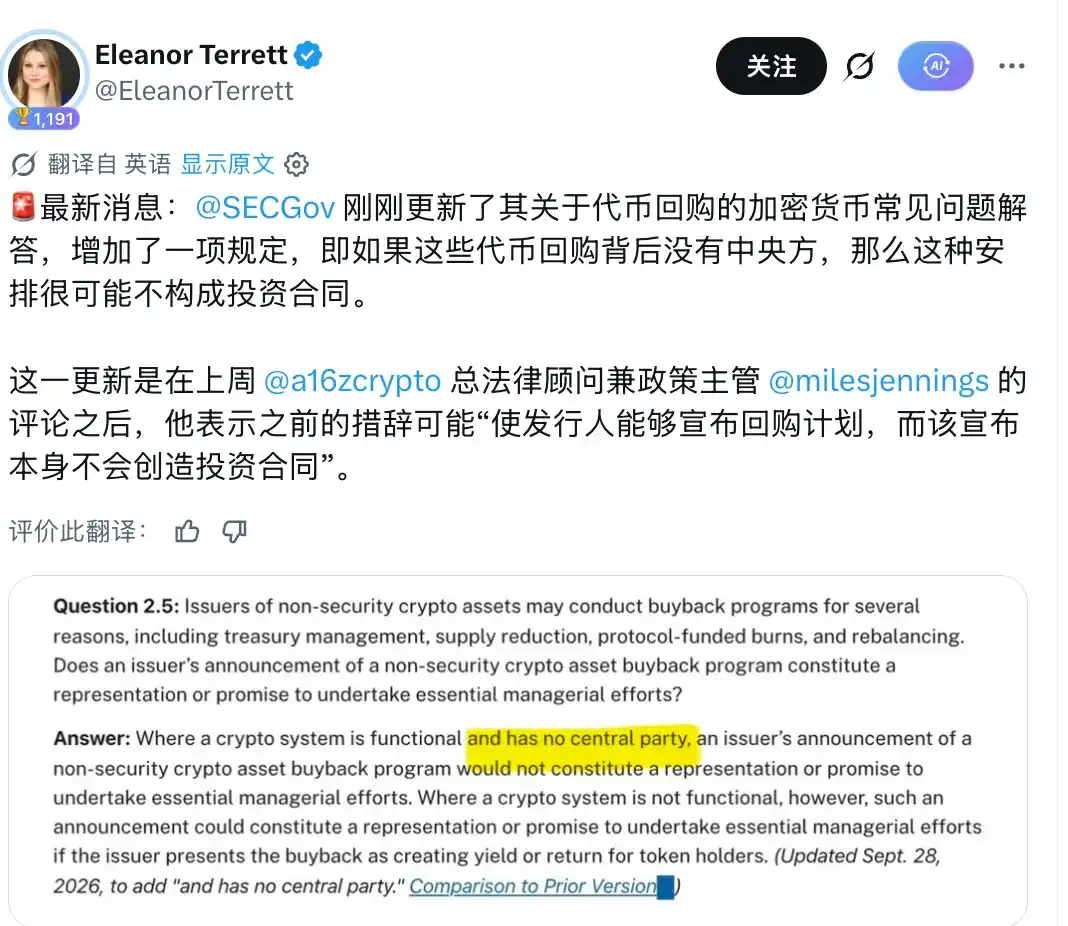
Citing crypto journalist Eleanor Terrett, the article says the SEC’s Division of Corporation Finance updated that FAQ on Sept. 28 in a section dealing with token buybacks. The revised message is narrow but important: only when a crypto system is already functional and there is no central party may an issuer’s announcement of a token buyback plan be more likely not to amount to an investment-contract promise.
That does not mean the SEC is rejecting all buybacks. It means the agency is distinguishing between buybacks executed automatically through on-chain code and buybacks driven by a foundation or core team that decides the size of the repurchase and promotes it to the community. The first looks more like protocol design. The second can still sit close to the zone the SEC considers risky.
The market may have to reprice buybacks through a regulatory filter
The article argues that over the past year, the market’s pricing logic around buybacks has been blunt: more buying was better, louder announcements mattered, and higher revenue strengthened the story.
After this FAQ revision, that approach may no longer be enough. Market participants now have to separate two things that were often bundled together: a protocol parameter that automatically routes value into token purchases, and a public-facing promise that management or a central entity will use profits to support token holders.
That change, the article says, effectively divides many of the market’s best-known buyback projects into a lower-risk camp and a higher-risk camp.
Tier one: automated mechanisms that sit closer to a “no central party” model
These projects share a few traits. Their products are already live, the buyback logic runs mostly through on-chain rules, and the room for a team to change course on impulse or turn the mechanism into a promotional tool is limited. Under the revised FAQ logic, they have a stronger argument that discussing buybacks does not automatically imply a promise of managerial efforts.
Hyperliquid (HYPE)
The article presents Hyperliquid as one of the strongest examples. About 99% of trading fees flow into the Assistance Fund and are converted directly into HYPE at the L1 execution layer. The proceeds go to a system address with no private key and, according to the article, cannot be withdrawn by human operators. No one can schedule the buyback by hand, and no one can pause it casually.
On the face of the FAQ language, that leaves HYPE in a comparatively stronger position on the specific question of whether an announced buyback is an investment-contract promise. The article is careful not to stretch that point. It says this does not mean HYPE has been given a free regulatory pass. Unlock-related sell pressure still exists, buybacks do not automatically create net deflation, and the token’s price still depends on real derivatives trading volume.
Uniswap (UNI)
For UNI, the article says that once governance turns on the fee switch, protocol fees flow into TokenJar, and outside parties can access those fees only by burning UNI. It also notes that Uniswap’s official messaging has been restrained and has explicitly said UNI holders do not have a direct claim on protocol revenue.
Mechanically, that puts UNI in a relatively strong position, though not a perfect one. Uniswap Labs and the governance structure still exist, so a strict “no central party” reading would not award full marks. The article says the practical value of the updated FAQ is that it reduces the verbal compliance friction around the idea that turning on the fee switch automatically amounts to securitization. In that reading, UNI’s design looks more defensible as a supply-management mechanism than as a revenue promise.
Tier two: profit-distribution narratives with heavier centralized control
This is the group where retail positioning is more concentrated and where the FAQ may bite harder. These projects can still have meaningful revenue and active repurchase programs, but the decision-making structure behind them is much more visible.
pump.fun (PUMP)
The article says PUMP has already carried out buybacks and burns worth hundreds of millions of dollars, making it one of the most recognizable names in the current buyback trade, second only to HYPE in symbolic weight.
The problem, as framed in the piece, is that the structure closely resembles a technology platform allocating profit. The team can change the split at any time and can decide whether tokens are accumulated first and burned later or destroyed immediately. The platform itself also has a clearly identifiable centralized operator.
Under that setup, the FAQ is unlikely to stop PUMP from buying back tokens. What it does make harder is presenting those buybacks as a compliant reward flowing to holders. Traders may still focus on the machine itself, but for capital trying to anchor a broader network-token thesis, the article says PUMP cannot simply use this FAQ as compliance validation. Real issuance volume and revenue-sharing ratios remain the critical variables.
Ethena (ENA)
On ENA, the article points to a foundation proposal that would route 95% of net revenue to ENA buybacks, provided that USDe supply first reaches a higher threshold. The income goes into the foundation and is then used for purchases according to governance parameters. In that setup, the roles of Labs and the Foundation remain clear.
The article says ENA looks more like a case where a foundation is promising future value to flow back into the token. The most difficult part of the new FAQ for this structure is not necessarily the mechanics but the wording. If the project continues to market the arrangement as “95% of revenue returned to token holders,” it could land directly in the category of statements the SEC is trying to target.
Aave, Pendle, and other established DeFi names
The piece also groups Aave, Pendle, and similar mature DeFi projects into a middle area. Their products are established and their revenues are real, yet their systems still carry strong DAO, founder-team, and treasury-committee characteristics.
These projects can continue with buybacks, according to the article, but the story around them has to change. “Returning value to token holders” becomes a much riskier framing. “Treasury management by the protocol” is the wording the market may need to hear instead.
The FAQ also hits pre-launch and early-stage projects
The article makes a broader point beyond the current market leaders. Projects that are still in presale, still on testnet, or newly launched and already writing “X% of future revenue will be used for buybacks” into white papers as a core selling point are described as the clearest target of the revised FAQ.
If the system is not yet functional and the buyback is being sold as a future return, the SEC has made clear, according to the article, that this can very likely amount to a key managerial promise.
That leaves those projects in the weakest position. They do not gain protection from the FAQ. Instead, they lose one of the easiest promotional tools available during the cold-start phase.
The buyback theme survives, but the bar is now higher
The article’s conclusion is not that the SEC has killed the buyback trade. It has not.
What the change does, in the author’s framing, is strip away some of the narrative premium. A weak project without trading activity does not become strong because it announces buybacks. A stronger project with a more automatic mechanism may now face one less regulatory talking point against it. Projects with weaker structures, though, lose some of the marketing power that buyback language once gave them.
The dividing line is no longer just whether a token is being repurchased. It is whether the project can explain the source of funds and who controls the process. If those answers are clear, a buyback can look more like a fundamental feature. If they are not, the article says, it may read more like a public-relations document that could attract an SEC subpoena.