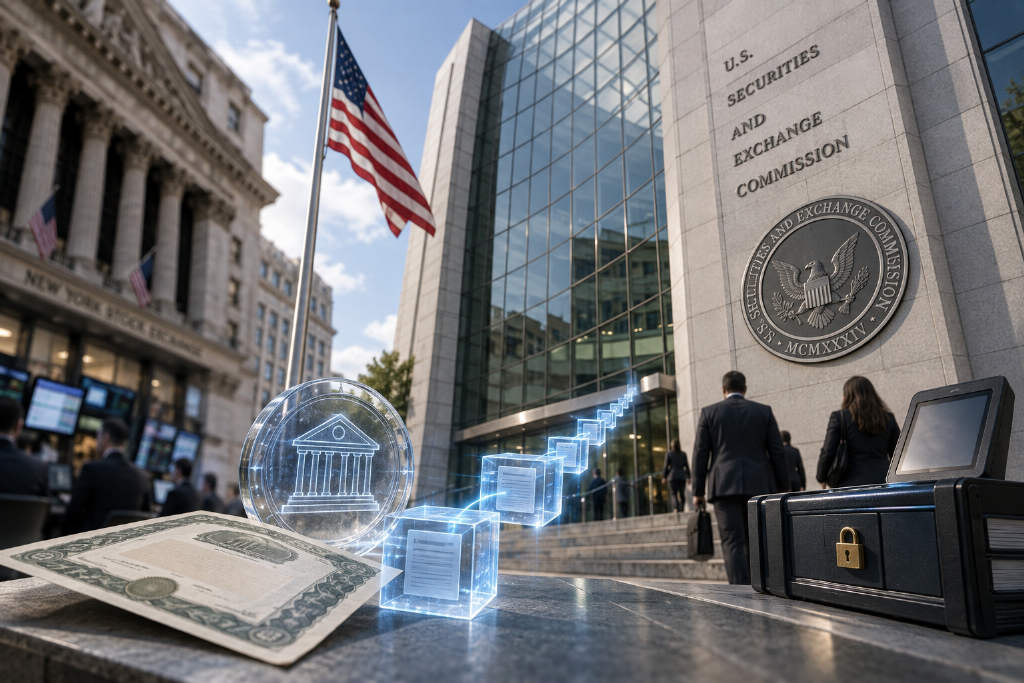
Rumored SEC exemption could let tokenized securities trade on-chain without traditional venues

Rumored SEC exemption could let tokenized securities trade on-chain without traditional venues

N
News Editor
2026-09-09 03:23:57
A market rumor circulated by The Rollup founder Andy says the U.S. Securities and Exchange Commission may be preparing what he described as the largest tokenization-related innovation exemption to date. If implemented, the framework could allow tokenized securities to trade through registered transfer agents alone, without broker-dealer licenses and without complying with rules tied to traditional trading venues or alternative trading systems, or ATSs. Andy also said the arrangement could extend to U.S. retail investors and overseas participants, though none of the claims has been officially confirmed. He argued that such a policy, if real, would have broad implications for on-chain finance. In his outline, tokenized funds could be issued and traded directly as on-chain tokens, while transfer agents maintain legal ownership records on-chain. The underlying assets held by those funds, including stocks and bonds, could also be tokenized, creating a structure in which both fund tokens and asset tokens circulate on-chain. Andy later added that one large fund had already received an SEC “green light,” but said there was still no official confirmation. He speculated that ARK, Fidelity, or BlackRock could be involved.

BlockBeats reported on Sept. 9 that Andy, founder of The Rollup, said in a post that the market is circulating a rumor that the U.S. Securities and Exchange Commission is preparing what he described as the biggest tokenization innovation exemption so far.

According to Andy, the proposal could allow tokenized securities to trade solely through a registered transfer agent. That would mean no broker-dealer license requirement and no need to follow rules tied to traditional trading venues or alternative trading systems, or ATSs. He also said the arrangement is rumored to cover both U.S. retail investors and overseas investors.

Andy said the implications would be significant if the report proves accurate. In the structure he outlined, tokenized funds could be issued and traded directly as on-chain tokens, with transfer agents maintaining legal ownership records on-chain. He added that the underlying assets held by those funds, including stocks and bonds, could also be tokenized, creating an on-chain trading system built around both fund tokens and underlying asset tokens.

In a later comment, Andy said one large fund had already received an SEC “green light,” though he added that there has been no official confirmation so far. He speculated that ARK, Fidelity, or BlackRock could be among the potential participants.

He also said that if the policy is ultimately adopted, U.S. asset managers could move faster to issue native equity tokens in an attempt to capture 24/7 liquidity and on-chain distribution, rather than waiting for third parties to create mirrored tokenized versions of traditional securities.

Andy linked the potential policy shift to what he described as recent moves by the Trump administration to open up crypto-market regulation, as well as efforts by the Commodity Futures Trading Commission, or CFTC, to bring perpetual futures into the U.S. market. In his view, the U.S. regulatory environment may be gradually opening the door to on-chain finance.

This article was originally published by Bit.Fan. For more cryptocurrency news and market insights, visit www.bit.fan.
1500

Disclaimer:

The market information, project data, and third-party content displayed on this platform are for industry information sharing only and do not constitute any form of investment advice or return commitment.

Cryptocurrency trading carries high risks. Users should fully assess their risk tolerance and make independent decisions. All profits, losses, and legal responsibilities are borne by the users themselves.