
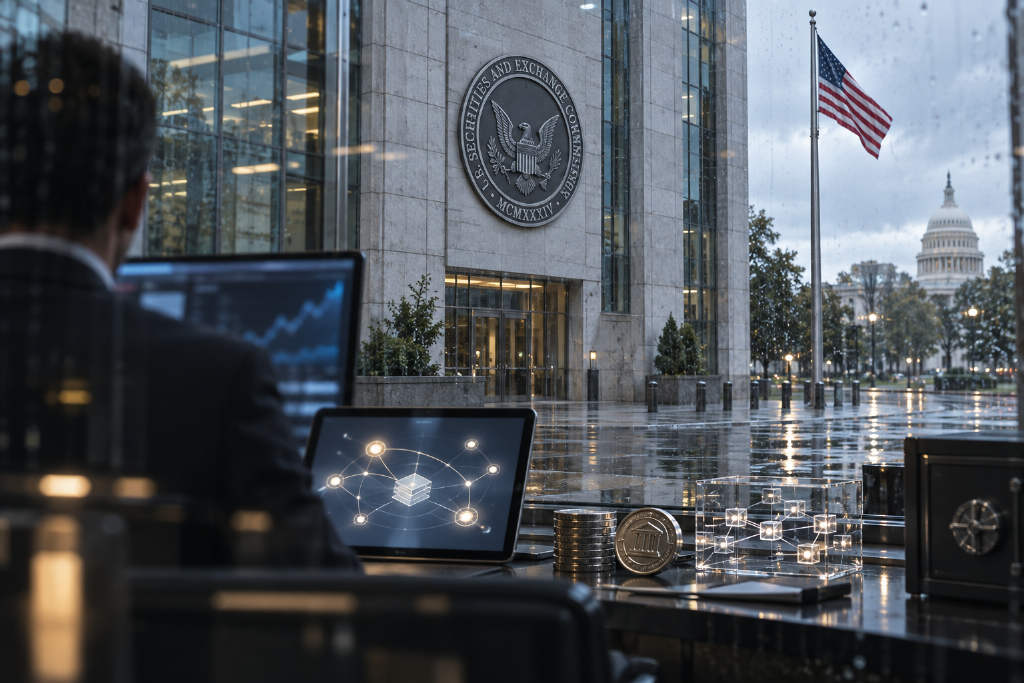
The U.S. Securities and Exchange Commission said it has approved a temporary, conditional "Innovation Exemption" that would allow limited trading of tokenized stocks on certain on-chain venues, putting tokenized equities at the center of the day’s regulatory discussion.
The agency said tokenization could lower costs across issuance, trading, transfer, settlement, and ownership recordkeeping, while improving transparency and liquidity. Under the new framework, qualified tokenized securities venues, or TSVs, will be allowed to facilitate limited trading in tokenized stocks. The SEC said the program is meant to generate data on how on-chain trading venues and market participants operate, which could inform permanent rulemaking later on.
SEC opens a conditional path for tokenized stock trading
According to the SEC, eligible TSVs may use automated market makers and liquidity pools for permitted trading, but they must meet requirements tied to public disclosure, trade transparency, circuit-breaker coordination, record retention, and technical safeguards. The venues will also face limits on the number of stock tickers and overall trading volume.
SEC Chair Paul S. Atkins said the exemption creates a temporary and conditional regulatory path for on-chain trading in certain tokenized National Market System, or NMS, stocks. Eligible TSVs can be exempted from the definition of an "exchange" under the Securities Exchange Act, while eligible liquidity providers can be exempted from the definition of a "dealer."
Atkins laid out four key conditions. First, a TSV must be a U.S. entity and comply with sanctions rules administered by the Office of Foreign Assets Control, or OFAC. Second, access must be permissioned, with only qualified participants allowed to trade tokenized NMS stocks. Third, synthetic tokenized stocks are prohibited. The tokenized shares must be created either by the issuer of the underlying stock or by an unaffiliated third party, and holders must receive the same rights as they would in traditional securities, including dividends and voting rights. Fourth, issuers retain the right to object to and block trading of their securities on a TSV, while federal anti-fraud and anti-manipulation provisions remain fully applicable.
Atkins says the SEC is preparing for longer U.S. equity trading hours
In remarks prepared for a roundtable, Atkins also said the SEC is moving ahead with preparations to expand U.S. stock market trading toward a 24-hour model. He said longer trading hours could let investors respond more quickly to market events, broaden global participation, and improve liquidity.
Atkins said the Depository Trust & Clearing Corporation, or DTCC, has already launched a "23×5" trade capture system to support clearing and settlement. He added that the industry has set overnight price bands and risk-control requirements for relevant trading centers, while securities information processors are preparing to publish overnight pricing data. He also said tokenization could help the securities industry manage inventory in real time, improve operational efficiency, reduce settlement failures, and lower the risk of naked short selling.
Robinhood CEO Vlad Tenev made a similar point, saying the U.S. is entering a tokenization era and that tokenization is arriving in America. Tenev said SEC action means Americans can start to access benefits tied to tokenization, including instant settlement, 24/7 trading, and native support for fractional trading. He called it an important moment for U.S. innovation.
Peirce raises six questions on the rise of “23×5” stock trading
SEC Commissioner Hester M. Peirce wrote that the U.S. equity market is gradually moving toward a "23 hours a day, five days a week" pattern. She said overnight trading still accounts for less than 1% of total NMS stock volume and remains heavily concentrated in a small number of names.
At the SEC’s overnight trading roundtable, Peirce raised six issues: how U.S. equities should draw from the long-running experience of foreign exchange, crypto, and futures markets; how brokers should meet best-execution duties and strengthen retail investor protection when overnight liquidity is fragmented and spreads widen; whether asset managers that avoid overnight trading because of weak liquidity and high execution costs are still making reasonable fiduciary decisions; whether longer trading hours will change the way listed companies release earnings and other material information; whether the SEC needs to adjust the EDGAR system because filings submitted after 5:30 p.m. Eastern are usually not processed until the next business day; and whether the SEC should provide guidance or regulatory relief for listed companies, especially smaller issuers.
Market board: CEX movers, gainers, and on-chain meme names
Among the most active centralized exchange tokens by trading volume, the 24-hour changes were BTC +1.23%, ETH +1.53%, SOL +2.77%, ZEC +23.12%, XRP +2.08%, NEAR +14.44%, BNB +2.28%, UNI +8.91%, DOGE +1.78%, and ARB +11.74%.
On the 24-hour gainers board, with data from OKX, the list showed ONE +63.89%, NEAR +23.04%, ARB +20.08%, UNI +18.10%, G +17.10%, MMT +14.97%, AEON +13.70%, FET +13.76%, GALA +13.53%, and DYDX +13.13%.
On the 24-hour crypto-stock gainers board, using data from msx.com, the top names were VICR +18.97%, AEHG +14.88%, TEM +14.41%, RDWU +13.63%, BNC +13.45%, FGNX +12.87%, SATL +12.12%, MUU +11.99%, SNXX +11.96%, and KORU +11.87%.
GMGN’s list of the top five on-chain meme tokens featured CPU (Robinhood), ACT (Robinhood), GSTOCK (BSC), GCAT (BSC), and PANCHU (Arc).
Grayscale says the latest Fed hike does not resemble the 2022 tightening cycle
Digital asset manager Grayscale said in an analysis published on Sept. 17 that the latest Federal Reserve rate increase looks closer to a mid-cycle adjustment than a major shift in monetary policy.
The Federal Open Market Committee raised its target range by 25 basis points to 3.75% to 4% on Sept. 16 and said the move was intended to return inflation to the 2% goal more quickly. Grayscale said this hike, and a possible second increase later this year, are unlikely to drive major changes in digital asset markets.
The firm noted that from March 2022 to July 2023 the Fed raised rates by a cumulative 525 basis points, lifting the return on cash and yield-bearing assets and increasing the opportunity cost of holding Bitcoin. The current backdrop, it said, is different because the latest move comes after years of hikes, cuts, and pauses.
Grayscale added that the impact will vary by crypto business model. Stablecoin issuers could benefit from higher interest income on reserve assets, while higher yields on tokenized bonds and money market funds could draw capital into on-chain financial products. On Sept. 17, Bitcoin briefly climbed above $77,000, and short liquidations during the rebound approached $260 million.
Hyperliquid, Ethereum, Nostra, and ZEC developments
Hyperliquid’s HIP-3-based markets accounted for nearly 50% of the platform’s perpetual trading volume in the summer of 2026, up from about 2% at the start of the year. TradeXYZ’s stock markets, including Nasdaq 100 and single-stock contracts, were the main driver. Over the same period, total RWA perpetual volume rose from about $85 billion per month in January to roughly $470 billion per month in June. Binance, Hyperliquid, and OKX together made up more than 80% of that category. Dragonfly managing partner Haseeb Qureshi said the industry needs multiple purpose-built blockchains aimed at institutional compliance rather than a winner-take-all structure.
On Ethereum, the Glamsterdam upgrade completed a rehearsal on Devnet-11 this week and successfully confirmed blocks under new block-building rules. The upgrade would raise the block gas limit from 60 million to 200 million and introduce block-level access lists so nodes can fetch data in parallel and validate unrelated transactions at the same time. Block data propagation time would increase from about 2 seconds to 9 seconds to accommodate larger blocks. In testing, the Nethermind execution client passed all 2,302 performance tests and processed 570.7 billion gas in 3 minutes and 15 seconds. Developers are targeting a deployment on the Sepolia testnet on Oct. 6, though the exact timing is still pending. The 200 million gas limit remains experimental and has not yet gone through adversarial stress testing.
Nostra suffered an oracle attack. A manipulated NSTR oracle price allowed a single account to borrow about $3.5 million worth of ETH, STRK, USDC, USDT, WBTC, and DAI from Nostra’s Starknet money market using NSTR as collateral. The attacker later bridged about $1.92 million in stolen funds to Ethereum, including 234.57 ETH and 1.3 million DAI.
Market data from OKX showed ZEC briefly broke above $1,500 earlier in the day, touching a high of $1,513.13 before trading at $1,469.59. Its 24-hour gain exceeded 10%.
MoonPay, Robinhood Chain, and Tenka updates
Fintech company MoonPay said it will work with asset manager WisdomTree to expand access for U.S. investors to the WisdomTree Treasury Money Market Digital Fund, or WTGXX. WisdomTree will use MoonPay’s technology to build an access point for the fund across MoonPay’s base of more than 35 million accounts.
MoonPay plans to incorporate the tokenized money market fund, which has about $1.2 billion in assets under management, into its stablecoin reserve management system. WTGXX is designed to maintain a $1 net asset value per share. MoonPay launched its business-focused stablecoin operation in November 2025.
Robinhood Crypto said Robinhood Chain has now processed more than 750 million transactions. The company said more developers are launching projects on the chain and that user numbers are still growing, though the network remains in an early stage.
In fundraising, Tenka completed a $2 million Pre-Seed round led by Maven 11. Tenka is building an institutional platform for asset-backed finance transactions that connects asset originators, investors, and liquidity providers. It offers structured bookbuilding, secondary trading, on-chain settlement, independent valuation, and unified reporting. The platform is scheduled to go live later this year. Its CEO is Emile Dubié.
Other regulatory and political developments
The board of the Federal Deposit Insurance Corporation, or FDIC, approved a proposed rule that would establish parity between out-of-state state-chartered banks and federal banks in how state law applies. The proposal would clarify which state laws govern state-chartered banks operating across state lines, including innovative financial activities tied to digital assets. Wyoming Senator Cynthia Lummis said the proposal could provide fresh momentum for state banking systems and responsible innovation, including digital assets.
Fox Business’s crypto reporter wrote that staff at the Commodity Futures Trading Commission, or CFTC, are clearing obstacles for software developers so they can build tools that connect users with registered futures firms and exchanges without having to register as brokers.
Nick Timiraos also wrote that Donald Trump has long criticized the Fed for keeping rates too high, but after this week’s rate increase he said he had already signaled support for the decision during a call with Fed Chair Warsh a few days before it was made. Timiraos added that, according to people familiar with the matter, the call surprised many of the president’s close advisers. He wrote that the temporary truce suggests Warsh has, for now, eased tensions that had cast the White House and the Fed as opponents, though that arrangement may only last until the Fed raises rates again.