
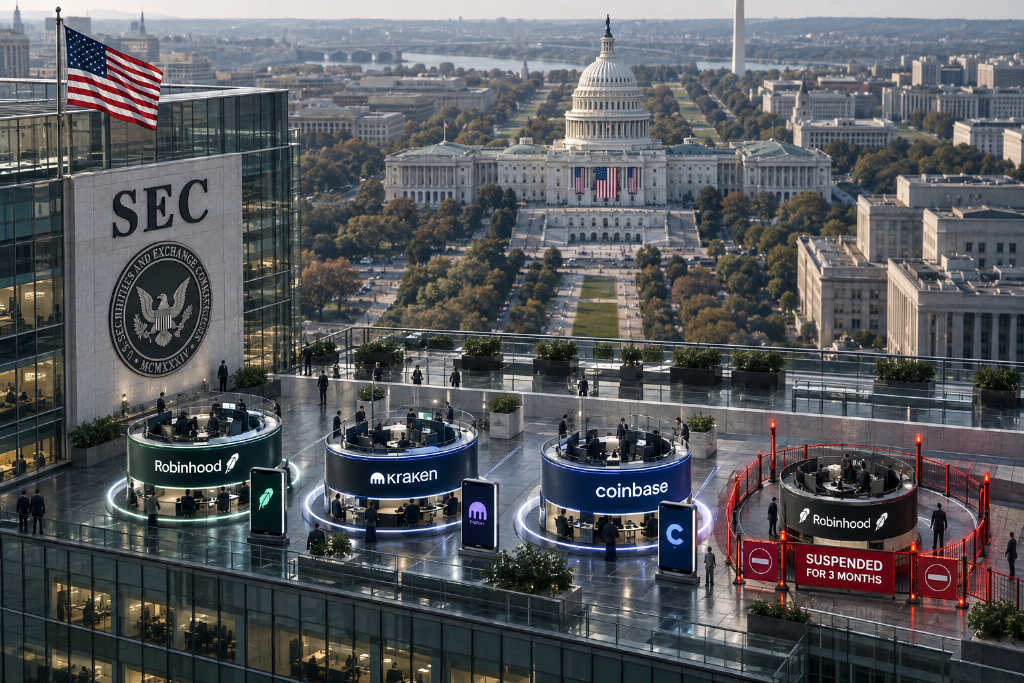
Buying a tokenized stock can sound straightforward: pick a familiar company, buy a token tied to its shares, and hold it in a digital wallet. The appeal is obvious. It borrows the logic of stock investing while adding the portability of crypto assets and, at least in theory, longer trading hours than a traditional exchange session.
But the idea of always-on stock trading looks different under the U.S. Securities and Exchange Commission’s Sept. 17 pilot framework for tokenized securities venues. Under that proposal, repeated breaches of trading-volume limits for a tokenized stock can lead to a three-month suspension on the venue involved.
The halt is venue-specific, not universal
The suspension mechanism does not freeze trading everywhere. It applies to the platform that violated the rule and its affiliated entities, and only to the tokenized version of that specific security on that platform. The same stock, if offered in tokenized form on another independent venue, would not automatically be affected.
That distinction matters because investors often collapse three separate questions into one: whether they hold a token, whether that token carries shareholder rights, and whether there is a functioning secondary market exit. In practice, those are separate layers of the product.
Not every token tied to a stock gives the same rights
Most stocks are already digital in practical terms. When an investor buys shares through a broker, what they receive is an electronic ownership record maintained across a chain of financial intermediaries. Tokenization inserts blockchain into that ownership-recording and transfer process.
The SEC distinguishes among several tokenization models. In one structure, the issuer or its agent uses blockchain records as part of the ownership system itself. In another, a third party holds the real shares and issues tokens representing the corresponding equity interest.
There is also a synthetic category, where a token’s return is linked to a stock price but the holder does not own actual shares in the company. Buying a token that tracks the price of a listed company is not the same as acquiring shareholder rights.
CryptoSlate previously reported that $25 billion worth of crypto stock tokens had traded even though holders did not have shareholder status. The lesson is simple: a familiar ticker is not enough. Investors need to know who stands behind the token and what rights it actually conveys. If an independent entity issues the token, that issuer’s financial condition and performance obligations become part of the investment risk alongside the underlying company.
Only products with dividend and voting rights qualify
The SEC’s pilot sets a clear boundary around what counts as an eligible tokenized stock. To qualify, the product must preserve the same economic and governance rights as a traditional share, including dividends and voting rights. Synthetic products are not eligible.
Access to the trading venue would also be permissioned, meaning participants or their wallets must satisfy verification requirements. This is not an open-access model where any wallet can necessarily trade.
A five-year AMM experiment is part of the framework
Within the pilot, the SEC would allow a five-year experiment using automated market makers. The mechanics are familiar to crypto markets: instead of matching one trader’s order with another trader’s order, software routes trades against a pool of assets supplied by participants.
In a simple example, a pool holds stock tokens and a settlement asset. When a user buys the stock token, the pool sends out the token, receives the payment asset, and adjusts pricing algorithmically as balances change. Uniswap documentation describes this kind of market structure, though different venues may use different formulas and mechanisms.
The model can run automatically and connect with other financial software. Still, it depends on enough underlying inventory, legally robust rights behind the token, and capital providers willing to fund the pool.
How the three-month suspension is triggered
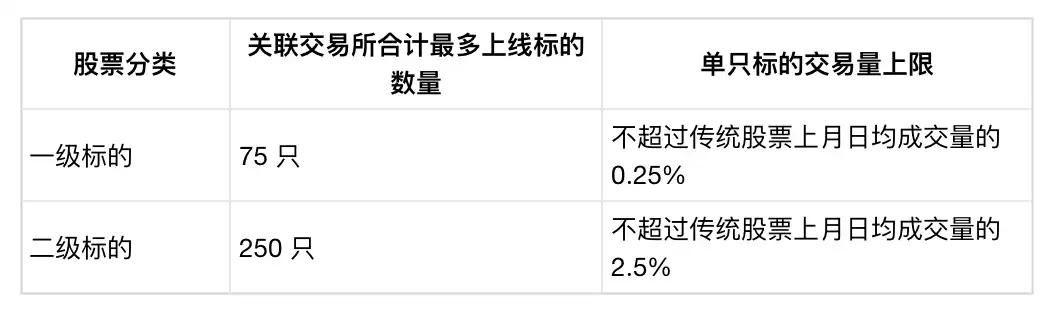
The pilot limits both the number of stocks a venue may list and the trading volume for each tokenized security. The volume cap is benchmarked to the traditional market, using the prior month’s average daily trading volume in the underlying stock.
The SEC divides eligible securities into two tiers. Tier 1 includes S&P 500 and Russell 1000 constituents, along with certain exchange-traded products. Tier 2 covers other eligible securities.
To determine compliance, the SEC compares average daily volume in the tokenized market with average daily volume in the traditional market and aggregates trading across affiliated venues. The test is based on averages, so a single burst of activity does not by itself establish a violation.
The article gives a simple illustration: if a stock traded 10 million shares a day on average in the prior month in the traditional market, the daily cap for a Tier 1 tokenized version would be 25,000 shares. The key metric is the ratio against traditional-market volume. It is not a fixed dollar cap, and it is not a limit on any one investor’s position size.
Escalating consequences
A first breach of the volume limit for a given security triggers a grace period, during which the venue must take corrective action and return to compliance.
A later breach for the same security triggers an immediate three-month trading suspension, and affiliated tokenized securities venues must apply it as well. The suspension starts on the date of the violation.
Other securities on the venue are not affected.
A venue may also suspend trading proactively to avoid crossing the threshold. Whether the halt is triggered by a breach or imposed preemptively for that reason, the venue must notify users immediately and publish a public notice within five business days.
Why the SEC imposed volume caps
The SEC’s stated aim is to contain risk to the broader equity market during the pilot period, including the possibility that prices in an AMM pool diverge from prices in the traditional stock market.
A simple stress case helps explain the concern. If the pool is shallow and several users try to buy at once, the algorithm may push the token price higher even though nothing comparable has changed in the listed company’s fundamentals. Arbitrageurs may be able to close that gap across markets, but only if they have enough capital and workable access between those markets.
The framework therefore puts a size boundary around the experiment. Repeated breaches would raise operating costs and push venues to manage trading activity more tightly.
Owning the token does not mean you can always exit
For investors, the practical issue is liquidity. Someone may buy a tokenized stock expecting to sell it quickly when cash is needed. Even if ownership rights remain intact, a trading suspension can disrupt that plan.
Moving the token to another wallet does not solve a frozen-liquidity problem by itself. The investor still needs a compliant venue that can trade that security, or a redemption channel specified in the product terms. That depends on the product design, the custody structure behind it, and access permissions.
The three-month suspension rule does not mean another broker will necessarily accept the token, and it does not mean every form of asset transfer is categorically banned. Those are separate product-level questions. Investors cannot assume that because a token can sometimes move across applications, liquidity will always be available.
That is also why the selling point of extended trading hours needs a closer look. Being able to open an app at midnight and place an order does not guarantee that a large position can be sold at a reasonable price. SEC Commissioner Mark Uyeda said longer trading hours could spread liquidity more evenly, but they could also dilute liquidity too much.
What investors need to ask before buying
The most important question before buying is whether the service provider has a clear plan for a halt. If trading in that tokenized stock stops on the venue, what happens next?
The answer should cover custody arrangements, whether shareholder rights remain in force, what forms of transfer are allowed, what redemption path exists, and what costs apply. It should also distinguish between functions the provider supports now and features it only plans to support later.
Tokenization may simplify share transfers and connect ownership records more directly with trading software. That could reduce operational delays and make financial services easier to use. The SEC pilot gives the industry a place to test that idea.
It also leaves investors with a basic reminder: an asset needs a dependable exit route.