
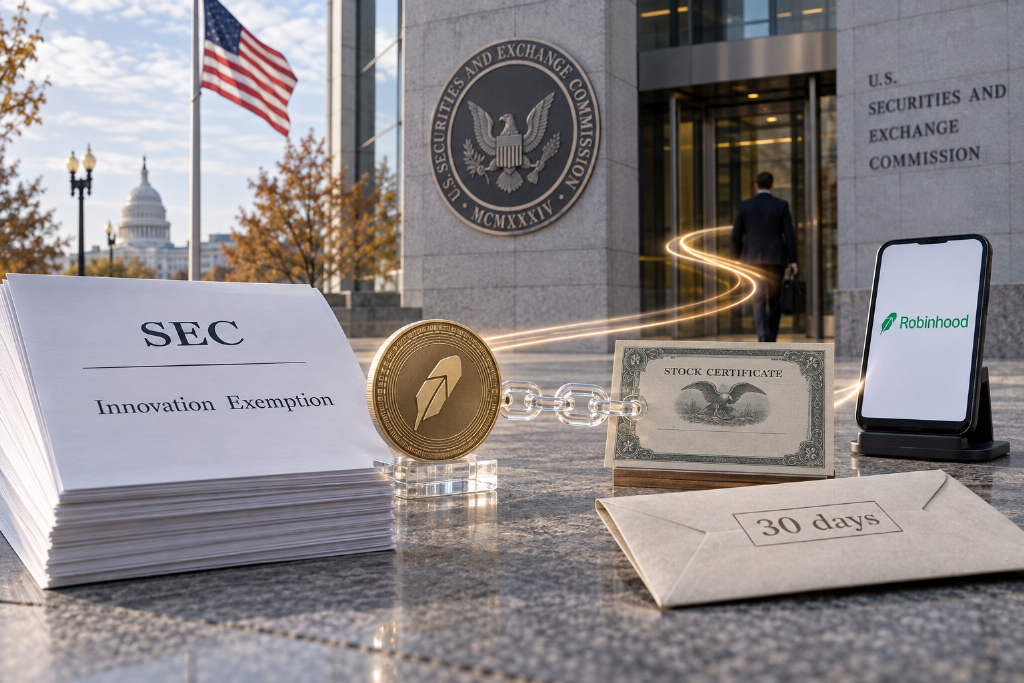
The U.S. Securities and Exchange Commission on Sept. 17 released an "innovation exemption" document for on-chain securities, setting out two conditions that mirror the recent fight over Robinhood’s tokenized stock product: tokenized shares must carry the same dividend and voting rights as the underlying stock, and any third party that wants to tokenize a listed company’s shares must first notify the issuer in writing and give it a 30-day window to object.
Those points surfaced after AMC CEO Adam Aron attacked Robinhood on X, saying the company had turned AMC stock into an on-chain token without AMC’s consent and that holders received none of the rights of actual shareholders. Aron used words such as "despicable" and "disgusting" to describe the product. Robinhood co-founder and CEO Vlad Tenev replied at the time: "What’s wrong with that?"
SEC puts a concrete standard in place
According to the report, the exemption is the most specific statement U.S. regulators have made in recent years on on-chain securities. It is not a broad policy signal. It is a set of operational entry requirements aimed at "tokenized securities venues" operating in the United States.
The document says tokenized stocks cannot simply track price. If a product is to fit inside this framework, holders must receive the same dividend and voting rights attached to the original shares. It also says a third party cannot tokenize a public company’s stock first and deal with the issuer later. Written notice must come first, followed by a 30-day objection period.
In that sense, the issuer consent issue raised by Aron is now reflected in the rule set, and the shareholder-rights question has been turned into a hard requirement.
Robinhood’s current product sits outside this framework
The report says Robinhood Chain went live in June 2025 and by July 2026 had expanded to more than 190 tokenized stocks and ETFs across over 120 countries. Those tokens are issued by Jersey-based Robinhood Assets. In substance, they are debt instruments that track stock prices. They are not offered to U.S. users, and holders do not receive voting rights or dividend rights. That is the product Aron was criticizing.
But the SEC document and Robinhood’s existing offshore tokens do not sit in the same legal bucket. The SEC framework is aimed at compliant trading venues inside the United States. Robinhood Chain’s tokens were designed as offshore products for non-U.S. users. The SEC also did not name Robinhood or directly comment on the AMC dispute.
So the overlap is better described as a coincidence than a ruling on that specific fight.
For Robinhood, this looks more like a route into the U.S. market
Even so, the document gives the dispute a regulatory frame. Anyone trying to repeat a model in which a stock is tokenized without the issuer’s consent would now run into this newly stated standard first.
The report says Tenev welcomed the exemption. Robinhood is itself seeking a path into the regulated U.S. market, and these standards look less like a punishment for its legacy offshore product and more like a ticket into a new line of business.
Peirce says DeFi is not the target
SEC Commissioner Hester Peirce said the same day that the exemption was not designed for decentralized finance. Her point, as quoted in the report, was that automated systems genuinely run by permissionless smart contracts do not create intermediary risk on their own and therefore do not need to apply for an exemption.
Uniswap founder Hayden Adams quickly reposted that statement. His reading was that ordinary users trading in Uniswap’s main pools would not be subject to this exemption. What would fall inside the framework are permissioned pools in Uniswap v4 that are built for specific groups and include access controls.
That distinction turns on what the SEC is trying to regulate: not on-chain trading as such, but who organizes trading on-chain and who bears responsibility for it. The report uses that line to separate an integrated model like Robinhood Chain, where the chain, issuance, and matching are all tied together, from open infrastructure such as Uniswap.
Market makers also get a path under the exemption
The exemption also includes a separate lane for liquidity providers. Institutional market makers that use their own capital to supply liquidity to these permissioned pools and quote customers can, if they meet the conditions, avoid being treated as "dealers" that must register.
That means market makers willing to comply with disclosure and recordkeeping requirements can place capital into the system without having dealer-status questions block them at the door. After the announcement, several tokenized equity-related tokens rose in price, and UNI also moved higher at one point.
Congress stalls, the SEC moves through administrative authority
The timing drew attention. Two days earlier, a procedural vote in the Senate on the Digital Asset Market Clarity Act, or CLARITY Act, received 49 votes, short of the 60 needed to move the bill forward. The legislation was left on hold for now.
The SEC did not wait for Congress. Instead, it used an administrative tool already within its authority. The report describes the exemption as conditional, valid for five years, and subject to adjustment based on feedback, without requiring new legislation.
The chair of the Commodity Futures Trading Commission had previously said the agency was studying whether existing exchanges could operate leveraged and margin trading as "crypto asset markets." The report places that alongside the SEC move as part of the same pattern: congressional gridlock does not mean regulators stop acting where current authority allows them to move.
What this path can and cannot do
The report also draws a clear boundary around that administrative route. Stocks already sit inside the securities-law system, and moving ownership records onto a blockchain does not change their legal character. That makes them easier for the SEC to handle.
Building a full registration, custody, and review regime for the broader spot market in digital commodities is a different matter. The report says that still requires congressional authorization. In other words, the exemption addresses the securities side of tokenization, not the entire structure of the digital commodity spot market.
The next test is who applies first
The document also shifts the discussion around tokenized equities away from narrative and toward infrastructure. SEC Chair Paul Atkins held a roundtable the same day on 24-hour trading in U.S. equities. Topics included the Depository Trust & Clearing Corporation’s "23 × 5" clearing system, overnight trading disclosures, and real-time inventory management.
Those are lower-level market structure questions than whether a tokenized stock can rally. They go to whether securities ownership and trading records can be updated close to real time on-chain, which in turn affects whether U.S. equities can actually move toward around-the-clock trading.
For trading platforms, the next steps are practical. Who applies first under the new rules to become a tokenized securities venue, or TSV, who secures written permission from listed companies first, and whose smart contracts first meet the public auditability threshold will show whether the framework works in practice.
The SEC said it will review the data at the end of the five-year term before deciding whether to turn the exemption into a longer-term rule. But this remains an administrative exemption, not an act of Congress. Whether it becomes permanent after five years, or whether it could be overturned earlier by a new SEC chair or by litigation, remains unresolved, according to the report.
