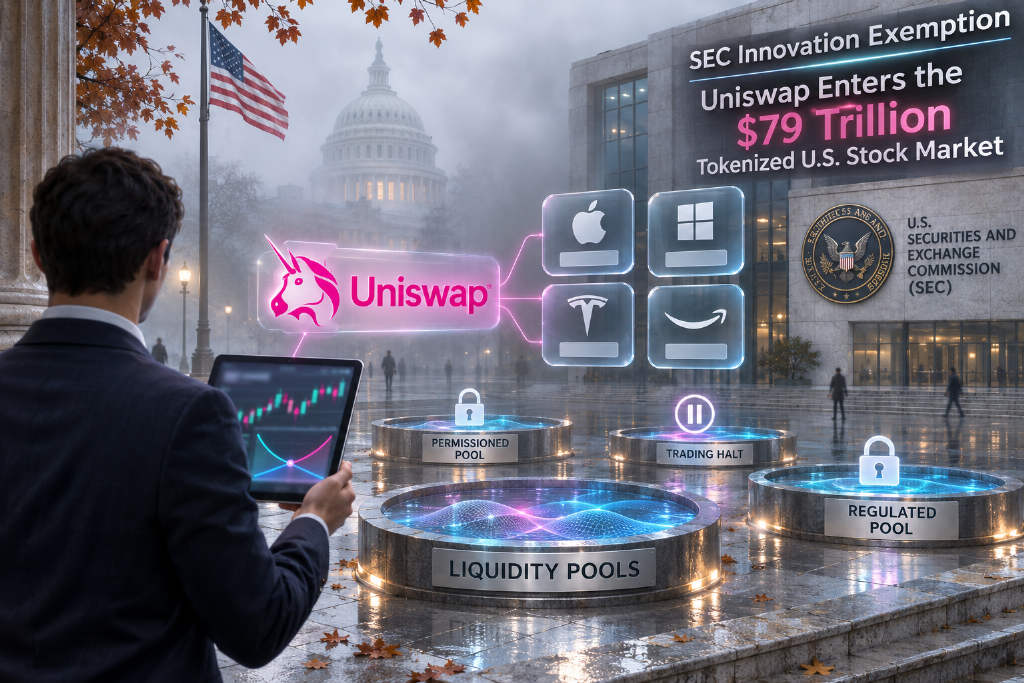
A U.S. Securities and Exchange Commission innovation exemption that took effect on Sept. 17, 2026, created a new compliance category for tokenized securities venues, or TSVs. The order gives qualifying venues a five-year exemption from registration while requiring automated market makers (AMMs) to run on public blockchains. Uniswap says more than $20 billion in tokenized stock volume has already been processed on its protocol.
The interpretation was published by Uniswap and compiled by TechFlowPost. It examines how AMMs could change traditional market making and settlement, and how developers could use Uniswap v4 permissioned liquidity-pool hooks to build tokenized securities markets.
Moving beyond the order book
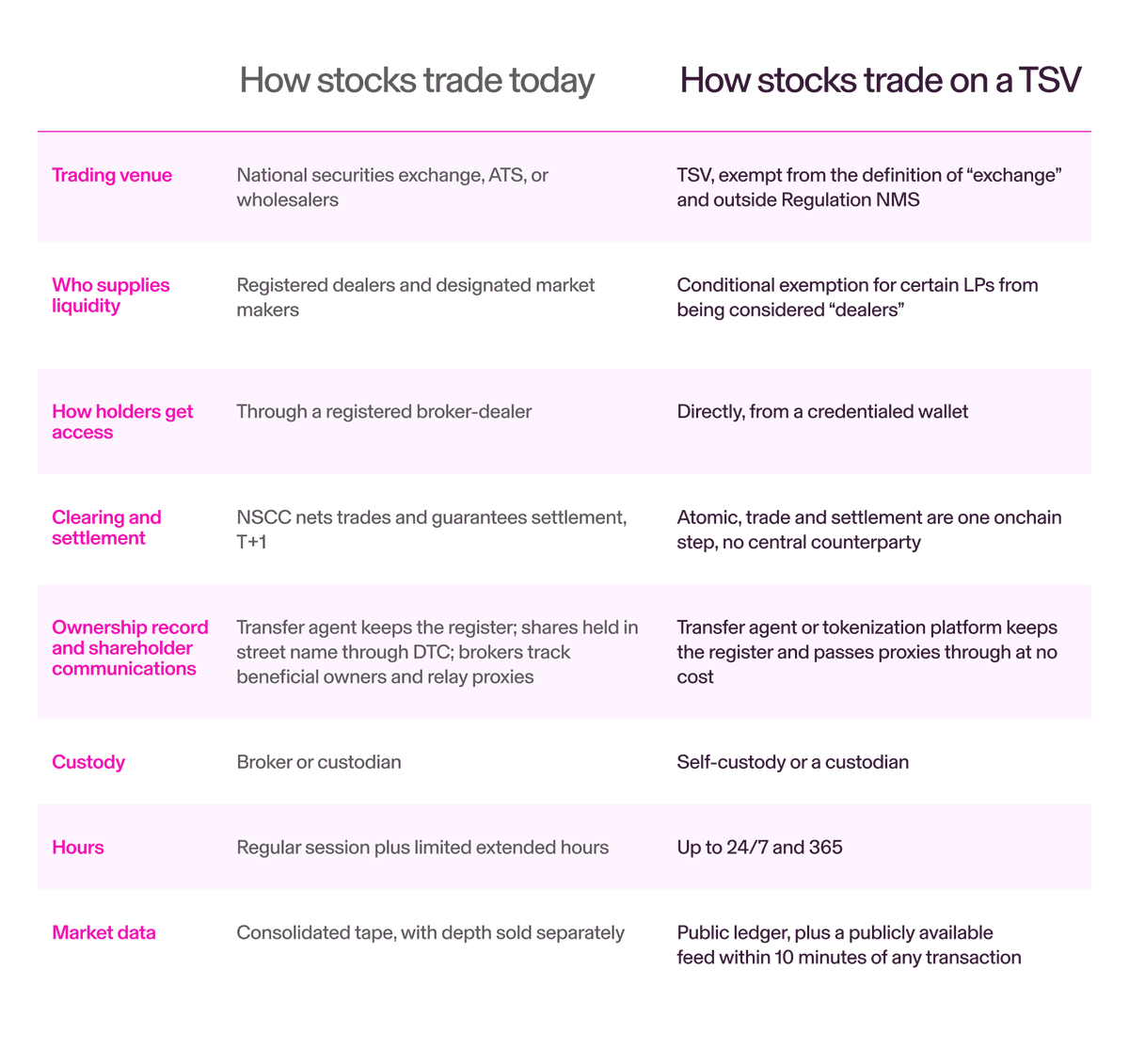
Wall Street markets have traditionally operated through order books. The SEC order instead creates a framework for venues that use AMMs on public blockchains. TSVs trade tokenized national market system, or NMS, stocks through permissioned liquidity pools.
As long as a venue meets the order’s conditions, it does not need to register as a securities exchange or an alternative trading system, or ATS. Liquidity providers that follow the stated requirements are also not classified as securities dealers. Uniswap says most of the tokenized stock activity on its protocol has come from products such as Robinhood Stock Tokens and xStocks, along with issuers including Ondo and Dinari. Stock exposure is already available on-chain, while shareholder rights could become the next area of development.
The U.S. stock market is valued at $79 trillion. AMMs could change how those assets trade, who supplies liquidity and the barrier to entering market making.
AMMs broaden access to market making
AMMs automate much of the work traditionally handled by professional market makers. Anyone can deposit assets directly into a smart contract to supply liquidity. That expands the pool of potential market makers, increases competition and gives issuers another way to build liquidity.
Liquidity pools can operate 24 hours a day, seven days a week, including nights, weekends and holidays. Thousands of interfaces around the world already connect to and use AMMs. A newly created market can therefore access a global distribution channel through those interfaces.
AMMs also widen the choice of trading pairs. NVIDIA stock, for example, is traded against the U.S. dollar on traditional exchanges. On-chain, it could be paired with a tokenized S&P 500 fund, a money market fund or a cryptocurrency.
Pairing assets with highly correlated price movements, such as NVIDIA and the S&P 500, can reduce a liquidity provider’s relative price risk. An automated routing system can still allow traders to buy the stock token directly with another asset.
Uniswap points to an early example of this structure. In August, 10 tokenized stocks and exchange-traded funds began trading against SPY on Robinhood Chain. Three months later, more than 40 assets had SPY liquidity pools, generating over $900 million in volume across 130,000 wallet addresses.
Uniswap’s interpretation says demand for on-chain stocks is real and continues to grow. TSVs give financial institutions a new route for meeting that demand.
How a TSV handles trading and settlement
A TSV provides AMM liquidity pools on a public, permissionless blockchain for approved participants. Compared with a traditional securities exchange, a TSV carries lighter regulatory obligations, and liquidity providers do not have to register as dealers.
Running through an AMM also changes settlement. In the existing system, a broker routes an order, an exchange or wholesaler handles execution, and a clearinghouse and depository institution complete delivery and settlement.
On a TSV, trading and settlement can be completed atomically in a single on-chain transaction. The funds and assets are exchanged and delivered together, or the entire transaction is rolled back. There is no partial completion and no central counterparty is required.
Listed companies retain a say over whether their shares trade on a TSV. A TSV must notify the stock issuer at least 30 days in advance and provide an opportunity to object. Once a stock is listed, any application connected to the relevant pool can offer trading services to approved users.
To qualify for the exemption, a venue must meet several compliance requirements. These include public fee disclosures, access controls, limits on eligible assets and trading volume, and mechanisms to pause trading. Enforcing those rules on-chain is a central design question for any venue.
Uniswap v4 hooks for programmable controls
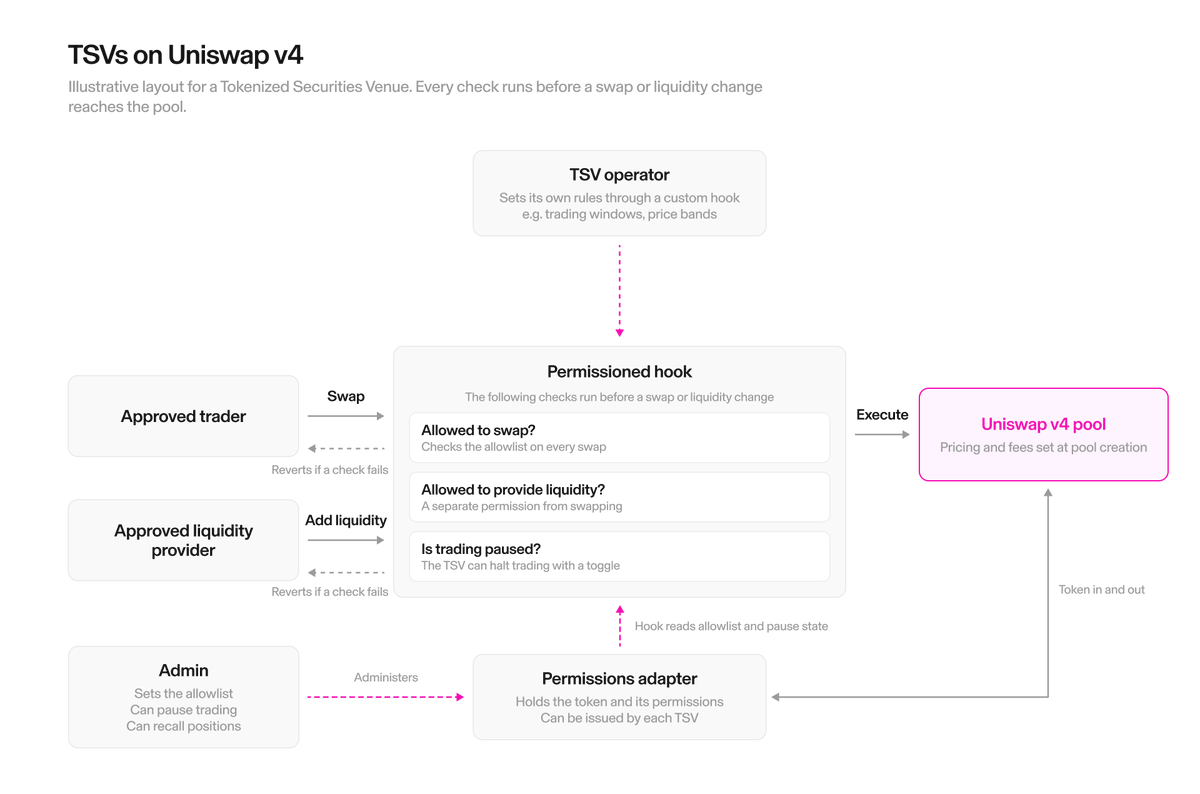
Uniswap v4 allows developers to customize the operating logic of a liquidity pool through hooks. Uniswap’s Permissioned Pools hook is intended to provide a base layer for venues that need controlled access.
Hooks are programmable code that runs automatically at defined points, such as before or after a trade. The underlying protocol still executes the trade and transfers the assets, while the operator can determine who may trade, which assets may be traded and when trading is permitted.
Since launching in 2018, the Uniswap protocol has processed more than $4.5 trillion in volume across more than 30 blockchains. Uniswap says its core smart contracts have never experienced a security vulnerability incident.
Uniswap Labs seeks builders across the market
Uniswap says bringing stocks on-chain is only the starting point. The deeper change concerns how markets make liquidity and who qualifies to act as a market maker. As the exemption takes effect, Uniswap says it wants to work with different teams to explore how these markets operate in practice.
- TSV operators: Uniswap can demonstrate how hooks can enforce access whitelists, circuit-breaker trading pauses and other pool-level compliance controls.
- Asset issuers: Uniswap can help explain how tokenized stocks trade through AMMs and where the protocol’s capabilities end.
- Liquidity providers: Uniswap can share research on actual AMM liquidity behavior and key changes observed in permissioned pools.
Uniswap Labs says teams exploring market construction, asset issuance or liquidity provision under the innovation exemption framework may contact the company.
Uniswap Labs does not operate, control or participate in the day-to-day operation of any tokenized securities venue. Any venue built on the Uniswap protocol is operated independently by its own operator, which is solely responsible for design decisions, legal analysis and compliance with applicable law, including the innovation exemption and its conditions.
The innovation exemption is temporary and conditional and may change in the future. This article is for informational purposes only. It is not legal, financial or investment advice, and it is not an offer or invitation to buy or sell any security or digital asset, or to provide liquidity for one.