
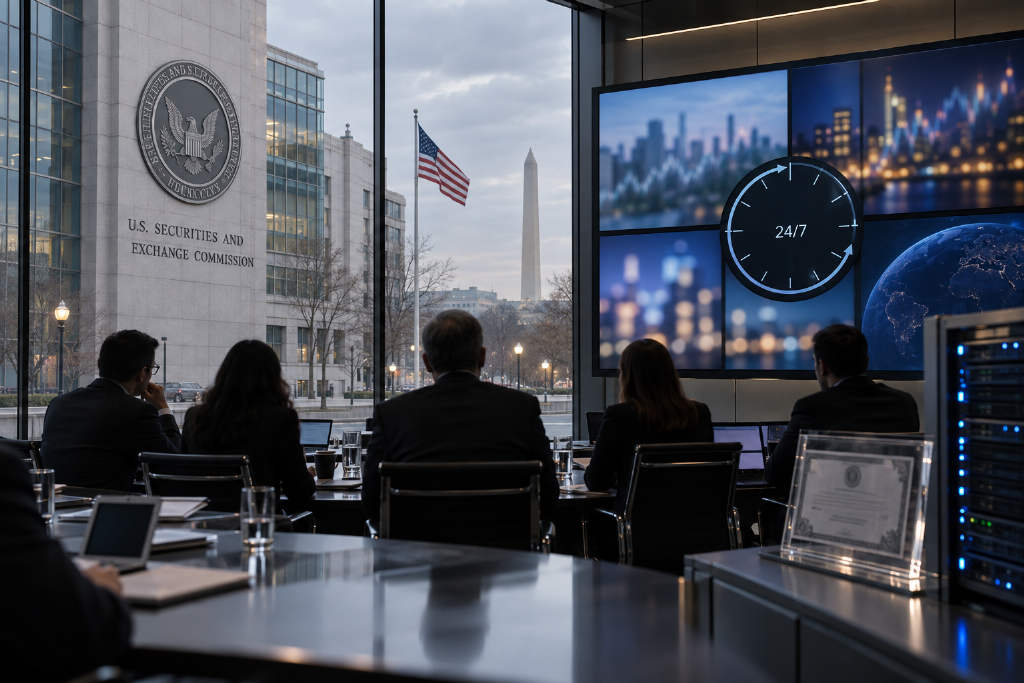
The U.S. Securities and Exchange Commission is preparing for a possible shift toward around-the-clock trading in U.S. equities. At a roundtable held Thursday at SEC headquarters in Washington, the agency discussed how traditional securities markets could extend into after-hours and holiday sessions, moving closer to the trading pattern already common in crypto.
The session came just one hour after the SEC issued its innovation exemption order for tokenized securities trading. In the report, the timing was presented as a sign that longer trading hours and on-chain securities sit within the same agenda under SEC Chair Paul Atkins.
Atkins links longer market hours with tokenized securities
Speaking to securities lawyers at the event, Atkins said, 「We are certainly entering a new day, and night.」 He argued that major market events do not happen only during standard trading hours, and that longer operating windows would let investors react to information more quickly.
Atkins also referred to the SEC’s new framework for tokenized securities. Under the innovation exemption, firms can apply for a five-year exemption that would allow them to trade tokenized securities on blockchain networks without being held to the full weight of traditional securities rules.
He said, 「I believe tokenization technology has the potential to enable real-time inventory management in the securities industry. That can improve efficiency, reduce the risk of settlement failures, and even reduce malicious short selling, with the goal of eliminating that possibility altogether.」 He added that he has asked SEC staff to assess how to strike a balance between a growth-friendly environment and protections tied to market conduct.
By addressing both topics at the same event, Atkins signaled that the SEC is not only preparing to move markets on-chain, but also to move them beyond fixed closing hours.
Peirce says crypto never sleeps, but the risks do not either
SEC Commissioner Hester Peirce put the contrast plainly during the roundtable: 「Crypto markets, of course, do not sleep.」 That line captured the core comparison running through the discussion, with traditional markets increasingly measured against the pace of crypto.
Peirce also laid out the practical concerns tied to longer trading sessions. Companies, she said, worry that extended hours could lead to wider bid-ask spreads, greater price volatility, less time to resolve technical problems, and more difficulty in market surveillance.
She added that companies may also fear that 「social media rumors could crash your stock price while your corporate office is asleep.」 In her account, extending trading into periods with limited human participation carries real consequences. A 24/7 market would not bring only 24/7 opportunity; it would also bring 24/7 risk.
SEC says groundwork is already in motion
Even with those concerns, the SEC’s direction appears clear. Atkins said that 「several necessary preparations are underway or have been completed.」 That suggests the agency is doing more than hosting a policy discussion and has already begun work on the system and regulatory changes needed for longer trading hours.
According to the report, that approach fits Atkins’ broader direction since taking office: reducing regulatory friction, speeding up market innovation, and helping the U.S. maintain its position as a global financial center. The report grouped support for the CLARITY Act, the innovation exemption for tokenized securities, and preparations for 24/7 trading under the same policy logic.