
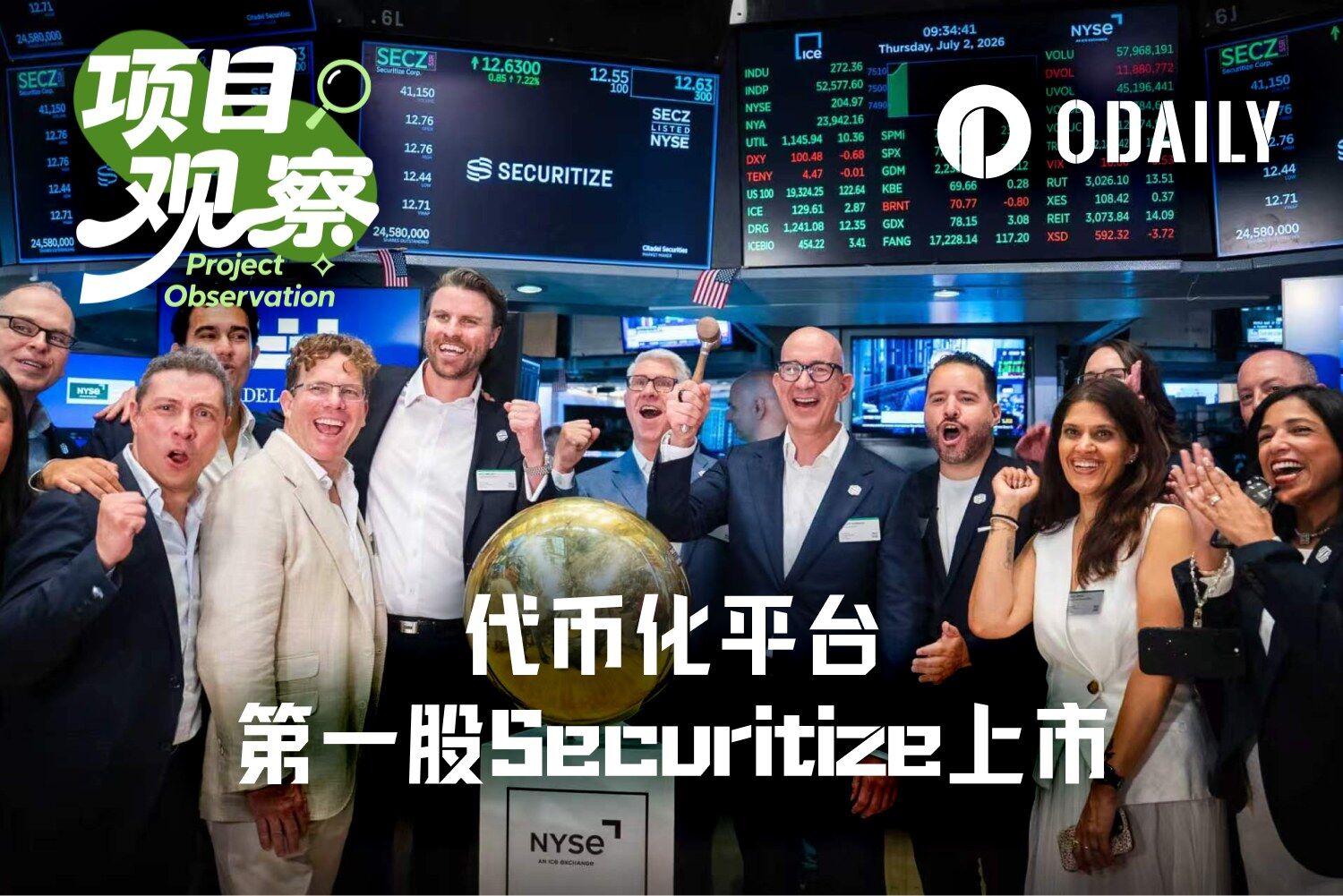
Securitize starts trading on the NYSE while launching SECZ on-chain
On July 2, Securitize officially entered the public market through a business combination with special purpose acquisition company Cantor Equity Partners II, beginning trading on the New York Stock Exchange under the ticker SECZ. In its debut session, SECZ opened at $12.45, climbed as high as $13.70 intraday, and eventually closed at $12.3. Based on market estimates, the company finished its first trading day with a valuation of roughly $1.96 billion, while its intraday market capitalization approached $2.2 billion at the session high.

The listing was notable not only because Securitize became a publicly traded company, but because it paired the traditional listing with an on-chain issuance of its own common shares. From day one, eligible U.S. investors were able to buy tokenized SECZ through Securitize’s regulated platform on Avalanche and Solana. According to RWA.xyz, tokenized SECZ immediately became the largest tokenized stock in the world by on-chain value, surpassing $295 million on its first day. That made Securitize the first company to achieve a simultaneous presence on the NYSE and on public blockchains for its own equity.
This was also Securitize’s first major tokenized stock product. In the context of the broader real-world asset market, that matters far beyond a symbolic launch. It signals that one of the most important players in tokenization infrastructure is now moving decisively into tokenized equities, a segment that has attracted far more retail attention than institutional debt or money-market products. While firms such as Ondo, xStocks, and Binance’s bStocks have often been more visible in retail conversations, Securitize has historically built its business around issuance, compliance, and institutional-grade tokenization rails. SECZ suggests that this positioning is beginning to broaden.

Why the RWA leader has remained relatively invisible to retail users
Measured by on-chain scale, Securitize is already one of the clearest leaders in the RWA sector. DeFiLlama data cited in the source article shows that the total on-chain market capitalization of RWAs issued by Securitize exceeds $4.4 billion, putting it ahead of Circle, Tether, Ondo, and other major platforms. The comparison excludes stablecoins such as USDT and USDC. Even so, despite that dominant position, many retail users are less familiar with Securitize than with some newer or more consumer-facing tokenization brands.
The reason is largely structural rather than branding-related. Securitize has not focused on building a mass-market trading app for casual users. Instead, its products have been aimed primarily at institutional clients and regulated capital markets participants. Of the 24 on-chain tokenized products it has issued, representing more than $4 billion in assets, most are concentrated in bonds, private credit, and money-market funds. Before SECZ, the company had only one tokenized single-stock product, CURR, and that asset had minimal trading activity. In practical terms, Securitize was already a giant in RWAs, but not in the part of the market most visible to retail traders.
Its most representative product remains BUIDL, the tokenized money-market fund launched for BlackRock. The fund has already grown beyond $2.2 billion and is currently the second-largest tokenized money-market fund in the RWA market, trailing only Circle’s USYC according to the source article. That product alone helps explain why Securitize has been seen more as core financial infrastructure than as a consumer-facing tokenized stock venue. The launch of SECZ may begin to shift that perception, because it places the company directly into one of the most commercially visible verticals in tokenization.

“Own the real thing”: how Securitize differs from synthetic tokenized stocks
Securitize’s website sums up its positioning with the slogan “OWN THE REAL THING, NOT A SYNTHETIC VERSION.” That line captures the company’s core differentiation from many other tokenized stock offerings currently in the market. According to the article, every tokenized stock issued by Securitize represents direct ownership of actual shares. Holders are meant to receive the same legal and economic rights as traditional shareholders, including dividends, voting rights, and other associated ownership claims.
That is materially different from the structure used by many tokenized equity products elsewhere in crypto. In many cases, what traders are buying is not direct legal title to the underlying stock, but rather an instrument that provides economic exposure. Such products may track the price of the stock and in some cases pass through certain economic benefits, but they do not necessarily transfer real ownership or the full regulatory protections attached to registered shareholding. As described in the source piece, tokenized stock products from Ondo, xStocks, Binance’s bStocks, and Bitget’s Reality fall into this broader category.
This distinction matters because tokenized equities are often discussed as if they were a single product category, when in practice they can sit on very different legal foundations. Securitize is choosing the harder route: it is attempting to tokenize actual securities ownership, rather than merely packaging market exposure into a more accessible on-chain wrapper. For institutional allocators or compliance-sensitive investors, this model is likely more credible and defensible. For retail traders who mainly care about price movement and ease of access, however, synthetic or quasi-synthetic products may remain more attractive simply because they are easier to buy and trade.
Compliance constraints: KYC, AML, whitelist controls, and limited access
The trade-off behind Securitize’s “real ownership” model is that access becomes much more restrictive. To buy tokenized SECZ, investors must complete KYC and KYC/AML reviews, satisfy jurisdictional requirements, and meet applicable securities-law conditions before they can participate. If an investor does not have the required U.S. status, even the onboarding process can become a barrier. Once approved, Securitize whitelists the investor’s wallet address, and only those approved wallet addresses are allowed to hold and trade tokenized SECZ.
That means the asset may exist on public blockchains and may technically be tradable in an on-chain environment, but it is not freely accessible in the way most crypto assets are. The blockchain serves as the settlement and ownership layer, not as a mechanism for bypassing securities regulation. In a post on X, Securitize said that even though U.S. stock markets would close on Friday, July 3, for the Independence Day holiday, SECZ would continue trading. From a technical standpoint, that statement highlights one of tokenization’s most compelling features: securities can be represented in a market infrastructure that is not limited by traditional exchange hours. But in practical terms, the number of people who can actually trade the asset remains very small.
That creates a striking contrast in the current tokenized stock market. Products with looser structures and fewer ownership rights may be easier for global retail users to access, while products that most closely resemble real securities remain tightly controlled and geographically constrained. In other words, the market currently rewards accessibility, but legal certainty still belongs to the heavily regulated end of the spectrum. Securitize is clearly betting that over time, the value of direct ownership and regulatory clarity will matter enough to justify the smaller addressable user base.
Importantly, the company does not appear to view SECZ as a one-off experiment. After the IPO, Securitize President Brett Redfearn said the company is discussing the possibility of tokenizing other IPOs within the next year. That indicates SECZ is being positioned as the starting point of a broader tokenized equities strategy rather than a symbolic product launch tied only to its own public debut.
Valuation: is SECZ cheap after listing, or already pricing in future growth?
From an investment standpoint, one of the immediate questions is whether Securitize’s public valuation is attractive. Because the company has not publicly disclosed its current fully diluted share count, market participants have to estimate it from the SEC filings. According to Securitize’s S-4 filing, the company valued itself at $1.25 billion, and the SPAC and PIPE subscription price was $10 per share, implying approximately 125 million shares tied to that valuation. Adding the roughly 30 million common shares outstanding from Cantor Equity Partners II suggests the merged company likely has a total share count of around 160 million. On that basis, the closing price of $12.3 implies a market capitalization of about $1.96 billion.

In April, investment bank Benchmark assigned Securitize a post-listing price target of $16, arguing that the company is well positioned to benefit from the rise of tokenized assets. Benchmark’s thesis was not based solely on token issuance volume. It emphasized that Securitize is more than a tokenization platform: the company also has a relatively complete regulated stack, including broker-dealer, transfer-agent, and trading capabilities. That mix, in theory, allows it to monetize multiple stages of the asset lifecycle, including issuance, secondary trading, and custody-related services.
The company’s own filing provides additional context. For the first nine months of 2025, Securitize reported revenue of $55.6 million, though it did not disclose full-year 2025 results. Management projected approximately $69 million in revenue for the full year. It also reported first-quarter 2026 revenue of $19.5 million, up 39% from the first quarter of 2025 and representing the highest quarterly revenue in the company’s history. Management forecast around $110 million in revenue for full-year 2026. Based on the 2025 revenue outlook, Securitize appears to be trading at a static price-to-sales multiple of roughly 28x.
A useful listed comparison mentioned in the article is Figure, another RWA-related platform focused mainly on real estate and private credit. Figure’s static 2025 price-to-sales multiple is about 15x, noticeably lower than Securitize’s. Looking at tokenized assets under management also tempers the bullish case somewhat. Securitize has around $4.4 billion in tokenized AUM, while Figure has about $19.4 billion. On a market-cap-to-AUM basis, Securitize is around 0.45, compared with 0.38 for Figure. On both metrics, Securitize screens as somewhat more expensive rather than obviously undervalued.
Still, valuation depends on what the market believes it is paying for. If investors see Securitize merely as another tokenization platform, the premium may look stretched. If they view it as the category leader in RWAs with a broader compliance moat, stronger institutional relationships, and a potentially differentiated position in tokenized equities, the current valuation may look more defensible. The article’s conclusion reflects that tension: Securitize does not appear clearly undervalued on simple multiples, but it may still not be meaningfully overvalued when its business breadth and leadership position are taken into account.
The larger strategic issue is whether tokenized stocks evolve into a market where direct ownership becomes a key differentiator, or whether most demand remains focused on low-friction price exposure. Today, the latter still seems dominant. Most investors primarily want stock-like exposure that can be traded on-chain with minimal restrictions, and they are less focused on voting rights or shareholder formalities. In that environment, Securitize’s insistence on selling the “real thing” may put it at a disadvantage in terms of mass adoption. Yet if regulation tightens or investor preferences shift toward legal robustness and ownership clarity, that same design choice could become its strongest edge.